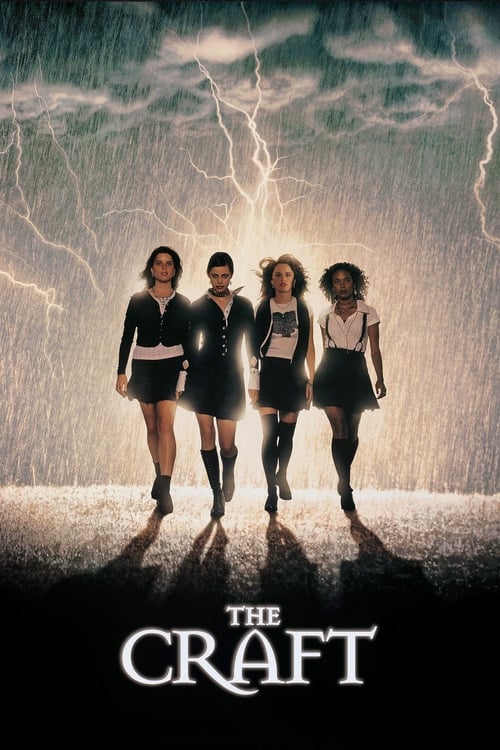
The Craft (1996)
Directed by Andrew Fleming
Partly — The Craft is somewhat woke, scoring 40 out of 100 on our wokeness meter.
The Craft arrives from 1996, a year when a studio could still sell teen witchcraft as a mood rather than a message.
Consciousness Markers
The film centers on female friendship, witchcraft as empowerment, and female anger, and critics noted a feminist message at its core. It is not framed through modern intersectional feminist discourse.
The film features a racially diverse main quartet for 1996, with Rachel True as Rochelle and a racism subplot written after her casting. However, True later described the character as tokenized and her subplot truncated.
Rochelle endures racist bullying from white classmates and curses her tormentor, giving the film a racial subplot. The treatment is limited and has been criticized by the actress as tokenizing.
The second half delivers a heavy-handed karma sermon about abusing power, which some critics found preachy. The moralizing is present but not sustained as modern issue-based lecturing.
There are no LGBTQ+ themes, characters, or subtext in the film.
There is no environmental or climate-themed content in the film.
The film includes class resentment and a life-insurance windfall, but it does not advance an anti-capitalist or eat-the-rich message.
Scars, beauty wishes, and hair loss appear as plot devices, but the film does not promote body positivity as a theme.
There is no exploration of neurodivergence or neurodiverse identity in the film.
The film is a fictional supernatural horror story and does not revise or reinterpret historical events.
Why it received this score
The Craft arrives from 1996, a year when a studio could still sell teen witchcraft as a mood rather than a message. Andrew Fleming assembles four outcasts at a Los Angeles parochial school and lets them want things: beauty, power, revenge, a boy. The casting of Rachel True prompted a rewrite that made Rochelle black and gave her a racism subplot, a genuine act of inclusion by the standards of the decade. It is also, by True's own later account, a truncated one. Her family life and much of her material were cut, leaving the character's arc to resolve around a bald classmate and a curse. The gesture counts. The follow-through is thinner than the gesture.
The film's center of gravity is female friendship and female rage, and the reviews of the day noticed. Critics found a feminist message under the camp, and Fairuza Balk's Nancy remains a portrait of anger that refuses to apologize for itself. This is empowerment rendered as appetite, not as a platform. The girls pursue what they want and the wanting curdles. Nothing here is framed through the vocabulary that later decades would bring to such material, which keeps the picture from reading as a tract.
The last act does climb a pulpit. The karmic accounting arrives with storm effects and stern warnings about power abused, and at least one major critic called it a heavy-handed sermon. It is a sermon, though it preaches about hubris and consequence instead of any current event, which dates it as moralizing of an older, gentler strain. Elsewhere the ledger is clean: no romantic subtext between the quartet, no environmental anxiety, no economic indictment, no meditation on bodies as they are, no interest in how minds differ. What remains is a moody, mean-spirited, occasionally rousing piece of nineties commodity horror about four girls who get exactly what they ask for. We classify it accordingly, and we do so without pleasure.
Analysis generated by our Consciousness Algorithm


Synopsis
A Catholic school newcomer falls in with a clique of teen witches who wield their powers against all who dare to cross them -- be they teachers, rivals or meddlesome parents.
Questions about The Craft
Is The Craft woke?
Partly — The Craft is somewhat woke, scoring 40 out of 100 on our wokeness meter. That earns it a verdict of Woke-Adjacent.
What makes The Craft woke?
4 of the 10 markers register at 30 or above, led by Feminist Agenda (60), Representation Casting (50) and Racial Consciousness (45). On Feminist Agenda: The film centers on female friendship, witchcraft as empowerment, and female anger, and critics noted a feminist message at its core.
How does The Craft compare to other 1996 movies?
It ranks #4 of the 93 films from 1996 we've scored; their average is 11. The wokest is Bound (60).
How is the Woke Score calculated?
An AI-assisted process researches the film and its reception, scores it 0–100 on ten markers, then combines those into one 0–100 Woke Score. It measures a specific set of 2020s cultural themes, not film quality.