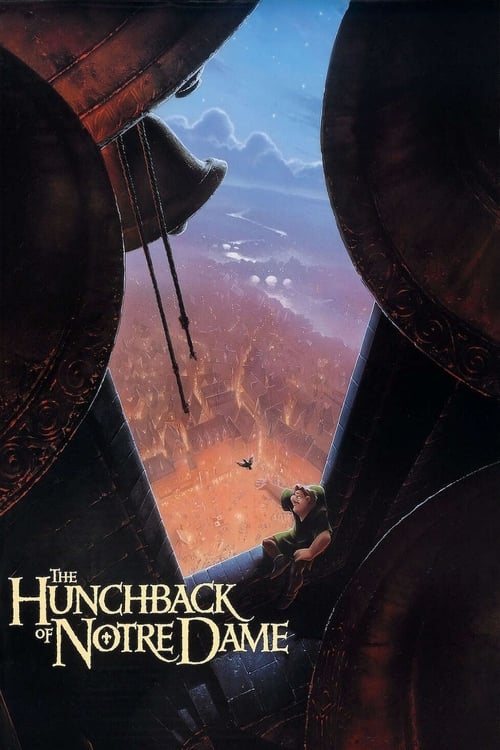
The Hunchback of Notre Dame (1996)
Directed by Gary Trousdale
Partly · Woke-Adjacent
How we score movies →Consciousness Markers
Quasimodo's physical deformity is central to his character arc, and the film's conclusion celebrates his acceptance by society. The narrative explicitly promotes dignity for those with visible disabilities.
The film significantly departs from Hugo's source material, particularly in its ending, which revises the original narrative to provide a more optimistic and morally clear conclusion.
The film frequently articulates its moral messages about acceptance and resistance to tyranny, though these themes emerge somewhat organically from character motivation rather than feeling entirely preachy.
Esmeralda actively resists patriarchal authority and demonstrates agency, standing against Frollo's advances and advocating for her people. However, her characterization remains somewhat limited to her relationship with the male protagonist.
The film sympathetically portrays the persecution of Romani people and positions Frollo's prejudice as villainous, yet employs outdated terminology like 'gypsy' and handles the subject matter with 1990s sensibility.
Esmeralda is portrayed sympathetically as a Romani protagonist, but Demi Moore (white actress) provides the voice, exemplifying the era's casual approach to casting that would later become controversial.
Judge Frollo's villainy contains coded subtext about repressed desire and obsession, but the film does not engage with explicit LGBTQ+ themes or representation.
While Quasimodo's social isolation and potential developmental differences are acknowledged, the film does not explicitly address neurodivergence as a contemporary framework.
While Frollo represents institutional corruption, the film does not engage with economic systems or class consciousness in any meaningful way.
No climate-related themes appear in the film. Environmental consciousness is entirely absent from the narrative.


Synopsis
Isolated bell-ringer Quasimodo wishes to leave Notre Dame tower against the wishes of Judge Claude Frollo, his stern guardian and Paris' strait-laced Minister of Justice. His first venture to the outside world finds him Esmeralda, a kind-hearted and fearless Romani woman who openly stands up to Frollo's tyranny.
Why it received this score
This 1996 Disney adaptation arrives at the midpoint of cultural consciousness, possessed of genuine progressive sensibilities yet hamstrung by the limitations of its era. The film's central thesis, that the marginalized deserve dignity and that institutional cruelty corrupts even those who enforce it, reads as earnest rather than cynical. Esmeralda's defiance of Judge Frollo's tyranny and her advocacy for her persecuted people represents a clear moral stance against injustice. Quasimodo's arc, culminating in his acceptance by society despite his physical difference, suggests a proto-disability consciousness that, while not sophisticated by contemporary standards, demonstrates genuine concern for the dignity of the disabled.
Yet the film stumbles across several contemporary red flags. Esmeralda is voiced by Demi Moore, a white actress, despite the character's Romani identity, a practice that would face immediate criticism today. The film employs the term "gypsy" without apparent self-awareness, using language that modern sensibilities recognize as reductive and dehumanizing. The narrative's moral clarity, while admirable, occasionally tips toward preachiness rather than organic character development. Judge Frollo's sexual obsession with Esmeralda, coded with troubling implications about repressed desire and male entitlement, suggests more about contemporary anxieties than about meaningful engagement with his psychology.
The result is a film that wants to do right by its themes of acceptance and resistance to systemic cruelty but lacks the sophisticated toolkit that later adaptations would employ. It is not cynical enough to be truly conservative, nor progressive enough to avoid the pitfalls of its own contradictions. A fascinating time capsule of 1990s Disney earnestness, it remains a document of the distance between that era's progressive instincts and our current expectations for cultural representation.
Analysis generated by our Consciousness Algorithm
Critic Reviews
“A whirling, uplifting, thrilling story with a heart-touching message that emerges from the comedy and song.”
“The Hunchback of Notre Dame is a beautiful and transporting experience — the best, I think, of Disney’s serious animated features in the multiplex era. ”
“If The Hunchback of Notre Dame isn't for younger kids, it's an ambitious, often stirring film that's easy to recommend for just about anyone else. [21 June 1996, p.17]”
“The Hunchback of Notre Dame ultimately misses its target, as it's more likely to find acceptance with an older-than-average Disney crowd.”