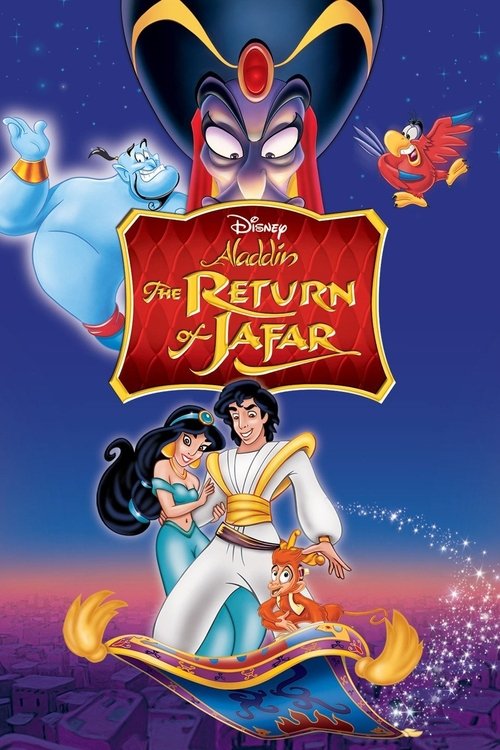
The Return of Jafar (1994)
Directed by Tad Stones
No — The Return of Jafar is not woke, scoring 3 out of 100 on our wokeness meter.
The Return of Jafar presents a fascinating case study in late-stage cinematic escapism.
Consciousness Markers
The cast is entirely voice actors of European descent performing Middle Eastern-coded characters, with no conscious effort at authentic or diverse casting; the setting is exotic backdrop rather than representation.
Jasmine exists largely as a romantic interest and hostage; she has a brief moment of friction with Aladdin over his secrecy, but the film offers no feminist critique or agency-driven arc.
The Agrabah setting is a fantasy Orientalist backdrop with no engagement with race, identity, or social commentary.
The film preaches only mild lessons about friendship and forgiveness through Iago's redemption arc, with no modern moralizing or didactic messaging.
No LGBTQ+ characters, themes, or subtext of any kind appear in this 1994 direct-to-video sequel.
No environmental or climate themes; the lava pit is a villain's trap, not an ecological parable.
No economic critique; the film is itself a commercial product engineered to extend a franchise's merchandising life.
No body-positivity themes or diverse body representation.
No neurodivergence themes; the Genie's manic energy is comedic performance, not a depiction of neurodivergence.
A fantasy sequel with no historical claims to revise.
Why it received this score
The Return of Jafar presents a fascinating case study in late-stage cinematic escapism. It operates within the highly polished confines of a commercial animated franchise, prioritizing spectacle over social introspection. The film employs an exotic, fantasy-driven backdrop that is culturally aware of its own origins but offers no meaningful engagement with racial identity or authentic representation. We observe a deliberate casting choice, utilizing entirely European voice talent for Middle Eastern-coded roles, which functions more as an atmospheric choice than an attempt at cultural mirroring. This choice suggests a focus on aesthetic presentation rather than contemporary progressive sensibilities.
The narrative arc fails to push beyond the established parameters of a high-fantasy romp. While Jasmine navigates brief moments of relational tension with Aladdin, her role remains heavily weighted toward romantic interest and hostage. The film lacks any sustained feminist critique or agency-driven subplot. Furthermore, the plot does not attempt to engage with critical issues, presenting the lava pit as a mere trap rather than a reflection of environmental fragility, nor does it offer any substantial economic commentary. The conflict remains purely personal, driven by ancient grudges and wish fulfillment.
This sequel is fundamentally a piece of highly profitable IP extension, a product designed for the expanding home video market. Its most significant cultural contribution is the sheer absence of modern social consciousness. The meager lessons about friendship and forgiveness are delivered with a low-energy sermonizing that feels entirely unburdened by the complex moral debates of the current decade. It is a clean, commercial adventure that exists comfortably outside the scope of contemporary cultural scrutiny.
Analysis generated by our Consciousness Algorithm


Synopsis
The evil Jafar escapes from the magic lamp as an all-powerful genie, ready to plot his revenge against Aladdin. From battling elusive villains atop winged horses, to dodging flames inside an exploding lava pit, it's up to Aladdin - with Princess Jasmine and the outrageously funny Genie by his side - to save the kingdom once and for all.
Questions about The Return of Jafar
Is The Return of Jafar woke?
No — The Return of Jafar is not woke, scoring 3 out of 100 on our wokeness meter. That earns it a verdict of Ultra Based.
Does The Return of Jafar have any woke elements?
Very few. None of the 10 markers reaches 30, the level where a marker counts as present; the highest is Representation Casting at 8.
How does The Return of Jafar compare to other 1994 movies?
It ranks #71 of the 86 films from 1994 we've scored; their average is 10. The wokest is On Deadly Ground (75).
Is The Return of Jafar the most woke Aladdin movie?
No. It ranks #3 of the 3 Aladdin films we've scored; the wokest is Aladdin (12).