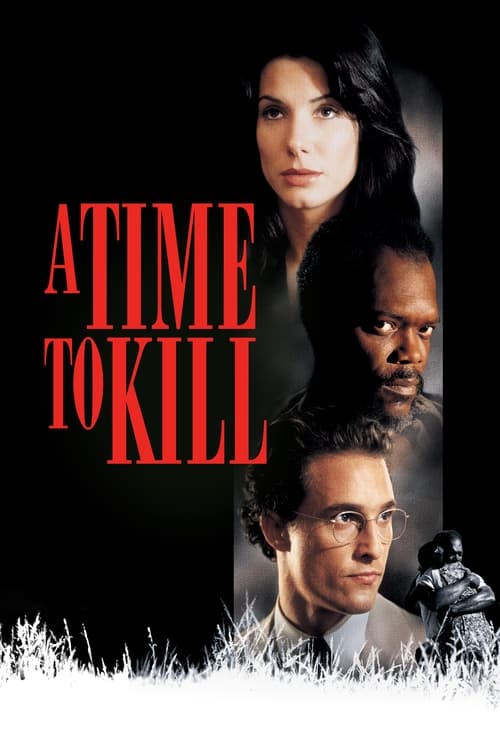
A Time to Kill (1996)
Directed by Joel Schumacher
No — A Time to Kill is not especially woke, scoring 38 out of 100 on our wokeness meter.
Joel Schumacher's adaptation of the John Grisham novel opens in 1984 Mississippi with a lynching, a rape, and a rifle, which is to say it does not ease into its subject matter.
Consciousness Markers
The film is explicitly centered on racism, the KKK, an all-white jury, and a closing argument that asks jurors to imagine the victim 'if she were white.' Racial injustice is the driving conflict.
Features a substantial Black supporting cast including Samuel L. Jackson, Charles S. Dutton, and Octavia Spencer, though the narrative is anchored by a white lawyer. The film's casting reflects its racial themes but is not a modern diversity initiative.
The film culminates in a lengthy, moralizing closing argument designed to sway the jury and audience on racial empathy, giving it significant lecture energy.
Sandra Bullock's law student is competent and integral to the defense, but the film does not advance a feminist agenda and she becomes a victim in the plot.
No LGBTQ+ characters or themes are present.
No environmental or climate themes.
No critique of capitalism or wealth inequality; the legal and political systems are criticized but not in economic terms.
No body positivity themes.
No neurodivergent characters or themes.
Set in 1984 and based on a novel, it does not revise historical events or offer a counter-narrative to established history.
Why it received this score
Joel Schumacher's adaptation of the John Grisham novel opens in 1984 Mississippi with a lynching, a rape, and a rifle, which is to say it does not ease into its subject matter. A ten-year-old girl is brutalized by two white supremacists, her father shoots them dead in the county courthouse, and the film spends the next two and a half hours sorting through the consequences. The Klan resurfaces, crosses burn on lawns, and a judge declines to move the trial, leaving an all-white jury to decide a Black man's fate. This is a film built on racial grievance and it knows it, devoting its long runtime to the mechanics of a Southern town tearing itself apart along a color line everyone can see.
Matthew McConaughey anchors the proceedings as the white attorney who must save a Black client, a structural choice the film never interrogates. Around him sits a substantial Black supporting cast, Samuel L. Jackson chief among them, quietly furious in a role that reportedly lost its best scenes in the edit. Sandra Bullock's law student is competent and useful until the screenplay decides she is more valuable as a hostage. She becomes a plot device with good posture. The film's investment in racial justice is genuine, and it is also arranged so that the white man does the arguing.
The moral architecture rests on a closing argument in which Jake Brigance asks twelve jurors to imagine the victim if she were white, a plea delivered with tears, strings, and no small amount of self-regard. It is a lecture, unmistakably, aimed at the courtroom and the audience in the same breath. French critics, who appended a question mark to the title, found the enterprise nauseating and borderline fascist, which is a great deal of heat for a studio thriller. The residue is a competent, overlong piece of moral machinery that argues for racial empathy while keeping a white man at the center of the argument. The progressive gestures are real. They are also load-bearing decoration.
Analysis generated by our Consciousness Algorithm
Part of


Synopsis
A young lawyer defends a black man accused of murdering two white men who raped his 10-year-old daughter, sparking a rebirth of the KKK.
Questions about A Time to Kill
Is A Time to Kill woke?
No — A Time to Kill is not especially woke, scoring 38 out of 100 on our wokeness meter. That earns it a verdict of Based.
Does A Time to Kill have any woke elements?
3 of the 10 markers register at 30 or above, led by Racial Consciousness (70), Lecture Energy (55) and Representation Casting (55). On Racial Consciousness: The film is explicitly centered on racism, the KKK, an all-white jury, and a closing argument that asks jurors to imagine the victim 'if she were white.' Racial injustice is the driving conflict.
How does A Time to Kill compare to other 1996 movies?
It ranks #5 of the 93 films from 1996 we've scored; their average is 11. The wokest is Bound (60).
How is the Woke Score calculated?
An AI-assisted process researches the film and its reception, scores it 0–100 on ten markers, then combines those into one 0–100 Woke Score. It measures a specific set of 2020s cultural themes, not film quality.