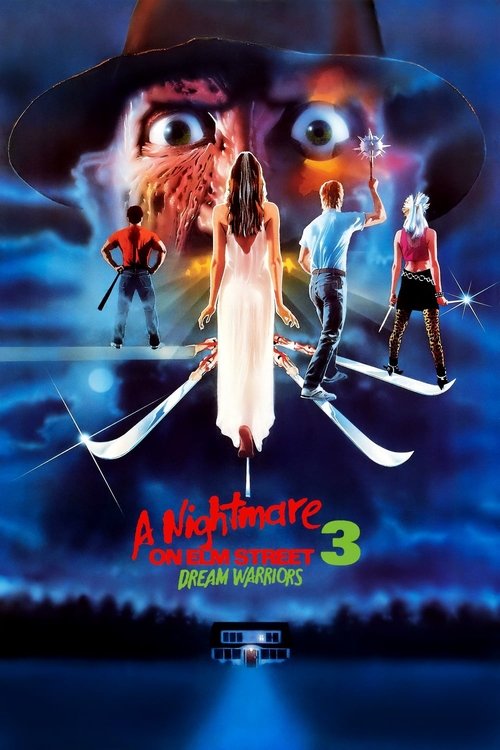
A Nightmare on Elm Street 3: Dream Warriors (1987)
Directed by Chuck Russell
No — A Nightmare on Elm Street 3: Dream Warriors is not woke, scoring 7 out of 100 on our wokeness meter.
A psychiatric hospital staffed by the well-meaning and the haunted provides the setting for the third installment in a franchise that had, by 1987, settled into a comfortable rhythm of dream-based mayhem.
Consciousness Markers
The ensemble of institutionalized teens includes Black actors (Ken Sagoes, Laurence Fishburne) and a wheelchair user, but they exist as natural genre casting with no commentary on representation.
Nancy Thompson returns as a capable psychiatrist and Kristen is a resourceful protagonist, but this is standard 1980s final-girl/slasher convention rather than a feminist thesis.
The setting is a psychiatric hospital and the plot hinges on suicide attempts, self-harm, and mental illness, but these are exploited as horror devices rather than framed as neurodivergent advocacy.
Will Stanton uses a wheelchair and fights as a full member of the group, but the film offers no body-positivity messaging and treats his disability as backstory.
Kincaid is written as a 'tough kid from the streets,' a stock urban-Black archetype, with no engagement with race as a subject.
No LGBTQ+ characters, themes, or subtext appear anywhere in the film.
No environmental or climate themes whatsoever.
No economic critique; the film is a commercial horror sequel with no class politics.
No historical revisionism; the film is entirely fictional supernatural horror.
A slasher sequel with dark humor and gore; it makes no attempt to lecture or moralize to its audience.
Why it received this score
A psychiatric hospital staffed by the well-meaning and the haunted provides the setting for the third installment in a franchise that had, by 1987, settled into a comfortable rhythm of dream-based mayhem. The patients are a curated assortment of adolescent troubles: a sleepwalker, a would-be television actress, a recovering addict, a boy who has stopped speaking, a tough kid from the streets, and a young woman in a wheelchair. Freddy Krueger dispatches several of them with the enthusiasm of a caterer working a long booking. The film is brisk, imaginative, and entirely uninterested in making a case for anything.
That is not a criticism. The ensemble happens to include Black performers in Ken Sagoes and Laurence Fishburne, and a wheelchair user in Will Stanton, all of whom exist as natural genre casting. The film observes them without comment. Heather Langenkamp returns as Nancy Thompson, now a psychiatrist, and Patricia Arquette's Kristen proves resourceful under pressure, though this is the standard resourcefulness of the surviving protagonist, not a thesis. Kincaid is written as a tough kid from the streets, a stock urban archetype the screenplay never bothers to examine. No LGBTQ material appears. No environmental lament. No class politics. The commercial machinery of a horror sequel has no room for such things.
The psychiatric setting deserves its own note. Suicide attempts, self-harm, and institutional confinement drive the plot, and the film treats them as raw material for spectacle. There is no advocacy here, no gentle instruction, no sense that the audience is being asked to reconsider its assumptions. It is a slasher picture with a dark sense of humor and a memorable death involving a television set, and it wants only to entertain. In that modest ambition it succeeds, and the ledger of social instruction remains, for once, entirely blank.
Analysis generated by our Consciousness Algorithm
Part of


Synopsis
A psychiatrist, familiar with the knife-wielding dream demon Freddy Krueger, helps teens at a mental hospital battle the killer who is invading their dreams.
Questions about A Nightmare on Elm Street 3: Dream Warriors
Is A Nightmare on Elm Street 3: Dream Warriors woke?
No — A Nightmare on Elm Street 3: Dream Warriors is not woke, scoring 7 out of 100 on our wokeness meter. That earns it a verdict of Ultra Based.
Does A Nightmare on Elm Street 3: Dream Warriors have any woke elements?
Very few. None of the 10 markers reaches 30, the level where a marker counts as present; the highest is Representation Casting at 18.
How does A Nightmare on Elm Street 3: Dream Warriors compare to other 1987 movies?
It ranks #23 of the 59 films from 1987 we've scored; their average is 8. The wokest is Maurice (68).
Is A Nightmare on Elm Street 3: Dream Warriors the most woke A Nightmare on Elm Street movie?
No. It ranks #6 of the 7 A Nightmare on Elm Street films we've scored; the wokest is A Nightmare on Elm Street: The Dream Child (26).