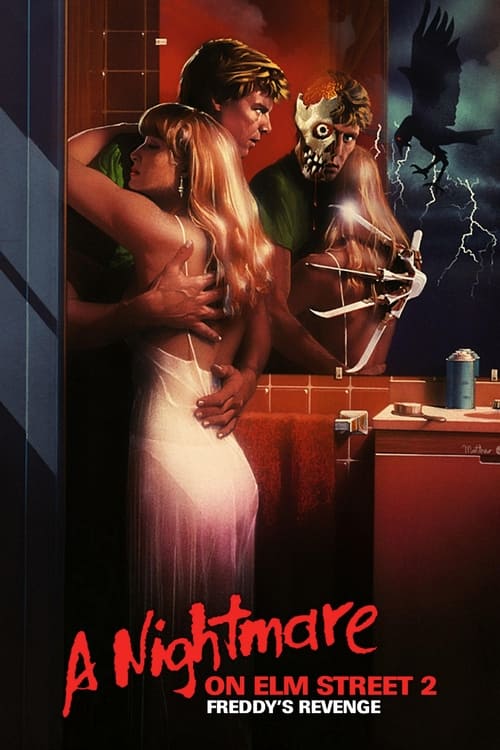
A Nightmare on Elm Street Part 2: Freddy's Revenge (1985)
Directed by Jack Sholder
No — A Nightmare on Elm Street Part 2: Freddy's Revenge is not especially woke, scoring 22 out of 100 on our wokeness meter.
The second entry in a franchise that had barely learned to walk, Freddy's Revenge arrives in 1985 carrying an awkward inheritance: a monster who now talks.
Consciousness Markers
The film is notorious for its pervasive homoerotic subtext—the S&M bar, the leather-clad coach, the sweaty wrestling match, the bare-ass spanking, and Freddy's forced-birth emergence from Jesse's stomach. Once called 'the gayest horror film ever,' it is now a celebrated gay cult classic, though the themes were largely unintentional at the time.
Mark Patton, a closeted gay actor, was cast as the male lead Jesse, a role now widely read as a gay protagonist and a gender-flipped 'final girl.' The casting was not intentional representation in the modern sense, but it has become central to the film's retrospective identity.
Lisa Webber is a relatively active female lead who ultimately confronts Freddy and confesses her love to break his hold, but this is a 1985 slasher operating within conventional genre gender dynamics rather than any feminist agenda.
The film contains no racial themes, commentary, or consciousness whatsoever.
No environmental or climate-related content of any kind.
No economic critique or anti-capitalist themes; it is a straightforward supernatural slasher.
No body-positivity messaging; the film trades in conventional horror imagery of disfigurement and transformation.
No neurodivergence themes; Jesse's sleepwalking and nightmares are supernatural possession, not a neurodivergent narrative.
No historical revisionism; the film is a fictional supernatural horror sequel.
The film makes no attempt to lecture or moralize; it is a pulpy slasher sequel with no didactic agenda.
Why it received this score
The second entry in a franchise that had barely learned to walk, Freddy's Revenge arrives in 1985 carrying an awkward inheritance: a monster who now talks. A talking monster is a diminished monster, and Wes Craven knew it, which is why he declined to direct. Jack Sholder, who by his own account had no interest in horror pictures, took the job and delivered a possession story in which teenager Jesse Walsh becomes the vessel for Freddy's return to the waking world. Parakeets combust. A pool party ends in slaughter. The plotting runs on dream logic, which is a generous way of saying it runs on nothing at all.
What the film does carry, in quantity and seemingly by accident, is an erotic charge aimed squarely at its own male lead. Mark Patton, closeted at the time, plays Jesse as a boy in a state of continual undress. He wrestles a tormentor in a sweaty gym. He is dragged out of a leather bar by his gym teacher and made to run laps as punishment. He endures a bare-bottomed spanking. Finally he serves as the birth canal for Freddy himself, who claws out of his stomach in a sequence borrowed wholesale from Alien. A publication of the day called it the gayest horror film ever made. Four decades later that reading has become the film's chief claim on our attention, and Patton has spoken with real bitterness about what the role cost him.
It would be tidy to report that the film argues for something. It does not. There is no racial consciousness here, no environmental sermon, no economic critique, no body-positive reframing of its own disfigurements, no neurodivergent reading of Jesse's sleepwalking, no historical revision, and no lecturing of any kind. Lisa Webber does more work in the final act than the era usually allowed a girlfriend, and her confession of love is what breaks Freddy's hold. That is a plot mechanic, not a thesis. What remains is a pulpy sequel that stumbled into a legacy it never intended, and now wears it like a borrowed leather jacket.
Thematic tags: sequel, box office performer but not a domestic number one. No awards of consequence. A possessed teenager, a dead coach, and a bus that never quite arrives at school. The classification stands.
Classification: sequel. Subtext: inherited, unclaimed, and now the whole point. The film endures not because it is good but because it is legible, and legibility is the only immortality this genre offers.
The second entry in a franchise that had barely learned to walk, Freddy's Revenge arrives in 1985 carrying an awkward inheritance: a monster who now talks. A talking monster is a diminished monster, and Wes Craven knew it, which is why he declined to direct. Jack Sholder, who by his own account had no interest in horror pictures, took the job and delivered a possession story in which teenager Jesse Walsh becomes the vessel for Freddy's return to the waking world. Parakeets combust. A pool party ends in slaughter. The plotting runs on dream logic, which is a generous way of saying it runs on nothing at all.
What the film does carry, in quantity and seemingly by accident, is an erotic charge aimed squarely at its own male lead. Mark Patton, closeted at the time, plays Jesse as a boy in a state of continual undress. He wrestles a tormentor in a sweaty gym. He is dragged out of a leather bar by his gym teacher and made to run laps as punishment. He endures a bare-bottomed spanking. Finally he serves as the birth canal for Freddy himself, who claws out of his stomach in a sequence borrowed wholesale from Alien. A publication of the day called it the gayest horror film ever made. Four decades later that reading has become the film's chief claim on our attention, and Patton has spoken with real bitterness about what the role cost him.
It would be tidy to report that the film argues for something. It does not. There is no racial consciousness here, no environmental sermon, no economic critique, no body-positive reframing of its own disfigurements, no neurodivergent reading of Jesse's sleepwalking, no historical revision, and no lecturing of any kind. Lisa Webber does more work in the final act than the era usually allowed a girlfriend, and her confession of love is what breaks Freddy's hold. That is a plot mechanic, not a thesis. What remains is a pulpy sequel that stumbled into a legacy it never intended, and now wears it like a borrowed leather jacket.
Analysis generated by our Consciousness Algorithm
Part of


Synopsis
A teenage boy is haunted in his dreams by deceased child murderer Freddy Krueger, who is out to possess him in order to continue his reign of terror in the real world.
Questions about A Nightmare on Elm Street Part 2: Freddy's Revenge
Is A Nightmare on Elm Street Part 2: Freddy's Revenge woke?
No — A Nightmare on Elm Street Part 2: Freddy's Revenge is not especially woke, scoring 22 out of 100 on our wokeness meter. That earns it a verdict of Based.
Does A Nightmare on Elm Street Part 2: Freddy's Revenge have any woke elements?
2 of the 10 markers register at 30 or above, led by LGBTQ+ Themes (75) and Representation Casting (30). On LGBTQ+ Themes: The film is notorious for its pervasive homoerotic subtext—the S&M bar, the leather-clad coach, the sweaty wrestling match, the bare-ass spanking, and Freddy's forced-birth emergence from Jesse's stomach.
How does A Nightmare on Elm Street Part 2: Freddy's Revenge compare to other 1985 movies?
It ranks #6 of the 68 films from 1985 we've scored; their average is 8. The wokest is The Color Purple (62).
Is A Nightmare on Elm Street Part 2: Freddy's Revenge the most woke A Nightmare on Elm Street movie?
No. It ranks #2 of the 7 A Nightmare on Elm Street films we've scored; the wokest is A Nightmare on Elm Street: The Dream Child (26).