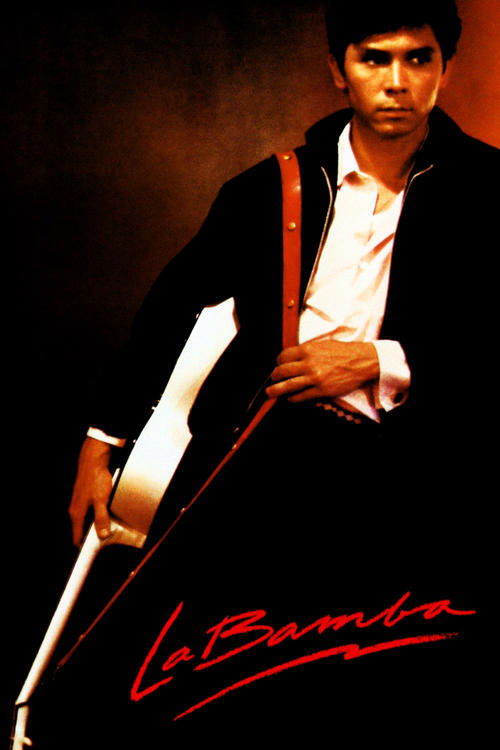
La Bamba (1987)
Directed by Luis Valdez
No — La Bamba is not especially woke, scoring 21 out of 100 on our wokeness meter.
Luis Valdez came to La Bamba from the Chicano theater movement, and it shows in the best way.
Consciousness Markers
The film is a rare 1980s studio picture centered entirely on a Mexican-American family, cast with Latino actors (Lou Diamond Phillips, Esai Morales, Elizabeth Peña, Rosanna DeSoto) and directed by Chicano theater pioneer Luis Valdez. The representation is authentic and intrinsic to the subject rather than a modern diversity checkbox.
Racism is a genuine plot element — Donna's father forbids her from dating a Hispanic boy, and the film is a landmark of Chicano representation. However, it treats prejudice as lived experience rather than delivering a modern racial-consciousness thesis.
Women (Connie, Donna, Rosie) are present but largely defined by their relationships to the men; Rosie's domestic abuse is depicted but not framed through any feminist critique. The film is a male-centric showbiz biopic.
The film is a warm, sentimental crowd-pleaser that shows rather than preaches; it carries no didactic social messaging.
No LGBTQ+ characters, themes, or subtext appear anywhere in the film.
No environmental or climate themes whatsoever.
The music-industry storyline is affectionate rather than critical; the record label is portrayed as a helpful partner, not an exploitative villain.
No body-positivity themes or messaging.
Ritchie's aviophobia and recurring nightmares are presented as trauma from a real plane crash, not as neurodivergence or a neurodiversity narrative.
The film is a fairly faithful, sentimentalized biopic of Ritchie Valens; it does not rewrite or reinterpret history through a modern ideological lens.
Why it received this score
Luis Valdez came to La Bamba from the Chicano theater movement, and it shows in the best way. The 1987 film plants itself inside a Mexican-American family in Northern California and never treats that family as a sociological exhibit. Lou Diamond Phillips, Esai Morales, Rosanna DeSoto, and Elizabeth Peña carry the picture with the plain authority of people who belong there. For a studio release of its era, that casting was close to radical, though the film wears it lightly, as a fact of life instead of a statement of purpose.
The picture is also, by the standards of later decades, a thoroughly traditional showbiz tragedy. The women exist chiefly as girlfriends, mothers, and objects of male jealousy; Rosie's abuse at Bob's hands is shown but never examined through any larger frame. There is no queer presence, no environmental concern, no body-acceptance thread, and no reading of Ritchie's aviophobia as anything but trauma. The record business, which a more suspicious film would roast, is presented as a kindly patron. Bob Keane signs the kid, nurtures him, and hands him a stage name. Nobody eats anybody.
Where the film does carry social weight, it carries it as biography. Donna's father forbids her to date a Hispanic boy, and the sting lands because it is small, domestic, and recognizable. Valdez shows the prejudice instead of lecturing about it. The result is warm, sentimental, and content to let a life speak for itself, which is presumably why the Library of Congress preserved it. A modest artifact of cultural awareness, then, and an unrepentant crowd-pleaser. The sommelier finds it pleasant, uncomplicated, and entirely of its moment.
Analysis generated by our Consciousness Algorithm


Synopsis
Los Angeles teenager Ritchie Valens becomes an overnight rock 'n' roll success in 1958, thanks to a love ballad called "Donna" that he wrote for his girlfriend. But as his star rises, Valens has conflicts with his jealous brother, Bob, and becomes haunted by a recurring nightmare of a plane crash just as he begins his first national tour alongside Buddy Holly.
Questions about La Bamba
Is La Bamba woke?
No — La Bamba is not especially woke, scoring 21 out of 100 on our wokeness meter. That earns it a verdict of Based.
Does La Bamba have any woke elements?
2 of the 10 markers register at 30 or above, led by Representation Casting (55) and Racial Consciousness (40). On Representation Casting: The film is a rare 1980s studio picture centered entirely on a Mexican-American family, cast with Latino actors (Lou Diamond Phillips, Esai Morales, Elizabeth Peña, Rosanna DeSoto) and directed by Chicano theater pioneer Luis Valdez.
How does La Bamba compare to other 1987 movies?
It ranks #6 of the 59 films from 1987 we've scored; their average is 8. The wokest is Maurice (68).
How is the Woke Score calculated?
An AI-assisted process researches the film and its reception, scores it 0–100 on ten markers, then combines those into one 0–100 Woke Score. It measures a specific set of 2020s cultural themes, not film quality.