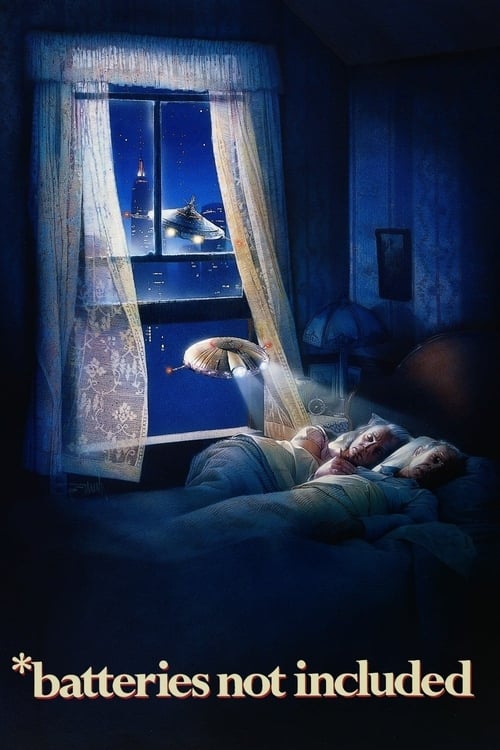
*batteries not included (1987)
Directed by Matthew Robbins
No — *batteries not included is not especially woke, scoring 24 out of 100 on our wokeness meter.
Conceived by Steven Spielberg as a half-hour episode of Amazing Stories, this 1987 feature retains the shape of a fable.
Consciousness Markers
The central conflict is tenants resisting a greedy developer's skyscraper scheme; the villain Carlos is framed as a victim of capitalism, and the final image of property looming over the human landscape reads as a critique of materialism.
A genuinely diverse 1987 ensemble: Frank McRae as the Black janitor/retired boxer Harry and Elizabeth Peña as the pregnant Latina tenant Marisa, both existing naturally in the story without comment. Representation is present but unremarked, not a stated agenda.
The anti-greed subtext is present but delivered through Spielbergian family entertainment rather than explicit sermonizing; the moral is shown, not lectured.
Faye is a resilient matriarch and Marisa asserts independence by telling her boyfriend to leave without her, but these are character beats rather than a feminist thesis.
The cast is multiracial and one critic read the film as a portrait of 'exclusion and racism,' but the film itself never engages race as a subject or message.
No LGBTQ+ characters, themes, or subtext of any kind.
No environmental or climate themes whatsoever.
No body-positivity themes or messaging.
Faye's dementia is portrayed with sympathy, but as a tragic condition rather than an affirming neurodivergence narrative.
No historical revisionism; the film is a contemporary fantasy with no historical subject matter.
Why it received this score
Conceived by Steven Spielberg as a half-hour episode of Amazing Stories, this 1987 feature retains the shape of a fable. The East Village tenants of the Riley building form a tidy cross-section of late-century New York: an elderly couple losing their grip, a painter who cannot sell a canvas, a pregnant woman waiting on a man who does not deserve her, a retired boxer mopping floors. Frank McRae and Elizabeth Peña occupy their roles with an ease that never announces itself as an agenda. The tiny saucer-shaped visitors arrive, repair the cafe, and the picture settles into the gentle business of family entertainment.
Where the film carries a genuine charge is in its treatment of property. Lacey wants the block cleared for a skyscraper. Carlos, the thug he hires, is fired for failing to deliver, then burns the building down out of spite. The script grants him a moment of conscience, and the closing image, the restored cafe dwarfed by towers, reads as an indictment of what gets built and who gets crushed beneath it. That is class resentment dressed in Amblin warmth, and it lands harder than the mechanical creatures ever do.
Elsewhere the ledger is thin. There is no LGBTQ presence, no environmental concern, no body-positivity messaging, and Faye's dementia is treated as a sorrow to be borne, not an identity to celebrate. Marisa's decision to send her boyfriend away is a character beat, not a manifesto. The moral is demonstrated, never preached. Decades on, the film remains a modest, sweet-natured artifact whose politics arrive through the walls instead of the pulpit.
Analysis generated by our Consciousness Algorithm
Part of


Synopsis
In a soon to be demolished block of apartments, the residents resist the criminal methods used to force them to leave so a greedy tycoon can build his new skyscraper. When tiny mechanical aliens land for a recharge, they decide to stay and help out.
Questions about *batteries not included
Is *batteries not included woke?
No — *batteries not included is not especially woke, scoring 24 out of 100 on our wokeness meter. That earns it a verdict of Based.
Does *batteries not included have any woke elements?
2 of the 10 markers register at 30 or above, led by Eat the Rich (60) and Representation Casting (35). On Eat the Rich: The central conflict is tenants resisting a greedy developer's skyscraper scheme; the villain Carlos is framed as a victim of capitalism, and the final image of property looming over the human landscape reads as a critique of materialism.
How does *batteries not included compare to other 1987 movies?
It ranks #3 of the 59 films from 1987 we've scored; their average is 8. The wokest is Maurice (68).
How is the Woke Score calculated?
An AI-assisted process researches the film and its reception, scores it 0–100 on ten markers, then combines those into one 0–100 Woke Score. It measures a specific set of 2020s cultural themes, not film quality.