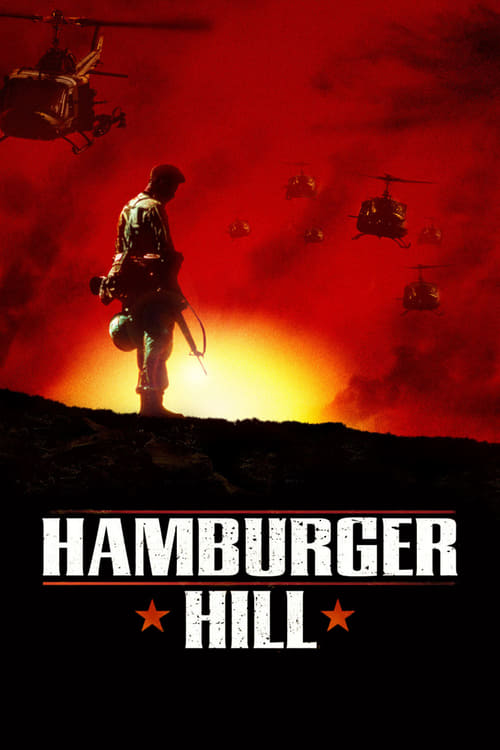
Hamburger Hill (1987)
Directed by John Irvin
No — Hamburger Hill is not especially woke, scoring 23 out of 100 on our wokeness meter.
Hamburger Hill arrives in 1987 with mud on its boots and no interest in being liked.
Consciousness Markers
The platoon features a notably integrated cast for 1987, including Black soldiers played by Don Cheadle, Courtney B. Vance, and Michael Boatman, but their presence reflects the historical reality of the draft rather than any modern casting mandate.
Black soldiers Motown, Doc Johnson, and Sergeant McDaniel explicitly discuss experiences of racial discrimination in the army, giving the film a genuine, if period-appropriate, racial consciousness.
The film carries an anti-war message and includes scenes of soldiers debating social upheaval back home, and critics noted it sometimes tells the audience what to think, but the lecturing is restrained and embedded in drama.
No LGBTQ+ characters, themes, or subtext appear anywhere in the film.
There are effectively no female characters; the film is entirely a combat narrative about men at war.
No environmental or climate themes are present; the scorched hill is a byproduct of napalm and air strikes, not an ecological statement.
The film critiques the futility of the war and the hostility soldiers faced at home, but offers no economic or anti-capitalist argument.
No body positivity themes; the film is unrelenting in its depiction of wounded and broken bodies as horror.
The battle-crazed Duffy and the general psychological toll of combat are depicted, but as war trauma rather than neurodivergence in any modern identity sense.
The film presents itself as a faithful, unvarnished account of the real Battle of Hamburger Hill, explicitly claiming 'this happened' rather than revising history.
Why it received this score
Hamburger Hill arrives in 1987 with mud on its boots and no interest in being liked. John Irvin's camera stays low on Hill 937, and the film's business is the eleven assaults, the decapitations, the botched air support, the shrinking platoon. The ensemble is integrated in a way that reads as period accuracy: Don Cheadle, Courtney B. Vance, and Michael Boatman appear as soldiers whose presence reflects the draft and the army's demographics, not a casting directive. That distinction matters when we tally the cultural ledger.
The film does carry a modest racial consciousness. Motown, Doc Johnson, and Sergeant McDaniel speak plainly about discrimination in the army, and the conversations sit inside the drama instead of interrupting it. Similar restraint applies to its politics. The soldiers argue about the social upheaval waiting for them at home, Worcester describes the hostility of anti-war students, and Frantz vents his contempt on a reporter. Critics at the time complained that the film occasionally tells us what to think, and the complaint has merit, though the sermonizing stays brief.
Everything else on the ledger reads zero. There are no women of consequence, no queer subtext, no ecological reading of the scorched ridge, no argument about capital, no framing of combat trauma as neurodivergence, and no revisionism: the film plants a flag on the historical record and insists that this happened. The bodies are treated as horror, not as material for affirmation. The result is a grim, well-made combat picture with an integrated cast and a conscience that predates the current vocabulary. Score it low on contemporary markers. It earns its small points honestly.
It is a film about a hill that was taken and then abandoned, which is its own quiet editorial. The men are given no larger frame, as Vincent Canby observed, and that narrowness is the point. We are left with a platoon, a slope of bare earth, and a poem. Nothing in it is engineered to flatter the audience of the present, and there is a certain relief in that. I filed it without enthusiasm and without objection, the way we file most of the honest ones.
Analysis generated by our Consciousness Algorithm


Synopsis
The men of Bravo Company are facing a battle that's all uphill… up Hamburger Hill. Fourteen war-weary soldiers are battling for a mud-covered mound of earth so named because it chews up soldiers like chopped meat. They are fighting for their country, their fellow soldiers and their lives. War is hell, but this is worse. Hamburger Hill tells it the way it was, the way it really was. It's a raw, gritty and totally unrelenting dramatic depiction of one of the fiercest battles of America's bloodiest war. This happened. Hamburger Hill - war at its worst, men at their best.
Questions about Hamburger Hill
Is Hamburger Hill woke?
No — Hamburger Hill is not especially woke, scoring 23 out of 100 on our wokeness meter. That earns it a verdict of Based.
Does Hamburger Hill have any woke elements?
2 of the 10 markers register at 30 or above, led by Representation Casting (35) and Racial Consciousness (30). On Representation Casting: The platoon features a notably integrated cast for 1987, including Black soldiers played by Don Cheadle, Courtney B.
How does Hamburger Hill compare to other 1987 movies?
It ranks #4 of the 59 films from 1987 we've scored; their average is 8. The wokest is Maurice (68).
How is the Woke Score calculated?
An AI-assisted process researches the film and its reception, scores it 0–100 on ten markers, then combines those into one 0–100 Woke Score. It measures a specific set of 2020s cultural themes, not film quality.