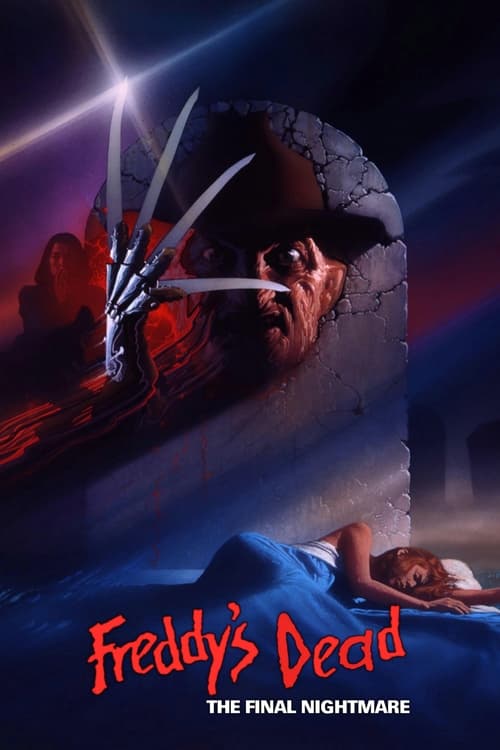
Freddy's Dead: The Final Nightmare (1991)
Directed by Rachel Talalay
No — Freddy's Dead: The Final Nightmare is not woke, scoring 14 out of 100 on our wokeness meter.
Freddy's Dead: The Final Nightmare arrives as the sixth entry in a franchise that had already exhausted its capacity for surprise, and it does so wearing 3D glasses in the final reel.
Consciousness Markers
The film features a female lead, a Black supporting actor in Yaphet Kotto, and a Latino character, but this casting reflects standard 1991 horror ensemble practice rather than a modern representation agenda.
A female director and a female protagonist who ultimately destroys Freddy give the film some feminist-adjacent weight, but it operates within conventional final-girl slasher tropes rather than an explicit feminist agenda.
There are no LGBTQ+ characters, themes, or subtext in the film.
Minority characters appear without any racial commentary or consciousness; the film does not engage with race as a theme.
There is no climate-related content or environmental messaging.
The film contains no critique of capitalism, wealth inequality, or corporate power.
There is no body-positivity theme or messaging.
Amnesia, troubled-youth shelters, and dream psychology are plot devices, not a neurodivergence advocacy theme.
The film is fictional horror and does not revise or reinterpret historical events.
The film does not deliver didactic social or political lectures.
Why it received this score
Freddy's Dead: The Final Nightmare arrives as the sixth entry in a franchise that had already exhausted its capacity for surprise, and it does so wearing 3D glasses in the final reel. Rachel Talalay directs with the enthusiasm of someone who has produced five of these pictures and now wants a turn in the chair. The result is a slasher film that mistakes a Nintendo Power Glove gag for wit and a pipe bomb for catharsis. It is, in the grand accounting of cultural markers, a quiet customer.
Which is not to say the film is devoid of interest. Lisa Zane's Maggie Burroughs is a female protagonist who destroys the monster with her own hands, and Talalay's presence behind the camera lends the proceedings a faintly feminist afterglow. Yaphet Kotto and Ricky Dean Logan round out an ensemble that looks like a 1991 horror cast, which is to say it includes faces that are not all white and does so without comment. That is the extent of it. The shelter residents carry histories of abuse and amnesia, but these function as dream fodder and kill setup, not as advocacy. No character wrestles with identity in a manner that would trouble a marketing department. The film has no interest in climate, in wealth, in the body, in the wiring of the mind, or in the rewriting of history. It wants to stab a teenager with a bed of spikes and reach the credits.
The lecture, notably, never arrives. There is no sermon, no moral instruction, no scene in which a character explains the audience to itself. The film's final thesis is that Freddy is dead, and it delivers this with a pipe bomb and a triumphant declaration. There is something to respect in that restraint.
Analysis generated by our Consciousness Algorithm
Part of


Synopsis
Just when you thought it was safe to sleep, Freddy Krueger returns in this sixth installment of the Nightmare on Elm Street films, as psychologist Maggie Burroughs, tormented by recurring nightmares, meets a patient with the same horrific dreams. Their quest for answers leads to a certain house on Elm Street -- where the nightmares become reality.
Questions about Freddy's Dead: The Final Nightmare
Is Freddy's Dead: The Final Nightmare woke?
No — Freddy's Dead: The Final Nightmare is not woke, scoring 14 out of 100 on our wokeness meter. That earns it a verdict of Ultra Based.
Does Freddy's Dead: The Final Nightmare have any woke elements?
1 of the 10 markers register at 30 or above, led by Representation Casting (30). On Representation Casting: The film features a female lead, a Black supporting actor in Yaphet Kotto, and a Latino character, but this casting reflects standard 1991 horror ensemble practice rather than a modern representation agenda.
How does Freddy's Dead: The Final Nightmare compare to other 1991 movies?
It ranks #20 of the 68 films from 1991 we've scored; their average is 14. The wokest is Paris Is Burning (77).
Is Freddy's Dead: The Final Nightmare the most woke A Nightmare on Elm Street movie?
No. It ranks #3 of the 7 A Nightmare on Elm Street films we've scored; the wokest is A Nightmare on Elm Street: The Dream Child (26).