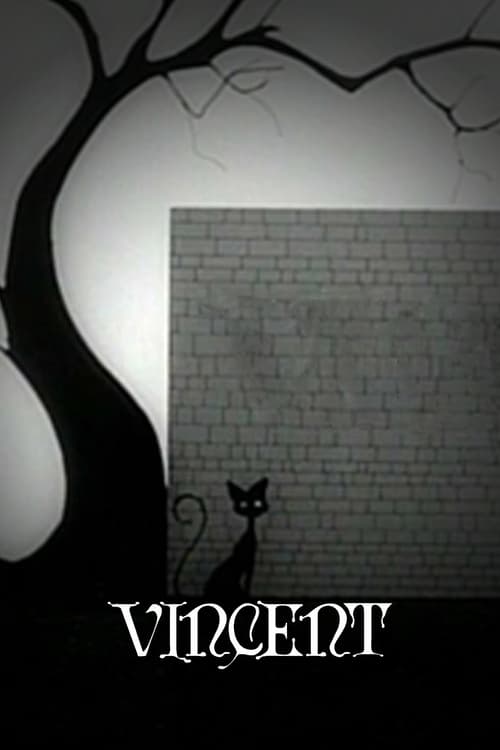
Vincent (1982)
Directed by Tim Burton
No — Vincent is not woke, scoring 0 out of 100 on our wokeness meter.
Vincent is a six-minute stop-motion short that Walt Disney Productions paid Tim Burton sixty thousand dollars to make in 1982, a decision history has treated kindly and the accountants presumably did not.
Consciousness Markers
A 1982 stop-motion short with a single narrator and one character; casting is entirely incidental to the gothic homage being made.
No LGBTQ+ characters, themes, or subtext of any kind appear in this six-minute Poe pastiche.
The mother exists only to dismiss her son's daydreams; there is no feminist framework or commentary on gender.
No engagement with race, racial identity, or racial politics whatsoever.
No environmental or climate themes; the film is concerned with macabre imagination, not ecology.
No economic critique or class commentary; the film is a personal artistic homage to Vincent Price and Edgar Allan Poe.
No body-positive messaging or diverse body representation; the imagery is deliberately grotesque in a gothic, not affirming, register.
The protagonist's morbid fantasy life is framed as gothic whimsy, not as neurodivergence or a neurodiversity narrative.
The film is a stylized homage to Poe and Vincent Price, not a revisionist retelling of any historical record.
The rhyming narration is atmospheric storytelling in service of mood, not a vehicle for social or political instruction.
Why it received this score
Vincent is a six-minute stop-motion short that Walt Disney Productions paid Tim Burton sixty thousand dollars to make in 1982, a decision history has treated kindly and the accountants presumably did not. Narrated in rhyming verse by Vincent Price, the boy's childhood idol, it follows seven-year-old Vincent Malloy through gothic daydreams borrowed from Edgar Allan Poe: the dog Abercrombie subjected to experiment, an aunt imagined in hot wax, a lost wife mourned in the manner of The Raven. Shot in stark black and white and steeped in 1920s German Expressionism, it is a mood piece and little else. The narrator supplies the only voice. The cast is, functionally, a child and a dog.
Those hunting for contemporary cultural instruction will find the cupboard bare. The mother appears briefly to dismiss her son's imagination and send him outdoors for some real fun. She is a plot device, not a thesis. The macabre imagery is grotesque by design and offers no affirming counter-narrative about the body. Race, class, sexuality, ecology, and the politics of representation go unaddressed, not through evasion but because a 1982 Disney animator making a Poe pastiche had other things on his mind. The film's only argument is that Vincent Price is magnificent, which is less a political position than a correct one. The meter does not twitch.
A curiosity, then, and a formative one: Burton's career in miniature, the outsider child, the gothic trappings, the affectionate borrowing from his betters. It took prizes at Chicago and Annecy, then disappeared into the Disney vault, resurfacing years later as a DVD bonus feature. As a document of progressive social consciousness it registers nothing whatsoever. Every dial reads zero, and the instrument is not malfunctioning. This is six minutes about a boy who wishes he were Vincent Price. It works.
Analysis generated by our Consciousness Algorithm
Part of
Synopsis
Young Vincent Malloy dreams of being just like Vincent Price and loses himself in macabre daydreams that annoy his mother.
Questions about Vincent
Is Vincent woke?
No — Vincent is not woke, scoring 0 out of 100 on our wokeness meter. That earns it a verdict of Ultra Based.
Does Vincent have any woke elements?
No. All 10 markers score zero.
How does Vincent compare to other 1982 movies?
It ranks #35 of the 41 films from 1982 we've scored; their average is 7. The wokest is Gandhi (42).
How is the Woke Score calculated?
An AI-assisted process researches the film and its reception, scores it 0–100 on ten markers, then combines those into one 0–100 Woke Score. It measures a specific set of 2020s cultural themes, not film quality.