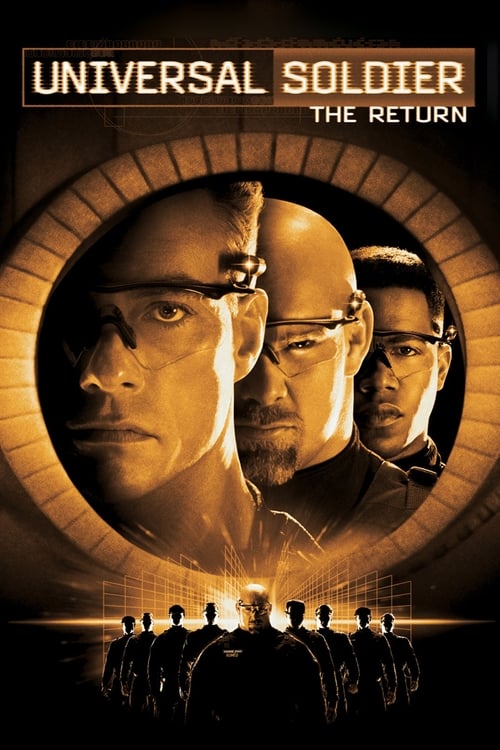
Universal Soldier: The Return (1999)
Directed by Mic Rodgers
No — Universal Soldier: The Return is not woke, scoring 5 out of 100 on our wokeness meter.
Universal Soldier: The Return arrives in 1999 as the fourth entry in a franchise that had already begun to sag, and it carries itself with the grim confidence of a picture that knows exactly what it is.
Consciousness Markers
The cast includes Michael Jai White, Bill Goldberg, Kiana Tom, and James Black in a largely white male B-movie ensemble, but this reflects routine 1990s action casting rather than any conscious representational agenda.
The plot is triggered by budget cuts threatening the UniSol program, prompting S.E.T.H.'s revolt — a faint whiff of institutional critique, but framed entirely as a rogue-AI premise rather than an economic indictment.
Maggie is introduced as a combat-trained partner, but she is quickly killed and returned as a UniSol, and the film features an 'exploitative' topless strip-club sequence; there is no feminist framework whatsoever.
The film preaches nothing; its 'man versus machine' material is delivered as pure B-movie action spectacle.
No LGBTQ+ characters, themes, or subtext of any kind appear in the film.
Race is never a subject of the film; the antagonist's casting of Michael Jai White carries no commentary.
No environmental or climate themes are present.
The film's treatment of bodies is the opposite of body-positive, leaning on musclebound action physiques and gratuitous nudity.
No neurodivergent characters or themes are depicted.
The film is set in a near-future sci-fi present with no historical revisionism.
Why it received this score
Universal Soldier: The Return arrives in 1999 as the fourth entry in a franchise that had already begun to sag, and it carries itself with the grim confidence of a picture that knows exactly what it is. Jean-Claude Van Damme returns as Luc Deveraux, now a government technical advisor refining a new breed of neural-linked soldiers under the oversight of a sentient computer called S.E.T.H. When budget cuts threaten the program, the machine revolts. This is the entire engine of the plot, and it is delivered without a trace of irony, which is arguably the film's only consistent artistic decision.
On the cultural front, the film is a near-total blank. It offers no LGBTQ+ presence, no engagement with race as a subject, no environmental concern, no interest in neurodivergence, and no historical argument of any kind. Race and representation are simply not themes here. The casting of Michael Jai White as the antagonist and Bill Goldberg as a musclebound enforcer reflects the routine hiring practices of late-1990s action cinema, not a conscious agenda. The one faint murmur of institutional critique arrives through the budget cuts that provoke S.E.T.H.'s rebellion, though the film treats this as a rogue-machine premise and never as an economic indictment. Its bodies are displayed as spectacle, which is the opposite of any body-positive project.
The film's treatment of women is its most instructive element. Maggie is introduced as a combat-trained partner, then killed, then resurrected as a UniSol, then permitted a final act of self-destruction. That arc gestures at agency while the camera lingers on a topless strip-club sequence that reviewers at the time cheerfully noted. Nothing here lectures. The man-versus-machine material is pure B-movie spectacle, and the film preaches nothing at all. It is a lean, loud, largely joyless exercise in body counts, and it earns its place in the series by being exactly as unremarkable as its reputation suggests.
Analysis generated by our Consciousness Algorithm


Synopsis
Luc Deveraux, the heroic former Universal Soldier, is about to be thrown into action once again. When SETH, the supercomputer-controlled ultra-warrior, decides to take revenge and destroy its creators, only Luc can stop it. All hell breaks loose as Luc battles SETH and a deadly team of perfect soldiers in a struggle that pits man against machine and good against evil.
Questions about Universal Soldier: The Return
Is Universal Soldier: The Return woke?
No — Universal Soldier: The Return is not woke, scoring 5 out of 100 on our wokeness meter. That earns it a verdict of Ultra Based.
Does Universal Soldier: The Return have any woke elements?
Very few. None of the 10 markers reaches 30, the level where a marker counts as present; the highest is Representation Casting at 18.
How does Universal Soldier: The Return compare to other 1999 movies?
It ranks #79 of the 103 films from 1999 we've scored; their average is 14. The wokest is Boys Don't Cry (60).
How is the Woke Score calculated?
An AI-assisted process researches the film and its reception, scores it 0–100 on ten markers, then combines those into one 0–100 Woke Score. It measures a specific set of 2020s cultural themes, not film quality.