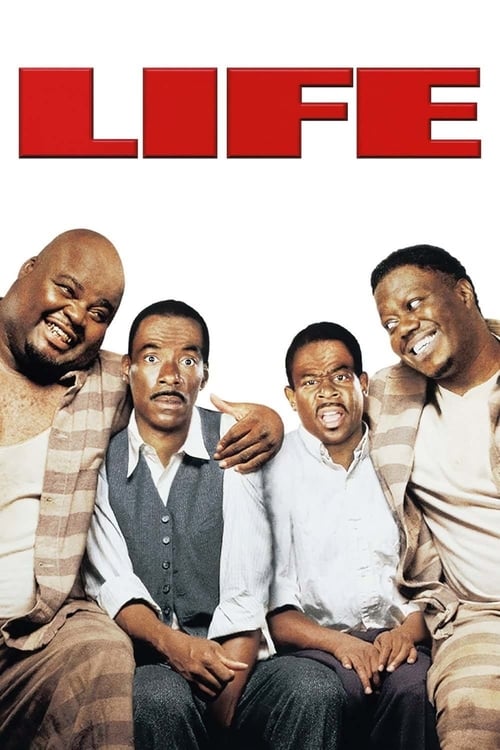
Life (1999)
Directed by Ted Demme
No — Life is not especially woke, scoring 36 out of 100 on our wokeness meter.
The 1999 buddy comedy Life opens as a caper and quietly becomes a forty-year meditation on wrongful incarceration, which is an odd mold for Eddie Murphy and Martin Lawrence to share.
Consciousness Markers
Racism is the engine of the plot: two innocent Black men are framed by a racist sheriff, denied service at Whites Only establishments, and condemned to a brutal labor camp. The wrongful-conviction narrative and the 'mulatto' child subplot foreground racial injustice throughout.
A predominantly Black ensemble led by Eddie Murphy and Martin Lawrence, with a deep bench of Black supporting players (Bernie Mac, Anthony Anderson, Obba Babatundé). The casting is organic to a story about Black men in the Jim Crow South rather than a modern diversity mandate, but the sheer centrality of Black performers is notable for a 1999 studio film.
The inmate Biscuit is a gay man who fears his family will reject him upon release and ultimately commits suicide by crossing the gun line; Jangle Leg also makes repeated same-sex advances toward Claude. The film treats Biscuit's plight with genuine sympathy, a substantive LGBTQ+ thread for its era.
The film dramatizes racism and injustice but delivers them through comedy and character rather than preachy monologue; the moral points are shown, not lectured.
Women appear only as prostitutes, a girlfriend who is seduced by Claude's cousin, and the superintendent's daughter Mae Rose. There is no feminist framing or agency granted to these characters.
Debt collectors and poverty motivate the opening, but the film offers no systemic critique of capitalism or wealth; the recurring 'Boom Boom Room' dream is one of personal aspiration, not economic rebellion.
No environmental or climate themes appear anywhere in the film.
No body-positivity themes or messaging are present.
The mute inmate 'Can't-Get-Right' has a communication disability, but it is not framed as neurodivergence or given any advocacy dimension.
The film is a fictional narrative set against a historically accurate backdrop of Jim Crow injustice; it does not rewrite or reinterpret historical events for ideological ends.
Why it received this score
The 1999 buddy comedy Life opens as a caper and quietly becomes a forty-year meditation on wrongful incarceration, which is an odd mold for Eddie Murphy and Martin Lawrence to share. Ted Demme directs with a steady hand and lets his leads age in makeup across decades, and the result lands somewhere between crowd-pleaser and elegy. Our task here is classification, not consolation.
The film's social consciousness is real but unevenly distributed. Racism is the motor of the plot: two innocent Black men are framed by a sheriff, turned away at Whites Only establishments, and condemned to a labor camp that eats their lives. Nearly every performer of consequence is Black, which for a 1999 studio picture is not incidental. The gay inmate Biscuit receives a thread of genuine sympathy, fearing his family's rejection before he walks across the gun line, and Jangle Leg's advances toward Claude are played for laughs without cruelty. The women fare worse. A prostitute, a faithless girlfriend, and the superintendent's daughter exhaust the roster, and agency ends there.
Where the film declines to lecture, it also declines to editorialize. There is no environmental sermon, no body-acceptance subplot, no clinical framing of the mute inmate as neurodivergent, and no reimagining of the historical record for ideological convenience. The recurring Boom Boom Room is a private dream of prosperity, not a critique of capital. Morality arrives through character and comedy instead of monologue, which keeps the sermonizing to a murmur. A flawed and strangely tender picture, and a mild one on the ledger that concerns us.
Analysis generated by our Consciousness Algorithm
Part of


Synopsis
Two men in 1930s Mississippi become friends after being sentenced to life in prison together for a crime they did not commit.
Questions about Life
Is Life woke?
No — Life is not especially woke, scoring 36 out of 100 on our wokeness meter. That earns it a verdict of Based.
Does Life have any woke elements?
3 of the 10 markers register at 30 or above, led by Racial Consciousness (65), LGBTQ+ Themes (50) and Representation Casting (50). On Racial Consciousness: Racism is the engine of the plot: two innocent Black men are framed by a racist sheriff, denied service at Whites Only establishments, and condemned to a brutal labor camp.
How does Life compare to other 1999 movies?
It ranks #8 of the 103 films from 1999 we've scored; their average is 14. The wokest is Boys Don't Cry (60).
How is the Woke Score calculated?
An AI-assisted process researches the film and its reception, scores it 0–100 on ten markers, then combines those into one 0–100 Woke Score. It measures a specific set of 2020s cultural themes, not film quality.