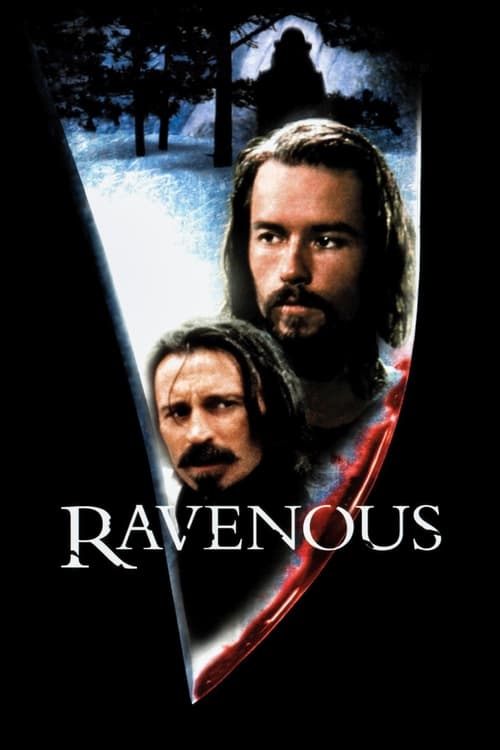
Ravenous (1999)
Directed by Antonia Bird
Partly — Ravenous is somewhat woke, scoring 40 out of 100 on our wokeness meter.
Antonia Bird's Ravenous arrives from 1999 with snow, mutton chops, and a cannibal problem.
Consciousness Markers
Bird explicitly frames cannibalism as a metaphor for a competitive society of 'consume or be consumed,' and the film critiques manifest destiny and capitalism as engines of savagery. This is a genuine, if allegorical, anti-capitalist reading.
The film engages the genocide of Native Americans and the colonial violence of westward expansion, with Bird explicitly stating Europeans 'practiced genocide.' The Native scout George and his sister Martha anchor this, though it remains subtextual rather than a central thesis.
The film reinterprets the American frontier and manifest destiny as a cannibalistic horror, drawing on the Donner Party and Alfred Packer to subvert the heroic Western myth. This is a revisionist take on frontier history, though embedded in genre rather than explicit argument.
The film is atmospheric and metaphorical rather than preachy; Ebert noted it is 'more interested in atmosphere than plot.' Its social critique is delivered through allegory and gallows humor, not direct lecturing.
The cast is overwhelmingly white men, with Sheila Tousey as Martha and a Native American scout (George) present as natural story elements rather than as a diversity statement. A woman director (Antonia Bird) is notable but does not constitute representation casting.
Directed by a woman, and Martha survives to walk away from the carnage, but the film's content is a hyper-masculine frontier cannibal tale with no feminist argument or critique of patriarchy.
No LGBTQ+ characters, themes, or subtext appear anywhere in the film.
No environmental or climate themes are present; the snowy wilderness is a setting for horror, not an ecological message.
No body positivity themes; the film's treatment of bodies is grotesque horror, not affirmation.
No neurodivergence themes or characters are present.
Why it received this score
Antonia Bird's Ravenous arrives from 1999 with snow, mutton chops, and a cannibal problem. The cast is a wall of white men in blue coats, with Native characters George and Martha folded into the frontier without ceremony. A woman directed the picture, which is notable, but the film itself is a hyper-masculine survival nightmare. There is no LGBTQ subtext, no climate sermon, no body positivity, and no neurodivergent arc. The wilderness is a pantry, not a cause.
That leaves the film's social consciousness to operate through metaphor. Cannibalism becomes a parable of a competitive society, a world of consume or be consumed. Bird spoke of Europeans practicing genocide, and the story uses the Donner Party and Alfred Packer to turn manifest destiny into a buffet of horrors. The critique of capitalism and colonial expansion is real, if allegorical. The Native scout and his sister anchor a flicker of racial awareness, though the film keeps that thread buried under gore. It revises the heroic western by making the frontier a slaughterhouse. None of this is delivered as a lecture. Ebert called it more interested in atmosphere than plot, and he was right. The message is in the stew.
Feminist argument? Not much. Martha survives and walks away, but the film never interrogates patriarchy. Representation casting is minimal, a few Native roles in a sea of white soldiers. The film's power comes from texture, dread, and a punchline involving a general savoring broth. It is a cult curio, a box office casualty, and a reminder that not every grim metaphor needs a seminar. Ravenous does not preach. It chews.
Analysis generated by our Consciousness Algorithm


Synopsis
After arriving at his new, remote Army outpost, Capt. John Boyd and his regiment aid a wounded frontiersman who recounts a horrifying tale of a wagon train murdered by its supposed guide – a vicious U.S. Army colonel gone rogue. Fearing the worst, the regiment heads out into the wilderness to verify the gruesome claims.
Questions about Ravenous
Is Ravenous woke?
Partly — Ravenous is somewhat woke, scoring 40 out of 100 on our wokeness meter. That earns it a verdict of Woke-Adjacent.
What makes Ravenous woke?
3 of the 10 markers register at 30 or above, led by Eat the Rich (55), Racial Consciousness (40) and Revisionist History (40). On Eat the Rich: Bird explicitly frames cannibalism as a metaphor for a competitive society of 'consume or be consumed,' and the film critiques manifest destiny and capitalism as engines of savagery.
How does Ravenous compare to other 1999 movies?
It ranks #5 of the 103 films from 1999 we've scored; their average is 14. The wokest is Boys Don't Cry (60).
How is the Woke Score calculated?
An AI-assisted process researches the film and its reception, scores it 0–100 on ten markers, then combines those into one 0–100 Woke Score. It measures a specific set of 2020s cultural themes, not film quality.