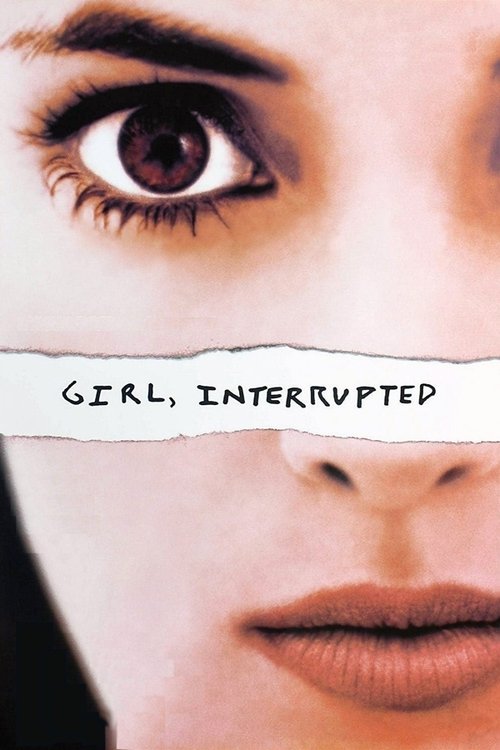
Girl, Interrupted (1999)
Directed by James Mangold
Partly — Girl, Interrupted is somewhat woke, scoring 45 out of 100 on our wokeness meter.
The late 1960s were, we are told, a changing world, and James Mangold's adaptation of Susanna Kaysen's memoir sets us down in a New England psychiatric hospital where that change mostly takes the form of young women being diagnosed with things.
Consciousness Markers
The entire film is a compassionate study of institutionalized neurodivergent women — borderline personality disorder, sociopathy, OCD, schizophrenia, depression — humanizing them beyond their diagnoses.
The film centers female interiority, friendship, and the pathologizing of women's nonconformity, explicitly framing Susanna's diagnosis as shaped by sexist preconceptions about 'lazy, self-indulgent little girls.'
A rare late-90s studio film built around a large ensemble of women, with Whoopi Goldberg and Vanessa Redgrave in supporting roles; the diversity is largely gender-based rather than a modern intersectional casting push.
Themes about the relativity of 'normal' and the DSM's generalizations surface in dialogue, but the film prefers melodrama and character study over direct sermonizing.
Whoopi Goldberg's Valerie is a grounded authority figure, but race is never a subject of the narrative or its themes.
The only trace is Lisa derisively labeling Cynthia a 'dyke'; it functions as an insult rather than any affirmative LGBTQ+ theme or storyline.
No environmental content whatsoever.
The critique is of psychiatric institutions and patriarchal diagnosis, not of capitalism or class.
Anorexia, self-harm, and burn scars appear as pathology to be dramatized, not as a body-acceptance message.
A period memoir adaptation set in 1967-68; it depicts its era rather than revising historical narrative for ideological ends.
Why it received this score
The late 1960s were, we are told, a changing world, and James Mangold's adaptation of Susanna Kaysen's memoir sets us down in a New England psychiatric hospital where that change mostly takes the form of young women being diagnosed with things. Claymoore houses a full ensemble of them, each issued a condition the way other pictures issue hats. There is the sociopath, the pathological liar, the burn victim with schizophrenia, the anorexic, the depressive, the girl who cuts. The film regards them with a patience that was uncommon for a studio release in 1999, and it treats their interiors as worthy of the runtime. That patience is its finest quality and also its structural trouble, since a movie about people waiting to get well has difficulty locating a third act.
The diagnosis Susanna receives is framed as a product of assumptions about lazy, self-indulgent little girls, and the screenplay lets her interrogate the manual that condemns her, dismissing its categories as generalizations. Here is a real strain of thought about how women's nonconformity gets pathologized, and it grants the film a social awareness that predates the current vocabulary for such things. Where it earns the most credit is in its handling of the institutionalized. These women are not case studies with punchlines. Lisa Rowe is monstrous and magnetic and also frightened. Polly is childlike and also a person. The film declines to reduce any of them to a chart entry, and that refusal accomplishes more than a dozen speeches would.
What it does not do is extend that sympathy into a broader program. Race passes through the ward as Valerie Owens, a grounded authority figure whose race the film never troubles to notice. The single reference to same-sex desire arrives as an insult flung across a hallway, landing as cruelty, not as theme. Class and capital go unexamined. The environment never appears. The body, here a site of scars and self-punishment, is never asked to be celebrated. The film gestures at the relativity of normal in dialogue, then retreats into melodrama whenever a point threatens to become a lecture. It is a character study with a conscience, which is not the same as a sermon, and we take our small mercies where we find them.
Analysis generated by our Consciousness Algorithm


Synopsis
Set in the changing world of the late 1960s, Susanna Kaysen's prescribed "short rest" from a psychiatrist she had met only once becomes a strange, unknown journey into Alice's Wonderland, where she struggles with the thin line between normal and crazy. Susanna soon realizes how hard it is to get out once she has been committed, and she ultimately has to choose between the world of people who belong inside or the difficult world of reality outside.
Questions about Girl, Interrupted
Is Girl, Interrupted woke?
Partly — Girl, Interrupted is somewhat woke, scoring 45 out of 100 on our wokeness meter. That earns it a verdict of Woke-Adjacent.
What makes Girl, Interrupted woke?
4 of the 10 markers register at 30 or above, led by Neurodivergence (78), Feminist Agenda (52) and Representation Casting (40). On Neurodivergence: The entire film is a compassionate study of institutionalized neurodivergent women — borderline personality disorder, sociopathy, OCD, schizophrenia, depression — humanizing them beyond their diagnoses.
How does Girl, Interrupted compare to other 1999 movies?
It ranks #4 of the 103 films from 1999 we've scored; their average is 14. The wokest is Boys Don't Cry (60).
How is the Woke Score calculated?
An AI-assisted process researches the film and its reception, scores it 0–100 on ten markers, then combines those into one 0–100 Woke Score. It measures a specific set of 2020s cultural themes, not film quality.