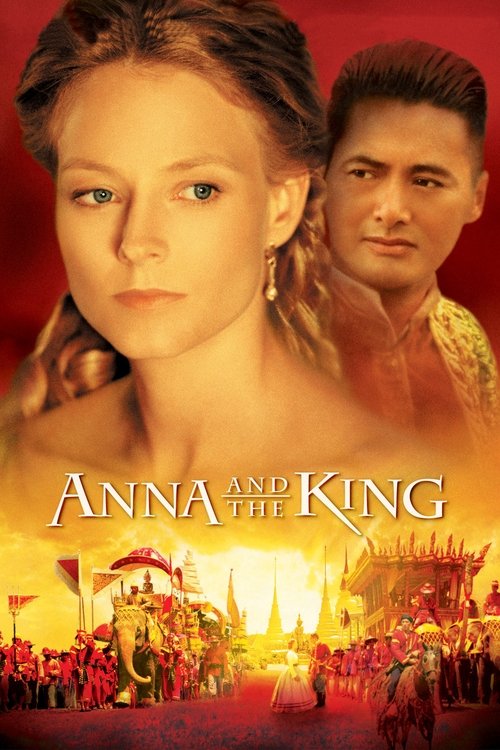
Anna and the King (1999)
Directed by Andy Tennant
Partly — Anna and the King is somewhat woke, scoring 40 out of 100 on our wokeness meter.
Anna and the King arrives with the calm confidence of a prestige picture that knows precisely which awards it intends to lose.
Consciousness Markers
A predominantly Asian supporting cast (Chow Yun-fat, Bai Ling, and a large Siamese ensemble) fills the palace roles, notable for 1999, though the film remains anchored by a white Western lead in a classic white-savior frame.
The film stages an East-versus-West clash in which Anna defends Siam against the racist condescension of the British envoys, and Chulalongkorn's arc toward abolition carries an anti-colonial conscience.
Anna is a strong-willed widow who challenges the King's polygamy, argues a man can love one woman, and publicly defies the court over Tuptim's punishment, giving the film a proto-feminist spine.
The film fictionalizes the Leonowens diaries and credits a British governess with steering Siam toward abolition and religious freedom, a white-savior reframing that Thailand itself rejected as historically inaccurate.
Anna delivers several earnest speeches on Western education, slavery, and the dignity of Siam, though the film mostly dramatizes rather than preaches.
The East India Company and Sir Mycroft are drawn as greedy imperialists trading in coups and bribery, offering a mild anti-imperialist critique of colonial commerce.
No LGBTQ+ characters, themes, or subtext appear anywhere in the narrative.
No environmental or climate themes are present.
No body-positivity themes or diverse body representation are present.
No neurodivergent characters or themes are depicted.
Why it received this score
Anna and the King arrives with the calm confidence of a prestige picture that knows precisely which awards it intends to lose. Andy Tennant's 1999 retelling of the Leonowens diaries is handsome, patient, and roughly two and a half hours of a British widow explaining the Enlightenment to a king who did not ask. Jodie Foster plays Anna with a spine of tempered steel, and the film surrounds her with a deep bench of Asian performers, Chow Yun-fat chief among them, which was not nothing in 1999. The palace is populated, textured, alive. The camera still finds its way back to the white lady at the center, as cameras tend to do.
The politics here are older than the decade that produced them. Anna argues that a man might love one woman, which the film treats as a radical proposition, and she publicly defies the court when Tuptim is sentenced, an outburst that costs the condemned woman her life and the film none of its dignity. An anti-colonial conscience is at work throughout: the British envoys sneer at Siam as backward, the East India Company trades in bribery and coups, and the young prince learns that slavery is a stain on his father's house. It is a critique of empire delivered from a comfortable carriage.
Thailand banned the film for insulting its monarchy and mangling its history, which remains a stronger critical position than most reviewers managed. The screenplay hands a foreign governess credit for abolition and religious freedom, a flattering fiction the descendants of the actual reformers might dispute. The result is a long, well-tailored romance with a conscience it wears lightly. The sermons are brief. The costumes are not.
Analysis generated by our Consciousness Algorithm


Synopsis
The story of the romance between the King of Siam (now Thailand) and the widowed British school teacher Anna Leonowens during the 1860s. Anna teaches the children and becomes romanced by the King. She convinces him that a man can be loved by just one woman.
Questions about Anna and the King
Is Anna and the King woke?
Partly — Anna and the King is somewhat woke, scoring 40 out of 100 on our wokeness meter. That earns it a verdict of Woke-Adjacent.
What makes Anna and the King woke?
5 of the 10 markers register at 30 or above, led by Representation Casting (45), Racial Consciousness (40) and Feminist Agenda (35). On Representation Casting: A predominantly Asian supporting cast (Chow Yun-fat, Bai Ling, and a large Siamese ensemble) fills the palace roles, notable for 1999, though the film remains anchored by a white Western lead in a classic white-savior frame.
How does Anna and the King compare to other 1999 movies?
It ranks #5 of the 103 films from 1999 we've scored; their average is 14. The wokest is Boys Don't Cry (60).
How is the Woke Score calculated?
An AI-assisted process researches the film and its reception, scores it 0–100 on ten markers, then combines those into one 0–100 Woke Score. It measures a specific set of 2020s cultural themes, not film quality.