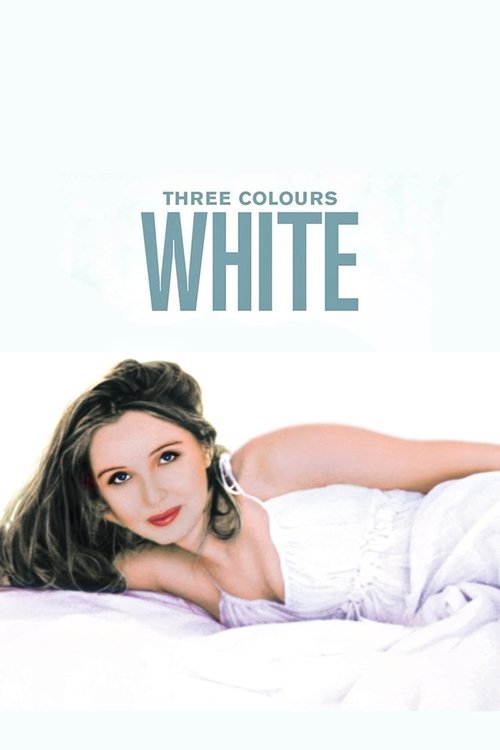
Three Colors: White (1994)
Directed by Krzysztof Kieślowski
No — Three Colors: White is not woke, scoring 7 out of 100 on our wokeness meter.
Krzysztof Kieślowski's second entry in his Three Colours trilogy arrives draped in the French Revolutionary ideal of equality, though the equality on offer here is the ledger-settling kind, tallied in grievances and repaid with interest.
Consciousness Markers
A subplot involves shady businessmen speculating on land for profit and Karol out-swindling them, offering a mild satirical glance at post-communist Polish capitalism, but it is incidental rather than a thesis.
The cast is a natural mix of Polish and French actors appropriate to a story about a Polish immigrant in France; there is no deliberate diversity-casting agenda at work.
Kieślowski is an ironist, not a preacher; the film's themes of equality and revenge are dramatized obliquely with essentially no didactic messaging.
No LGBTQ+ characters or themes appear anywhere in the film.
The film is a male-centered revenge narrative in which the wife functions largely as a femme fatale object of obsession; it advances no feminist critique.
Race and racial identity play no role in the story or its themes.
No environmental or climate concerns are present.
Karol's impotence is a plot device for humiliation and revenge, not a body-positivity statement.
No neurodivergent characters or themes are depicted.
The film engages no historical revisionism; it is a contemporary (1990s) character drama.
Why it received this score
Krzysztof Kieślowski's second entry in his Three Colours trilogy arrives draped in the French Revolutionary ideal of equality, though the equality on offer here is the ledger-settling kind, tallied in grievances and repaid with interest. Karol Karol, a Polish barber, is divorced by his French wife for his inability to perform, stripped of salon, passport and savings, and reduced to comb-and-paper harmonica work in the Métro. He smuggles himself home in a suitcase, builds a fortune, and engineers an elaborate revenge that ends with Dominique behind bars. It is a comedy, apparently. The tone sits somewhere between a shrug and a knife.
The film's treatment of its central marriage is where contemporary sensibilities would find the least purchase. Dominique exists as an object of obsession and a mechanism of humiliation, a femme fatale whose interior life is never granted a scene of its own. Kieślowski famously reshot her final moment to make her seem less monstrous, which is a curious instinct for a story that otherwise uses her as a target. Anyone hunting for a feminist reading will be hunting for some time. The film simply is not interested in that conversation, and it does not pretend otherwise.
A mild satirical edge targets the scramble of post-communist commerce, where Karol watches his employers hoard land for speculative resale and then beats them at their own game. It is a glancing joke, not a thesis, and it passes quickly. The casting is a natural Franco-Polish arrangement, drawn from the story's geography and nothing else. Kieślowski is an ironist by temperament, and he dramatizes his themes obliquely, refusing to lecture. The whole enterprise is cool, precise, and largely indifferent to the cultural preoccupations that would arrive decades later.
Analysis generated by our Consciousness Algorithm


Synopsis
Polish immigrant Karol Karol finds himself out of a marriage, a job and a country when his French wife, Dominique, divorces him after six months due to his impotence. Forced to leave France after losing the business they jointly owned, Karol enlists fellow Polish expatriate Mikołaj to smuggle him back to their homeland.
Questions about Three Colors: White
Is Three Colors: White woke?
No — Three Colors: White is not woke, scoring 7 out of 100 on our wokeness meter. That earns it a verdict of Ultra Based.
Does Three Colors: White have any woke elements?
Very few. None of the 10 markers reaches 30, the level where a marker counts as present; the highest is Eat the Rich at 15.
How does Three Colors: White compare to other 1994 movies?
It ranks #40 of the 86 films from 1994 we've scored; their average is 10. The wokest is On Deadly Ground (75).
Is Three Colors: White the most woke Three Colors movie?
No. It ranks #2 of the 3 Three Colors films we've scored; the wokest is Three Colors: Blue (8).