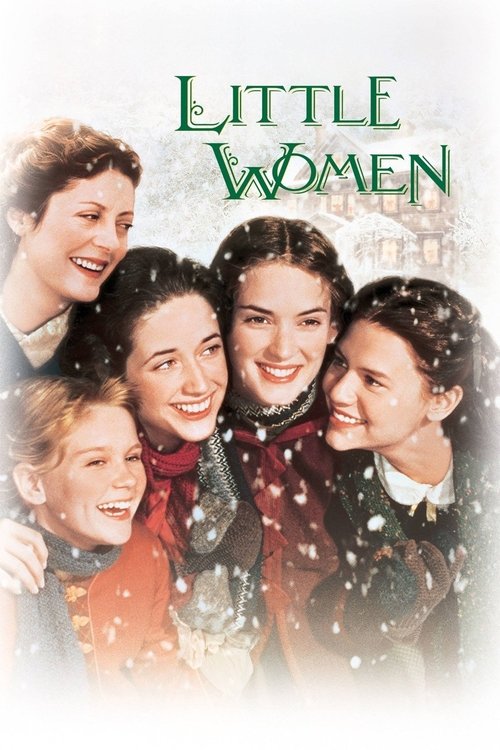
Little Women (1994)
Directed by Gillian Armstrong
Partly — Little Women is somewhat woke, scoring 40 out of 100 on our wokeness meter.
The 1994 Little Women arrives as a handsomely mounted period piece, faithful to Louisa May Alcott and directed by Gillian Armstrong with a steady, unsentimental eye.
Consciousness Markers
The film centers on four sisters and their mother, explores women's limited options and Jo's literary ambition, and was directed by a woman with an explicitly feminist reading of the novel.
The film offers gentle moral lessons about family and kindness, but it does not lecture the audience on contemporary social issues.
The principal cast is almost entirely white, reflecting the source material's 19th-century New England setting; no modern diverse casting choices are evident.
No LGBTQ+ characters, relationships, or themes appear in the film.
The film includes a poor immigrant family aided by Beth, but this is framed as Christian charity rather than racial or systemic consciousness.
No environmental or climate themes are present.
The story contrasts poverty and wealth, but its treatment of class is moral and charitable rather than anti-capitalist.
No body positivity themes or diverse body representations are present.
No neurodivergent characters or themes are present.
The film is a faithful period adaptation of a 19th-century novel, not a revisionist historical narrative.
Why it received this score
The 1994 Little Women arrives as a handsomely mounted period piece, faithful to Louisa May Alcott and directed by Gillian Armstrong with a steady, unsentimental eye. Winona Ryder's Jo scribbles in the attic and dreams of authorship, while the March sisters negotiate courtship, illness, and genteel poverty in Civil War-era Concord. The film's progressive pulse is real but measured. It takes women's limited options seriously, gives Jo a stubborn artistic hunger, and places a female director at the helm of a story that studios once dismissed as a needle in the eye. That earns it a respectable place in the feminist ledger, circa 1994. It does not, however, arrive with a modern ideological toolkit.
Elsewhere, the ledger is mostly blank. The cast is white, as the source and setting dictate, with no revisionist gesture toward diverse representation. There are no queer currents, no climate anxieties, no body-positive sermon, no neurodivergent diagnosis, and no anti-capitalist rage. The poor immigrant family Beth aids is treated as an object of Christian charity, not as evidence of structural racial or economic critique. Aunt March's money becomes a school, which is generous but not redistributive. The narrative remains a faithful nineteenth-century adaptation, not a corrective history. Its moral lessons concern family, kindness, and endurance. They are delivered gently, without the hectoring tone that contemporary audiences have learned to recognize.
Armstrong's film is warm, literate, and emotionally precise, but its cultural awareness is ancestral. It belongs to an earlier mode of liberal humanism, where women's stories could be told seriously without every scene doubling as a seminar. The result is a pleasant, well-acted artifact. It stirs the heart, mildly. It does not reeducate the viewer, which may be its quietest virtue.
Analysis generated by our Consciousness Algorithm


Synopsis
Four sisters come of age in America in the aftermath of the Civil War.
Questions about Little Women
Is Little Women woke?
Partly — Little Women is somewhat woke, scoring 40 out of 100 on our wokeness meter. That earns it a verdict of Woke-Adjacent.
What makes Little Women woke?
1 of the 10 markers register at 30 or above, led by Feminist Agenda (55). On Feminist Agenda: The film centers on four sisters and their mother, explores women's limited options and Jo's literary ambition, and was directed by a woman with an explicitly feminist reading of the novel.
How does Little Women compare to other 1994 movies?
It ranks #5 of the 86 films from 1994 we've scored; their average is 10. The wokest is On Deadly Ground (75).
How is the Woke Score calculated?
An AI-assisted process researches the film and its reception, scores it 0–100 on ten markers, then combines those into one 0–100 Woke Score. It measures a specific set of 2020s cultural themes, not film quality.