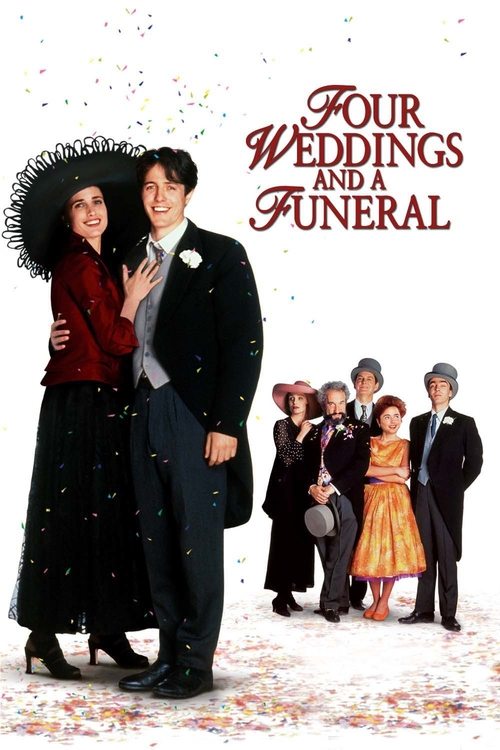
Four Weddings and a Funeral (1994)
Directed by Mike Newell
Partly · Woke-Adjacent
How we score movies →Consciousness Markers
Gareth and Matthew's relationship is portrayed with dignity and their love is treated as genuine and moving. The film centers their emotional bond in one of its most affecting moments, though they exist within a fundamentally heteronormative narrative structure.
Features a gay couple as substantial supporting characters with emotional depth and a touching funeral scene, genuinely progressive for 1994 mainstream comedy. Cast is otherwise uniformly white and British.
Female characters exist primarily in relation to male romantic interest. Women have some agency but remain defined by availability and desirability rather than by their own pursuits or autonomy.
All characters conform to conventional standards of physical attractiveness. No body diversity or challenge to beauty norms is present.
The film contains no meaningful racial representation or consciousness. The cast is entirely white and the film shows no awareness of race as a category.
The film makes no explicit social commentary or moral lectures. Its progressive moments exist implicitly within a conventional romantic comedy structure.
No climate themes or environmental consciousness present in the film.
The film celebrates and normalizes wealthy, leisured upper-middle-class life without any critique of economic inequality or class structures.
No representation of neurodivergence or disability in any form.
Not a historical film and contains no revisionist historical claims.


Synopsis
Over the course of five social occasions, a committed bachelor must consider the notion that he may have discovered love.
Why it received this score
Four Weddings and a Funeral occupies a peculiar position in the genealogy of mainstream cultural representation. Released in 1994, it features a gay couple as central supporting characters with genuine emotional depth, a choice that was genuinely progressive for a major studio romantic comedy at that moment in time. Gareth and Matthew are not presented as punchlines or tragic cautionary tales, and their relationship receives the film's most moving sequence. Yet this representation exists within a thoroughly heteronormative narrative structure where the entire plot machinery exists to get Hugh Grant's character into a romantic relationship with a woman. The film's progressive instincts are real, but they operate within strict limitations.
The film presents itself as a comedy of manners about upper-middle-class Londoners navigating romance and social obligation. Its concerns are almost entirely domestic and personal rather than systemic. There is no engagement with economic inequality, no interrogation of power structures, no consciousness of the broader world beyond the bubble of wedding season. The cast is uniformly white and British. The few female characters who exist are defined almost entirely by their romantic availability or unavailability to men. Body types are conventional. The film's feminism, such as it is, consists of women having agency within the existing romantic framework rather than any fundamental questioning of that framework itself.
What makes this film's cultural status complicated is that it genuinely was ahead of its peers in 1994, yet it would be considered cautious and insufficient by modern standards. It is a film that did something quietly progressive within an otherwise conservative container, which is precisely the kind of thing that tends to age into invisibility.
Analysis generated by our Consciousness Algorithm
Critic Reviews
“British humour at its eclectic best, a deliciously heady mix of dry wit and ribald farce.”
“Grant is the rare actor who can mix the characteristics of sex appeal and ambivalence in believable, rather than irritating, proportions.”
“Not only do Grant, Scott Thomas, Callow and company handle the sprightly dialogue with aplomb, they are also adept at the doubletakes and befuddled looks that make Four Weddings both amusing and irresistible all the way through the not-to-be-missed final credits. [9 March 1994, Calendar, p.F-1]”
“Maybe you'll enjoy it, but don't expect to remember it ten minutes later, or even to believe in the characters while you're watching them.”