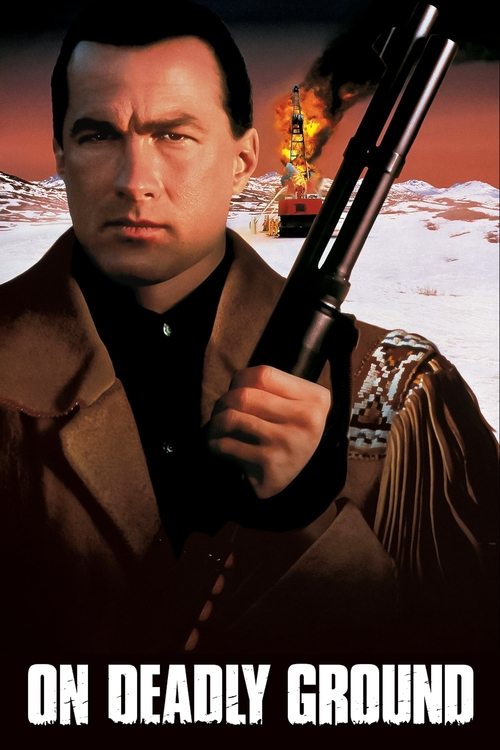
On Deadly Ground (1994)
Directed by Steven Seagal
Yes — On Deadly Ground is woke, scoring 75 out of 100 on our wokeness meter.
On Deadly Ground is a 1994 environmental action film directed by and starring Steven Seagal, a man who approaches the Alaska oil industry with the moral clarity of a wrecking ball and the subtlety of a C-4 charge.
Consciousness Markers
The film is notorious for its closing sanctimonious speech at the Alaska State Capitol, and critics (Ebert, Siskel, Klady) singled out its preachy, sermonizing tone throughout.
Environmental destruction from oil operations is the film's driving conflict, culminating in a plea to protect the Alaskan ecosystem. It is 1990s pollution-focused environmentalism rather than modern climate-change activism.
The villain is a corrupt oil CEO who sacrifices safety and the environment purely for profit, and the film explicitly condemns corporate greed as the root evil.
The film centers on a Yupik/Inuit tribe and casts Native Alaskan actors (Chief Irvin Brink, Apanguluk Charlie Kairaiuak) in significant roles, with Joan Chen as the female lead. The indigenous community is integral to the plot rather than decorative.
The plot hinges on indigenous land and oil rights reverting to the Yupik tribe, and the villain's disregard for Native lives and territory. This is a genuine racial/indigenous-consciousness thread, though framed through a white savior.
Joan Chen's Masu is a present but largely reactive supporting figure; the film offers no feminist critique or gender-conscious framing.
No LGBTQ+ characters or themes appear anywhere in the film.
No body-positivity themes or messaging present.
No neurodivergent characters or themes present.
The film is a work of fiction and makes no revisionist claims about historical events.
Why it received this score
On Deadly Ground is a 1994 environmental action film directed by and starring Steven Seagal, a man who approaches the Alaska oil industry with the moral clarity of a wrecking ball and the subtlety of a C-4 charge. The plot's indigenous thread is not decorative: Aegis Oil's rights revert to the Yupik tribe, and the villain's contempt for Native land and lives drives the conflict. The casting of Native Alaskan actors in significant roles gives those scenes a pulse. This is still a white savior narrative, and Joan Chen's Masu spends too much time reacting to Seagal's vision quest, but the film does not treat the tribe as scenery.
Its environmental and anti-corporate instincts are loud and sincere. The oil company cuts corners, poisons the ecosystem, and murders anyone who notices, which makes the corporate greed thread easy to follow. We are not dealing with modern climate policy here. This is 1990s pollution outrage with a body count. The film has no interest in LGBTQ+ lives, body positivity, neurodivergence, or revising history. Its feminism is mostly theoretical. Masu is present, capable, and underused. The movie's real religion is the lecture. Seagal's closing address at the Alaska State Capitol arrives after an industrial massacre and a refinery explosion, and the film presents it as civic duty. Critics called the tone sanctimonious. They were correct.
This leaves a strange artifact: a revenge thriller with a conscience, a vanity project with a cause, and a directorial debut that mistakes volume for argument. Michael Caine's accent wanders the globe. The action is functional. The sermon is inevitable. On Deadly Ground earns its place in the cabinet of environmental action curiosities, not because it is good, but because it is so earnest about being bad for you. We watch, we sigh, we classify.
Analysis generated by our Consciousness Algorithm
Part of


Synopsis
Forrest Taft is an environmental agent who works for the Aegis Oil Company in Alaska. Aegis Oil's corrupt CEO is the kind of person who doesn't care whether or not oil spills into the ocean or onto the land—just as long as it's making money for him.
Questions about On Deadly Ground
Is On Deadly Ground woke?
Yes — On Deadly Ground is woke, scoring 75 out of 100 on our wokeness meter. That earns it a verdict of Woke.
What makes On Deadly Ground woke?
5 of the 10 markers register at 30 or above, led by Lecture Energy (85), Climate Crusade (75) and Eat the Rich (65). On Lecture Energy: The film is notorious for its closing sanctimonious speech at the Alaska State Capitol, and critics (Ebert, Siskel, Klady) singled out its preachy, sermonizing tone throughout.
How does On Deadly Ground compare to other 1994 movies?
It is the wokest of the 86 films from 1994 we've scored; their average is 10.
How is the Woke Score calculated?
An AI-assisted process researches the film and its reception, scores it 0–100 on ten markers, then combines those into one 0–100 Woke Score. It measures a specific set of 2020s cultural themes, not film quality.