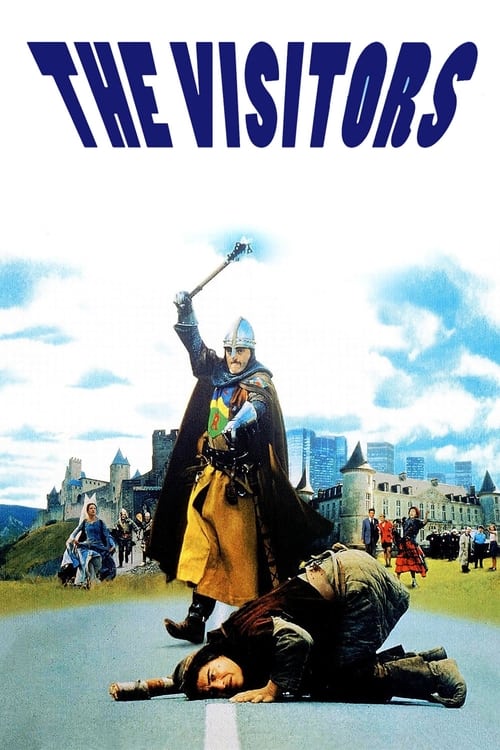
The Visitors (1993)
Directed by Jean-Marie Poiré
No — The Visitors is not woke, scoring 0 out of 100 on our wokeness meter.
Jean-Marie Poiré's The Visitors arrives from 1993 with a medieval knight, his unhygienic squire, and a time-travel plot that deposits them in a France of automobiles, dentists, and indoor plumbing.
Consciousness Markers
The cast is almost entirely white French actors; a single Black postman appears as a brief comic foil, not as a deliberate representation-casting choice.
No LGBTQ+ characters, themes, or subtext.
Female characters exist as romantic interests, descendants, and comic sidekicks, but the film advances no feminist critique or agenda.
The only racial moment is a medieval squire calling a Black postman a 'Saracen' for a fish-out-of-water joke; it is not racial consciousness or social critique.
No environmental or climate themes.
The film lightly mocks a nouveau riche castle owner and a banker, but this is aristocratic nostalgia and class farce, not an anti-capitalist thesis.
No body-positivity themes; physical comedy includes mockery of appearances but not advocacy.
A psychiatric hospital appears as a plot device, but neurodivergence is not explored or affirmed.
The medieval past is played for farce, not revised to make a contemporary ideological point.
The film is a broad comedy that never pauses to lecture the audience on social issues.
Why it received this score
Jean-Marie Poiré's The Visitors arrives from 1993 with a medieval knight, his unhygienic squire, and a time-travel plot that deposits them in a France of automobiles, dentists, and indoor plumbing. The film's engine is collision: chainmail against the Renault 4, feudal deference against a castle-owning nouveau riche, Latin battle cries against the language of banking. It is a broad farce, expertly timed in places, and it has no interest in instructing us about the present. The comedy depends on incongruity, not on a thesis.
On the social-consciousness ledger, the film is a blank page. The cast is white French stock, with a Black postman used for a quick gag about a Saracen and then dismissed. Women are wives, descendants, and comic appendages; the screenplay notices them only as plot furniture. A psychiatric hospital appears as a convenient holding cell, and no condition is explored beyond the punchline. The medieval world is not revised to flatter modern politics; it is recreated as a mud-and-iron playground for slapstick.
Class enters the film as aristocratic sulking. Godefroy is appalled that a peasant's descendant owns his castle, and the joke lands on the vulgar rich man, not on the system that produced him. That is nostalgia dressed as satire, and it never hardens into an anti-capitalist argument. There is no sermon waiting at the end, and no subplot that asks us to applaud our own advanced values. The Visitors remains a well-oiled machine for collisions between eras, and its cultural agenda is the absence of any such thing.
Analysis generated by our Consciousness Algorithm


Synopsis
After a wizard's spell goes awry, 12th-century Gallic knight Godefroy de Papincourt, Count of Montmirail finds himself transported to 1993, along with his dimwitted servant, Jacquouille la Fripouille. Startled and perplexed by modern technology, the duo run amok, destroying cars and causing chaos until they meet Beatrice de Montmirail, an aristocratic descendant of the nobleman, who may be able to help them get back to 1123.
Questions about The Visitors
Is The Visitors woke?
No — The Visitors is not woke, scoring 0 out of 100 on our wokeness meter. That earns it a verdict of Ultra Based.
Does The Visitors have any woke elements?
No. All 10 markers score zero.
How does The Visitors compare to other 1993 movies?
It ranks #76 of the 97 films from 1993 we've scored; their average is 11. The wokest is Bound by Honor (60).
Is The Visitors the most woke The Visitors movie?
No. It ranks #2 of the 3 The Visitors films we've scored; the wokest is The Visitors: Bastille Day (7).