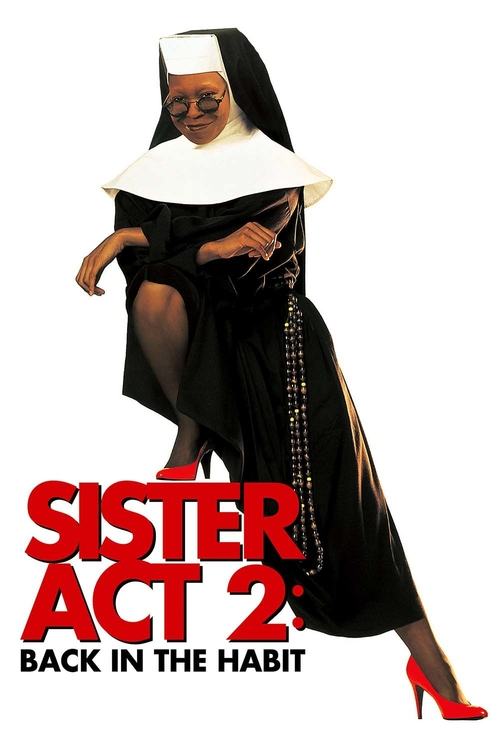
Sister Act 2: Back in the Habit (1993)
Directed by Bill Duke
No — Sister Act 2: Back in the Habit is not especially woke, scoring 36 out of 100 on our wokeness meter.
Sister Act 2: Back in the Habit arrives as a sequel to a surprise hit, directed by Bill Duke, with Whoopi Goldberg returning to a San Francisco Catholic school.
Consciousness Markers
A largely Black ensemble and Black director anchor the film, and it has been retrospectively cited as a landmark of mainstream representation. The casting is central to its cultural legacy, though not framed in modern DEI terms.
The film centers Black students, gospel and hip-hop culture, and a Black director, and is now discussed as a standard in Black cinema. It does not organize its plot around racial injustice or systemic racism.
Whoopi Goldberg leads as a woman who mentors girls and helps save a school, with a mother-daughter arc for Rita. The film does not advance an explicit feminist critique.
The plot pits the choir against an administrator eager to close a struggling school for his own early retirement, giving it a mild anti-austerity streak. It is not a systemic eat-the-rich parable.
Deloris delivers inspirational lectures about discipline, fear, and following one's passion. The didacticism is conventional musical-comedy uplift rather than modern social lecture.
No LGBTQ+ characters, themes, or subtext are present.
No climate or environmental themes are present.
No body-positivity themes or messaging are present.
No neurodivergence themes or characters are present.
The film is loosely inspired by a real choir instructor, but it does not revise or reinterpret historical events.
Why it received this score
Sister Act 2: Back in the Habit arrives as a sequel to a surprise hit, directed by Bill Duke, with Whoopi Goldberg returning to a San Francisco Catholic school. The film gathers a largely Black ensemble of students, Lauryn Hill among them, and lets gospel, hip-hop, and choir culture carry the emotional weight. That casting and cultural texture became its legacy. Retrospective claims about representation in mainstream American film are not wrong. The movie simply placed those faces at the center and let them sing.
The plot is a familiar save-the-school contraption. Mr. Crisp wants closure and early retirement; Deloris wants discipline, passion, and a winning choir. The conflict has a mild anti-austerity streak, since an administrator's self-interest threatens a struggling institution. It never builds a systemic critique of capital. The feminist dimension is present but soft: a woman mentors girls, and Rita's mother-daughter arc resolves in pride. No LGBTQ themes, no climate concerns, no body-positivity messaging, no neurodivergent characters. The film's inspirational speeches are conventional musical-comedy uplift, not modern social sermonizing. Deloris tells the students fear cannot run their lives. That is as preachy as it gets, and it is aimed at stage fright.
What remains is a curious artifact. Critics in 1993 found it saccharine and recycled. Audiences and later generations found something else: a vehicle for Lauryn Hill, a pipeline to Glee, a gospel crossover moment, a cult classic. The film's racial consciousness lives in its Black students, Black director, and Black musical traditions, but it does not organize itself around racial injustice. Its social awareness is incidental, embedded in who gets to be on screen and whose music fills the room. It claims loose inspiration from a real choir instructor, but it does not rewrite history. As a piece of progressive cultural export, it is modest, sincere, and mostly interested in getting the choir to Hollywood. The classification is straightforward. A sequel with a good heart, a weak script, and a soundtrack that outlived the reviews.
Analysis generated by our Consciousness Algorithm


Synopsis
Deloris Van Cartier is again asked to don the nun's habit to help a run-down Catholic school, presided over by Mother Superior. And if trying to reach out to a class full of uninterested students wasn't bad enough, the sisters discover that the school is due to be closed by the unscrupulous chief of a local authority.
Questions about Sister Act 2: Back in the Habit
Is Sister Act 2: Back in the Habit woke?
No — Sister Act 2: Back in the Habit is not especially woke, scoring 36 out of 100 on our wokeness meter. That earns it a verdict of Based.
Does Sister Act 2: Back in the Habit have any woke elements?
2 of the 10 markers register at 30 or above, led by Representation Casting (65) and Racial Consciousness (50). On Representation Casting: A largely Black ensemble and Black director anchor the film, and it has been retrospectively cited as a landmark of mainstream representation.
How does Sister Act 2: Back in the Habit compare to other 1993 movies?
It ranks #6 of the 97 films from 1993 we've scored; their average is 11. The wokest is Bound by Honor (60).
How is the Woke Score calculated?
An AI-assisted process researches the film and its reception, scores it 0–100 on ten markers, then combines those into one 0–100 Woke Score. It measures a specific set of 2020s cultural themes, not film quality.