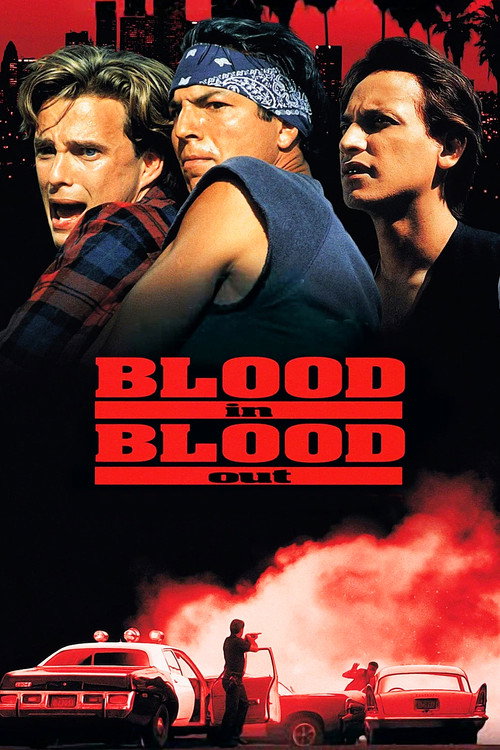
Bound by Honor (1993)
Directed by Taylor Hackford
Yes — Bound by Honor is woke, scoring 60 out of 100 on our wokeness meter.
Bound by Honor arrived in 1993 as a three-hour epic of East Los Angeles, following three Chicano cousins from a street gang called the Vatos Locos into the prisons, the police force, and the art studios that will define them.
Consciousness Markers
The film explicitly examines Chicano identity, racism, and racialized prison gang warfare, making racial dynamics central to its plot and themes.
The film features a predominantly Mexican-American/Chicano cast in leading roles, centering their experiences in a major Hollywood production; this is significant representation, though the story naturally demands it rather than being a modern diversity mandate.
The film carries moral themes about gang violence, addiction, and forgiveness, but they emerge through drama rather than preachy direct address.
No LGBTQ+ themes, characters, or subtext; prison sexual violence is depicted but not framed as queer identity or romance.
Women appear only peripherally as mothers, girlfriends, or daughters; the narrative is male-dominated and offers no feminist critique or agency.
No environmental or climate-change themes are present.
While it depicts poverty, crime, and the prison system, it offers no critique of capitalism or the wealthy.
No body-positivity themes or diverse body representation are present.
No neurodivergent characters or themes are present.
The film is a fictionalized drama inspired by real experiences, not a revisionist historical narrative.
Why it received this score
Bound by Honor arrived in 1993 as a three-hour epic of East Los Angeles, following three Chicano cousins from a street gang called the Vatos Locos into the prisons, the police force, and the art studios that will define them. Taylor Hackford directs with a documentarian's patience and a genre filmmaker's appetite for violence. The cast is almost entirely Mexican-American, and the film asks them to carry the weight of a community's story without a single wink toward the audience. This is representation that predates the era of casting mandates, which makes it more interesting, not less. The film knows what it is about.
The racial consciousness here is not decorative. Race organizes the entire prison system on screen, dividing San Quentin into the Black Guerrilla Army, the Aryan Vanguard, and La Onda, and the plot turns on the fragile treaties between them. The film takes Chicano identity as its subject, not its garnish. Elsewhere the ledger is quiet. Women drift through as mothers and girlfriends and daughters, given no interior life. There is no queer current, no environmental concern, no critique of capital, no attention to body image or neurodivergence. The film has other business.
Its moral instruction arrives through blood and consequence, not sermon. The themes of addiction, loyalty, and forgiveness are dramatized, so the audience is trusted to draw its own conclusions. The result is a sprawling, uneven, occasionally preachy work that nonetheless treats its characters as fully human. It is a serious film about serious people, and it does not need a lecture to make its case.
Analysis generated by our Consciousness Algorithm
Synopsis
Based on the true life experiences of poet Jimmy Santiago Baca, the film focuses on half-brothers Paco and Cruz, and their bi-racial cousin Miklo. It opens in 1972, as the three are members of an East L.A. gang known as the "Vatos Locos", and the story focuses on how a violent crime and the influence of narcotics alter their lives. Miklo is incarcerated and sent to San Quentin, where he makes a "home" for himself. Cruz becomes an exceptional artist, but a heroin addiction overcomes him with tragic results. Paco becomes a cop and an enemy to his "carnal", Miklo.
Questions about Bound by Honor
Is Bound by Honor woke?
Yes — Bound by Honor is woke, scoring 60 out of 100 on our wokeness meter. That earns it a verdict of Woke.
What makes Bound by Honor woke?
2 of the 10 markers register at 30 or above, led by Racial Consciousness (85) and Representation Casting (80). On Racial Consciousness: The film explicitly examines Chicano identity, racism, and racialized prison gang warfare, making racial dynamics central to its plot and themes.
How does Bound by Honor compare to other 1993 movies?
It is the wokest of the 97 films from 1993 we've scored; their average is 11.
How is the Woke Score calculated?
An AI-assisted process researches the film and its reception, scores it 0–100 on ten markers, then combines those into one 0–100 Woke Score. It measures a specific set of 2020s cultural themes, not film quality.