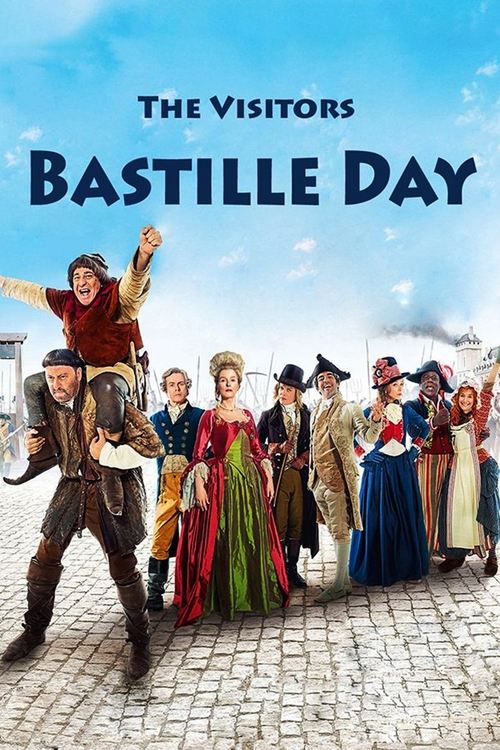
The Visitors: Bastille Day (2016)
Directed by Jean-Marie Poiré
No — The Visitors: Bastille Day is not woke, scoring 7 out of 100 on our wokeness meter.
There is a particular species of fatigue that settles in when a franchise returns after eighteen years to find its audience gone.
Consciousness Markers
The cast is overwhelmingly white French comedy regulars, with Pascal N'Zonzi as a lone Black supporting player; his presence is incidental rather than a statement of inclusive casting.
The Revolution setting involves aristocrats fleeing and property being confiscated, but this is comic backdrop rather than any coherent eat-the-rich message.
Karin Viard, Sylvie Testud, and Marie-Anne Chazel fill prominent roles, but the film offers no feminist critique or gender commentary whatsoever.
This is a broad crowd-pleasing comedy that preaches nothing; there is no didactic or sermonizing impulse.
No LGBTQ+ characters, themes, or subtext appear anywhere in this time-travel farce.
Race is never addressed; the film is a period comedy about French aristocrats and revolutionaries with no racial themes.
There is no environmental or climate content in this 1793-set comedy.
No body-positivity themes or messaging are present.
No neurodivergent characters or themes are depicted.
The film uses the French Revolution as a slapstick backdrop without reinterpreting or revising historical narratives for ideological ends.
Why it received this score
There is a particular species of fatigue that settles in when a franchise returns after eighteen years to find its audience gone. The Visitors: Bastille Day deposits the medieval knight Godefroy and his squire Jacquouille into 1793, into the Reign of Terror, where they bumble among aristocrats fleeing confiscation and a descendant who serves as public accuser. It was a critical and commercial failure in France. The film proceeds with the grim cheerfulness of a reunion nobody requested, dusting off the same time-travel potion and the same broad physical comedy that carried the 1993 original. The corridors of time, it turns out, lead mostly to the same jokes.
On the matter of social consciousness, the ledger is spare. The cast is a roster of white French comedy regulars, and the lone Black performer occupies a supporting slot without the film pausing to comment on his presence. Three accomplished actresses hold prominent roles, yet the screenplay offers no gender critique, no angle on their positions, nothing beyond the mechanics of farce. The Revolution supplies aristocrats in flight and property under threat, which gestures toward a class grievance, though the film treats confiscation as set dressing for slapstick. Race never enters the frame. Neither does the environment, nor the body, nor the mind's varied wiring. This is a period comedy that wants only to get its knight back to the twelfth century.
What remains is the absence of instruction. The film lectures no one. It sermonizes about nothing. It rewrites no history for ideological purpose, using 1793 purely as a backdrop for mistaken identity and collapsing staircases. A viewer arrives expecting to be scolded and departs merely bored. For a trilogy that has now traveled from the Middle Ages to the Terror, it is a strange achievement to have said so little about anything at all, and to have said it so loudly.
Analysis generated by our Consciousness Algorithm


Synopsis
Stuck in the corridors of time, Godefroy de Montmirail and his faithful servant Jacquouille are projected to a time of profound political and social upheavals: the French Revolution... specifically, The Terror, time of great dangers, during which the descendants of Godefroy and Jacquouille had their castle and all their property confiscated by arrogant aristocrats, fleeing and lifes hanging by a thread.
Questions about The Visitors: Bastille Day
Is The Visitors: Bastille Day woke?
No — The Visitors: Bastille Day is not woke, scoring 7 out of 100 on our wokeness meter. That earns it a verdict of Ultra Based.
Does The Visitors: Bastille Day have any woke elements?
Very few. None of the 10 markers reaches 30, the level where a marker counts as present; the highest is Eat the Rich at 12.
How does The Visitors: Bastille Day compare to other 2016 movies?
It ranks #190 of the 285 films from 2016 we've scored; their average is 16. The wokest is 13th (92).
Is The Visitors: Bastille Day the most woke The Visitors movie?
Yes. It scores highest of the 3 The Visitors films we've scored.