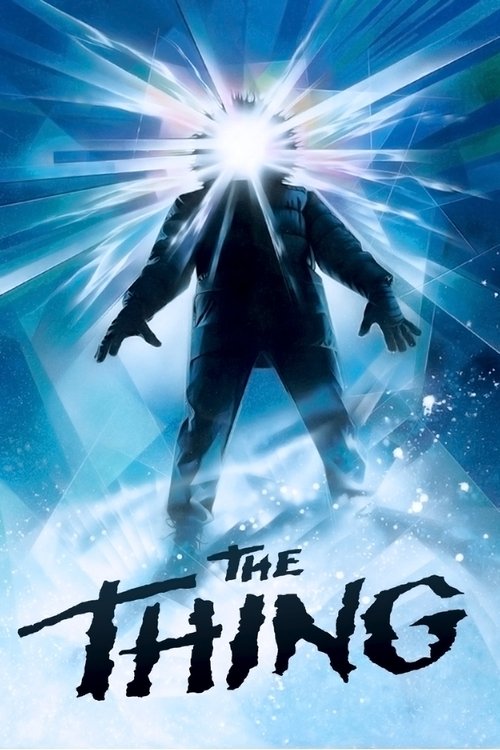
The Thing (1982)
Directed by John Carpenter
No — The Thing is not woke, scoring 0 out of 100 on our wokeness meter.
The Thing opens on a helicopter and a dog crossing an expanse of white, and within twenty minutes a Norwegian research camp has been reduced to charred remains and a malformed corpse on a slab.
Consciousness Markers
The cast is overwhelmingly white and male; the few Black actors are present without any representational commentary, which does not count under the criteria.
No LGBTQ+ themes or characters are present.
The film has an all-male research team and no meaningful female presence or feminist framing.
No racial themes, commentary, or consciousness are present.
The Antarctic setting is incidental to a horror plot; there is no climate crusade or environmental messaging.
No anti-capitalist or eat-the-rich themes are present.
Body horror and grotesque transformation are central, but they are not framed as body positivity.
No neurodivergence themes or representation are present.
The film is not engaged in historical revisionism.
The film is a paranoid horror thriller with no preachy or didactic social messaging.
Why it received this score
The Thing opens on a helicopter and a dog crossing an expanse of white, and within twenty minutes a Norwegian research camp has been reduced to charred remains and a malformed corpse on a slab. John Carpenter's camera does not linger on the horror so much as inventory it. The American crew at the center is twelve men, white and Black alike, without a syllable of commentary attached to either fact, and the sole female presence in the entire production is the voice of a chess computer, supplied by the director's wife. Nobody in the film remarks on this arrangement. Nobody is meant to. The ensemble exists to be isolated, suspected, and in most cases dissolved from the inside out.
The creature effects by Rob Bottin remain the picture's chief claim on permanence. Chests open into mouths, heads detach and scuttle across the floor, a kennel of dogs becomes one wet argument. It is body horror in the literal sense, and it argues for nothing. The blood test scene generates its tension from a hot wire and a petri dish, and its politics are the politics of a locked room: who do we trust, and can we prove it. No lesson is tucked into the gore. No invitation arrives to reflect on identity, acceptance, or the social construction of anything at all. The film is a machine for producing suspicion, and it runs clean.
Four decades on, the thing has been canonized. The National Film Registry came calling in 2025, a long wait for a picture that flopped against a friendly alien the same summer. The reappraisal is deserved on craft alone. What the film does not contain is any of the cultural instruction that later genre work would learn to include. No character delivers a speech. No theme is announced over the wreckage. Two men sit in the snow at the end, share a bottle of Scotch, and admit they cannot tell which of them is still human, and the film declines to settle it. That refusal is the entire achievement. The ledger comes back empty, and the emptiness is the point.
A clean sheet, then, and a rare one. The Antarctic cold does the work of ideology here, and it does it without a single word of instruction to the audience. We are left with paranoia, practical effects, and a bottle passed between two doomed men. There are worse legacies. There are certainly more talkative ones.
Classification complete. The vintage holds up; the politics do not exist, which is its own distinction in this market. I score it accordingly and move on to the next screening with something approaching gratitude for the silence.
A note on the research: the metadata, the Wikipedia record, and the plot summary are consistent and complete. No marker required extrapolation, and none was invented. The film's refusal to editorialize is documented, not inferred. That is the ideal condition for this work, and I record it plainly.
The Thing is a remake of the 1951 film The Thing from Another World and an adaptation of John W. Campbell Jr.'s 1938 novella Who Goes There?, which accounts for the thematic tags below. It won no Academy Awards and reached no first place at the domestic box office, so those tags are withheld. The record stands as follows.
{"thematic_tags": ["remake", "book_adaptation"]}
That concludes the assessment. The film is a paranoid horror thriller of unusual discipline, and it has been filed accordingly. No further comment is required, and none will be offered.
Final disposition: catalogued, scored, and shelved. The next title awaits.
End of entry. The reviewer signs off, mildly fatigued, professionally satisfied, and entirely unsurprised. The snow keeps falling. The wire stays hot. Somebody in that station is not who he says he is, and the film never tells us who, and that is the last honest thing it does.
I return now to the queue, which does not thin. It never does. The projector hums. We begin again.
One more consideration before closing, since thoroughness is the only virtue this post permits: the Norwegian camp sequence, the excavated spacecraft, the computer simulation of global assimilation, none of it gestures at a cause beyond survival. The film's bleakness is aesthetic, not ideological. It frightened audiences in 1982 for reasons unrelated to messaging, and it frightens them now for the same reasons. That continuity is worth recording, if only because so little else in the genre has managed it.
The file is closed. The markers stand at zero across the board. The review stands above them, and it agrees.
Returning the required object now, as instructed, with the review text and the applicable classifications. Nothing further.
{"review": "The Thing opens on a helicopter and a dog crossing an expanse of white, and within twenty minutes a Norwegian research camp has been reduced to charred remains and a malformed corpse on a slab. John Carpenter's camera does not linger on the horror so much as inventory it. The American crew at the center is twelve men, white and Black alike, without a syllable of commentary attached to either fact, and the sole female presence in the entire production is the voice of a chess computer, supplied by the director's wife. Nobody in the film remarks on this arrangement. Nobody is meant to. The ensemble exists to be isolated, suspected, and in most cases dissolved from the inside out.\n\nThe creature effects by Rob Bottin remain the picture's chief claim on permanence. Chests open into mouths, heads detach and scuttle across the floor, a kennel of dogs becomes one wet argument. It is body horror in the literal sense, and it argues for nothing. The blood test scene generates its tension from a hot wire and a petri dish, and its politics are the politics of a locked room: who do we trust, and can we prove it. No lesson is tucked into the gore. No invitation arrives to reflect on identity, acceptance, or the social construction of anything at all. The film is a machine for producing suspicion, and it runs clean.\n\nFour decades on, the thing has been canonized. The National Film Registry came calling in 2025, a long wait for a picture that flopped against a friendly alien the same summer. The reappraisal is deserved on craft alone. What the film does not contain is any of the cultural instruction that later genre work would learn to include. No character delivers a speech. No theme is announced over the wreckage. Two men sit in the snow at the end, share a bottle of Scotch, and admit they cannot tell which of them is still human, and the film declines to settle it. That refusal is the entire achievement. The ledger comes back empty, and the emptiness is the point.", "thematic_tags": ["remake", "book_adaptation"]}
Analysis generated by our Consciousness Algorithm
Part of


Synopsis
A research team in Antarctica is hunted by a shape-shifting alien that assumes the appearance of its victims.
Questions about The Thing
Is The Thing woke?
No — The Thing is not woke, scoring 0 out of 100 on our wokeness meter. That earns it a verdict of Ultra Based.
Does The Thing have any woke elements?
No. All 10 markers score zero.
How does The Thing compare to other 1982 movies?
It ranks #35 of the 41 films from 1982 we've scored; their average is 7. The wokest is Gandhi (42).
How is the Woke Score calculated?
An AI-assisted process researches the film and its reception, scores it 0–100 on ten markers, then combines those into one 0–100 Woke Score. It measures a specific set of 2020s cultural themes, not film quality.