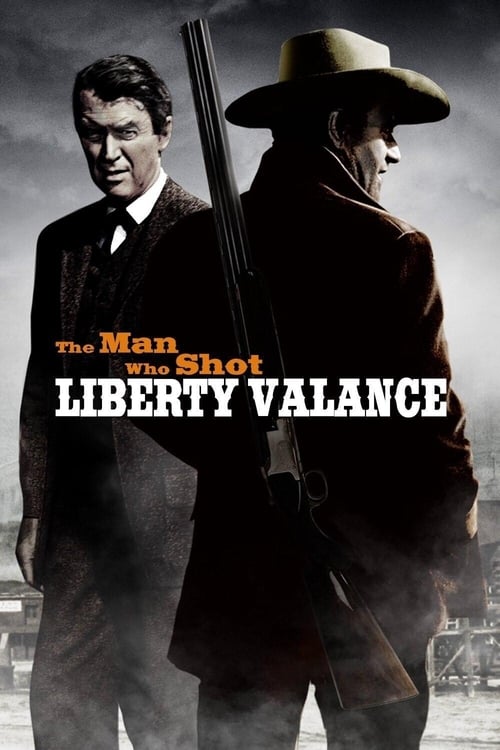
The Man Who Shot Liberty Valance (1962)
Directed by John Ford
No — The Man Who Shot Liberty Valance is not woke, scoring 8 out of 100 on our wokeness meter.
John Ford's 1962 western arrives on black-and-white soundstages, stripped of the Monument Valley vistas that once gave his frontier a romantic glow.
Consciousness Markers
The film deconstructs the heroic legend of the West, revealing that Doniphon, not Stoddard, killed Valance, and that 'when the legend becomes fact, print the legend.' This is myth-debunking rather than modern progressive historical revisionism.
The film carries a reflective thesis about legend versus truth and the compromises of political heroism, but it dramatizes rather than preaches these ideas.
The cast is overwhelmingly white; Woody Strode appears as Pompey, Doniphon's Black handyman, a subservient role presented without any commentary or agency. This is natural period presence, not representation casting.
The cattle barons who hire Valance to block statehood are villains of entrenched power, giving a faint populist anti-oligarch undertone, but the film is not a critique of capitalism.
Hallie is largely a prize contested between two men, defined by her illiteracy and her choice between suitors. There is no feminist critique or female agency in the modern sense.
No LGBTQ+ characters, subtext, or themes of any kind.
Pompey exists as a background servant with no racial commentary, and the film engages no questions of race or racial justice.
No environmental or climate themes whatsoever.
No body positivity themes or diverse body representation.
No neurodivergent characters or themes.
Why it received this score
John Ford's 1962 western arrives on black-and-white soundstages, stripped of the Monument Valley vistas that once gave his frontier a romantic glow. It is a film about a funeral, a flashback, and the manufacture of a political hero. James Stewart's Ransom Stoddard becomes a senator on the strength of a gunfight he did not win. John Wayne's Tom Doniphon actually fired the fatal shot, then watched another man take the credit. Vera Miles's Hallie moves between them with quiet sorrow. This is a serious, autumnal work about legend and compromise. It is also, by the standards of modern social consciousness, a mostly barren landscape.
The representation ledger is thin. Woody Strode's Pompey exists as Doniphon's handyman, loyal and largely silent, with no interiority and no racial commentary. Hallie is defined by her illiteracy and by the choice she must make between two suitors; she is a prize, not a subject. The cattle barons who hire Liberty Valance stand in for entrenched oligarchy, which gives the film a faint populist hum. That hum is not a critique of capital. There is no LGBTQ material, no climate anxiety, no body positivity, no neurodivergent character, and no engagement with racial justice. The film simply does not know these categories.
Where it earns a small measure of credit is in its treatment of history and rhetoric. Ford debunks the heroic legend by revealing the truth behind the killing. That is myth-making turned inside out, not the modern revisionist project of correcting the historical record along progressive lines. The film also carries a thesis about legend versus fact and the compromises of political heroism. It dramatizes that thesis. It does not sermonize. We are left with a somber, influential western that predates the cultural inventory we now apply to it. The classification is severe. The film endures anyway.
Analysis generated by our Consciousness Algorithm
Part of


Synopsis
Questions arise when Senator Stoddard attends the funeral of a local man named Tom Doniphon in a small Western town. Flashing back, we learn Doniphon saved Stoddard, then a lawyer, when he was roughed up by a crew of outlaws terrorizing the town, led by Liberty Valance. As the territory's safety hung in the balance, Doniphon and Stoddard, two of the only people standing up to him, proved to be very important, but different, foes to Valance.
Questions about The Man Who Shot Liberty Valance
Is The Man Who Shot Liberty Valance woke?
No — The Man Who Shot Liberty Valance is not woke, scoring 8 out of 100 on our wokeness meter. That earns it a verdict of Ultra Based.
Does The Man Who Shot Liberty Valance have any woke elements?
Very few. None of the 10 markers reaches 30, the level where a marker counts as present; the highest is Lecture Energy at 15.
How does The Man Who Shot Liberty Valance compare to other 1962 movies?
It ranks #8 of the 23 films from 1962 we've scored; their average is 9. The wokest is The Exterminating Angel (47).
How is the Woke Score calculated?
An AI-assisted process researches the film and its reception, scores it 0–100 on ten markers, then combines those into one 0–100 Woke Score. It measures a specific set of 2020s cultural themes, not film quality.