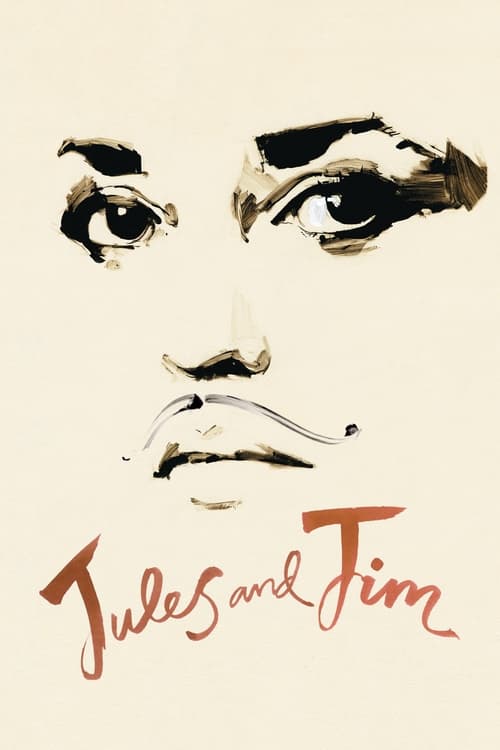
Jules and Jim (1962)
Directed by François Truffaut
No — Jules and Jim is not woke, scoring 12 out of 100 on our wokeness meter.
François Truffaut's Jules and Jim arrives from 1962, six decades before the cultural machinery that now governs our viewing habits had assembled itself.
Consciousness Markers
Catherine is an unusually autonomous, capricious, sexually liberated woman for 1962, and she drives the narrative, but the film offers no modern feminist thesis or critique of patriarchy.
A lyrical romantic drama whose narration is storytelling rather than moral instruction; it carries no agenda-driven sermonizing.
The cast is entirely white European, reflecting the bohemian Parisian milieu of 1912 with no attention to diverse representation.
The love triangle and 'polyamory' keyword describe a heterosexual arrangement; there are no LGBTQ+ characters or themes.
No engagement with race or racial politics; the story is confined to white European bohemians.
No environmental or climate content whatsoever.
The bohemian rejection of bourgeois convention is a lifestyle posture, not an economic critique of capitalism.
No body-positivity themes present.
No neurodivergence themes or characters.
The film is set around WWI but makes no revisionist historical claims or re-readings of events.
Why it received this score
François Truffaut's Jules and Jim arrives from 1962, six decades before the cultural machinery that now governs our viewing habits had assembled itself. The film concerns a love triangle among three white European bohemians: Jules, a shy Austrian writer, Jim, his gregarious French friend, and Catherine, who drifts between them wearing the serene smile of a marble goddess. They holiday on the Adriatic. They endure the Great War on opposing sides. They reunite in a chalet in the Black Forest. It is beautiful, restless, and almost entirely devoid of the markers we are tasked with cataloguing.
Catherine is the closest thing to a live wire in the picture. She is capricious, sexually unbound, and she drives the narrative with an autonomy that would have startled audiences in 1962. The film proposes no thesis about this. She is a force of nature, not a case study, and the movie never pauses to explain her. The bohemian disdain for bourgeois convention is a posture, a way of wearing a scarf, and it never hardens into an economic argument. When the men march off to war on opposite sides, they fret about killing each other. That is a humanist worry, not a political program.
The narration tells us things. It does not instruct us. There is no sermon here, no moment where the film turns to the audience and explains how we ought to live. Race, climate, disability, the body as a site of affirmation: none of it appears, and the absence is not a failure of nerve. It is simply what the story is. We are left with a doomed romance, a very good one, and a classification sheet that stays mostly quiet. A sommelier would call this a clean vintage, unremarkable in the ways our ledger cares about. The film endures on its own terms. Our terms are not its terms.
Analysis generated by our Consciousness Algorithm


Synopsis
In the carefree days before World War I, introverted Austrian author Jules strikes up a friendship with the exuberant Frenchman Jim and both men fall for the impulsive and beautiful Catherine.
Questions about Jules and Jim
Is Jules and Jim woke?
No — Jules and Jim is not woke, scoring 12 out of 100 on our wokeness meter. That earns it a verdict of Ultra Based.
Does Jules and Jim have any woke elements?
Very few. None of the 10 markers reaches 30, the level where a marker counts as present; the highest is Feminist Agenda at 20.
How does Jules and Jim compare to other 1962 movies?
It ranks #6 of the 23 films from 1962 we've scored; their average is 9. The wokest is The Exterminating Angel (47).
How is the Woke Score calculated?
An AI-assisted process researches the film and its reception, scores it 0–100 on ten markers, then combines those into one 0–100 Woke Score. It measures a specific set of 2020s cultural themes, not film quality.