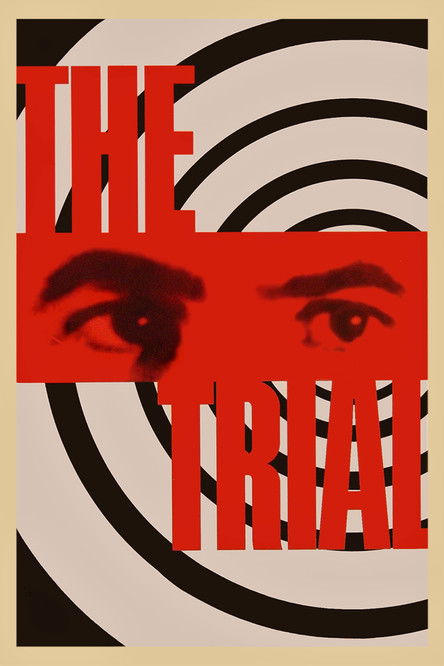
The Trial (1962)
Directed by Orson Welles
No — The Trial is not woke, scoring 18 out of 100 on our wokeness meter.
Orson Welles made The Trial in 1962 with total artistic control and a budget assembled from three national film industries, and the result remains one of the more disciplined exercises in cinematic unease available to us.
Consciousness Markers
Welles deliberately exploited Anthony Perkins' closeted homosexuality to imbue Josef K. with a subtext of repression and 'fear of exposure,' an intentional coded layer for its time.
The film indicts an oppressive, labyrinthine bureaucracy and judicial machinery, a critique of authoritarian power structures rather than of capital or wealth accumulation specifically.
Welles preserves Kafka's essential ambiguity rather than delivering didactic messaging; the parable 'Before the Law' carries thematic weight but the film resists sermonizing.
The cast is an all-white European ensemble (Perkins, Schneider, Moreau, Welles), with no meaningful attempt at inclusive or cross-racial casting. Representation was neither a goal nor a feature of this production.
Women appear as seductresses, mistresses, and objects of Josef's disinterested encounters; the film offers no feminist critique or agency agenda.
The film engages no racial themes whatsoever; its characters inhabit an abstract, raceless bureaucratic nightmare of Kafka's Central Europe.
The closing mushroom cloud evokes nuclear menace and Cold War dread, but there is no ecological or climate-conscious content in the film.
No body-positive themes or diverse physical representation are present; the subject never arises.
No neurodivergent characters or themes are depicted or implied.
The film adapts a fictional Kafka novel and makes no revisionist claims about historical events.
Why it received this score
Orson Welles made The Trial in 1962 with total artistic control and a budget assembled from three national film industries, and the result remains one of the more disciplined exercises in cinematic unease available to us. A bureaucrat named Josef K. is arrested for a crime no one will name, and the machinery of judgment grinds him down across a hundred borrowed sets. The film has no interest in instructing its audience about contemporary social arrangements. Its target is authority itself, an abstract and administrative power that predates any modern political flashpoint.
The cast is European, white, and assembled from the art houses of four countries. No effort was made toward inclusive hiring, and none was contemplated. The women in Josef's orbit (Moreau, Schneider, Martinelli) exist to pursue him, and the film grants them no interiority beyond that pursuit. Welles was explicit in later accounts that he cast Anthony Perkins partly to exploit the actor's closeted homosexuality, building a texture of repression and fear of exposure into a man who cannot respond to anyone. This coding was intentional and, for 1962, quietly bold. It is also a single thread in a fabric otherwise untouched by identity politics.
The bureaucratic nightmare reads as an indictment of authoritarian power, of fascism, of the judicial apparatus, not of wealth or markets. Ambiguity is preserved where a lesser filmmaker would have sermonized. The closing dynamite blast and its mushroom cloud summon nuclear dread without a word about the environment. The film trusts the audience to reach its own conclusions, a courtesy modern cinema rarely extends. A restrained artifact, then. It asks nothing of us but attention, and gives back unease.
Analysis generated by our Consciousness Algorithm


Synopsis
Arrested for an unnamed crime, Josef K. is trapped in a surreal bureaucratic maze where justice is unknowable and guilt is assumed.
Questions about The Trial
Is The Trial woke?
No — The Trial is not woke, scoring 18 out of 100 on our wokeness meter. That earns it a verdict of Ultra Based.
Does The Trial have any woke elements?
1 of the 10 markers register at 30 or above, led by LGBTQ+ Themes (35). On LGBTQ+ Themes: Welles deliberately exploited Anthony Perkins' closeted homosexuality to imbue Josef K.
How does The Trial compare to other 1962 movies?
It ranks #3 of the 23 films from 1962 we've scored; their average is 9. The wokest is The Exterminating Angel (47).
How is the Woke Score calculated?
An AI-assisted process researches the film and its reception, scores it 0–100 on ten markers, then combines those into one 0–100 Woke Score. It measures a specific set of 2020s cultural themes, not film quality.