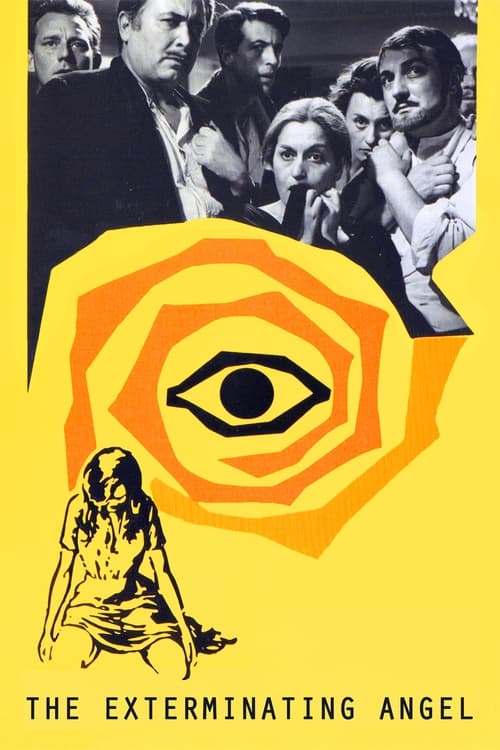
The Exterminating Angel (1962)
Directed by Luis Buñuel
Partly — The Exterminating Angel is somewhat woke, scoring 47 out of 100 on our wokeness meter.
Luis Buñuel's The Exterminating Angel (1962) deposits nineteen wealthy Mexicans in a salon after a dinner party and declines to let them out.
Consciousness Markers
Buñuel's central target is the parasitic upper class, whose elaborate pretenses collapse into savagery; Ebert read the guests as the ruling class trapped in their own bourgeois cul-de-sac. This is a genuine, sustained class satire, though rooted in mid-century anarchist/surrealist critique rather than modern 'eat the rich' discourse.
The film is sharply satirical and allegorical, but Buñuel deliberately refused to explain its meaning, leaving interpretation to the viewer; the critique is absurdist and implicit rather than preachy or didactic.
A 1962 Mexican production with a naturally Latin American cast; the ethnic composition reflects the film's setting and industry rather than any modern representational agenda.
No LGBTQ+ characters, themes, or subtext are present in the narrative.
Female characters exist (Lucía, Leticia, Blanca) but the film offers no feminist critique or gendered power analysis; the satire is aimed at class, not patriarchy.
The film's target is the bourgeoisie as a class, not race; there is no racial consciousness or commentary.
No environmental or climate themes appear in the film.
No body positivity themes or body-diverse messaging are present.
No neurodivergence themes or characters are present.
The film is a surrealist allegory, not a historical revision; it makes no claims about rewriting recorded events.
Why it received this score
Luis Buñuel's The Exterminating Angel (1962) deposits nineteen wealthy Mexicans in a salon after a dinner party and declines to let them out. The camera does not explain the mechanism, and neither does the director. Instead we get a slow, exquisitely rude unmooring of polite society: a closet repurposed as a toilet, a bear and three sheep wandering the halls, a corpse stored among the coats. The cast is Latin American because the film is Mexican and was made in 1962, not because anyone was counting heads. There is no LGBTQ material, no gendered power analysis, and no racial commentary anywhere in the frame. The women bicker and scheme like everyone else, which is the point of the satire and not a failure of it.
The target is class, and the aim is steady. Ebert read the guests as the ruling class of Franco's Spain, seated at a banquet they won by beating the workers and discovering the meal never ends. That reading holds. The servants slip away early, one by one, with no explanation and no apology. The aristocrats then devour their own pretensions, then the sheep. This is a real and sustained assault on the bourgeoisie, though its pedigree is anarchist surrealism from the middle of the last century, not the contemporary language of eat-the-rich branding. Buñuel was doing this before it was a genre, and doing it with better manners about the manners.
The sermonizing is minimal, which is its own small mercy. Buñuel refused to explain the film, and the refusal is the film's ethic: the allegory sits there, absurd and unresolved, and the audience does the work. Nothing here lectures. There is also no climate anxiety, no body-diverse messaging, no neurodivergent framing, and no attempt to revise the historical record. It is a comedy about people who cannot leave a room, and it trusts that this is enough. It is.
Analysis generated by our Consciousness Algorithm


Synopsis
After a lavish dinner party, the guests find themselves unable to depart... and, over the next few days, all of their elaborate societal pretenses and façades deteriorate as they are reduced to living like animals.
Questions about The Exterminating Angel
Is The Exterminating Angel woke?
Partly — The Exterminating Angel is somewhat woke, scoring 47 out of 100 on our wokeness meter. That earns it a verdict of Woke-Adjacent.
What makes The Exterminating Angel woke?
1 of the 10 markers register at 30 or above, led by Eat the Rich (65). On Eat the Rich: Buñuel's central target is the parasitic upper class, whose elaborate pretenses collapse into savagery; Ebert read the guests as the ruling class trapped in their own bourgeois cul-de-sac.
How does The Exterminating Angel compare to other 1962 movies?
It is the wokest of the 23 films from 1962 we've scored; their average is 9.
How is the Woke Score calculated?
An AI-assisted process researches the film and its reception, scores it 0–100 on ten markers, then combines those into one 0–100 Woke Score. It measures a specific set of 2020s cultural themes, not film quality.