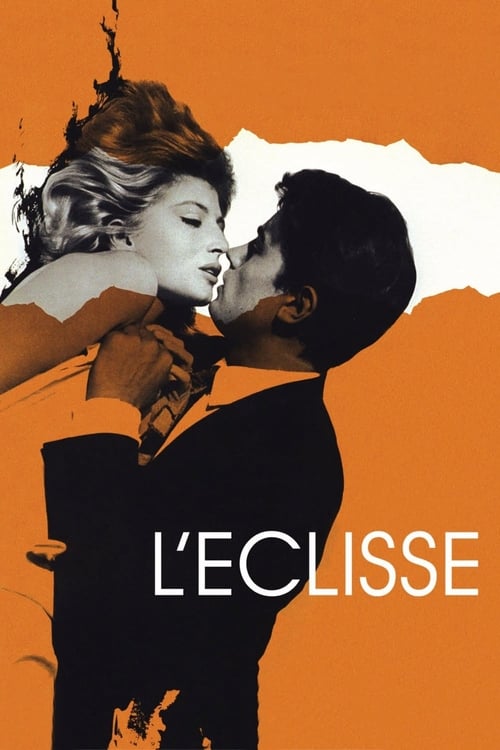
L'Eclisse (1962)
Directed by Michelangelo Antonioni
No — L'Eclisse is not woke, scoring 12 out of 100 on our wokeness meter.
Michelangelo Antonioni's L'Eclisse arrives from 1962, which is to say from a time before the cinema discovered its conscience.
Consciousness Markers
The Rome Stock Exchange and the frantic, dehumanizing trading floor serve as a sustained symbol of modern alienation and the emptiness of the market, though the critique is existential rather than explicitly political.
Vittoria is a self-possessed woman who refuses marriage and conventional commitment, but this is existential character study rather than a feminist agenda.
A brief satirical scene has Vittoria don blackface to mock a white colonialist neighbor's racism toward Kenyans, but this is a passing provocation, not a sustained racial consciousness.
Antonioni's famously open, ambiguous form is the opposite of didactic; the film offers no moralizing or preachy messaging.
The cast is entirely white European (Italian and French actors); no meaningful representation casting is present.
No LGBTQ+ characters or themes appear anywhere in the film.
No environmental or climate themes are present.
No body positivity themes are present.
No neurodivergence themes are present.
No historical revisionism is present.
Why it received this score
Michelangelo Antonioni's L'Eclisse arrives from 1962, which is to say from a time before the cinema discovered its conscience. Vittoria, a literary translator played by Monica Vitti, ends one relationship and drifts into another with Piero, a stockbroker played by Alain Delon, and the film declines to instruct us on what any of it means. That refusal is its defining quality. There is no sermon here, no lesson tucked into the final reel, and for that reason the film registers barely a tremor on the scale of contemporary moral instruction.
Where the film does engage the world, it does so obliquely. The Rome Stock Exchange, with its shouting men and cascading numbers, is rendered as a machine for producing emptiness, and the critique lands on the market as a spiritual condition instead of a political program. Vittoria herself resists marriage and the tidy arrangements that accompany it, though her refusal reads as temperament rather than thesis. A single scene finds her donning blackface to mock a white Kenyan colonist's contempt for Africans; it is a sharp provocation, delivered once, then abandoned.
The rest of the ledger is bare. The cast is uniformly white and European. No queer lives, no climate anxieties, no body politics, no neurodivergent interiority, no reworking of the historical record. Antonioni's open form, all those long walks and empty streets and that famous final sequence of absences, offers nothing so vulgar as a message. Scorsese called it a poem. Poems do not hand out homework.
What remains is a beautiful, patient film about people who cannot reach each other, which is not the same thing as a film with something to say. The eclipse comes, the lovers fail to appear, and the camera simply keeps looking at the places they used to stand.
Analysis generated by our Consciousness Algorithm


Synopsis
Vittoria is a beautiful literary translator living in Rome. After splitting from her writer boyfriend, Riccardo, Vittoria meets Piero, a lively stockbroker, on the hectic floor of the Roman stock exchange. Though Vittoria and Piero begin a relationship, it is not one without difficulties, and their commitment to one another is tested during an eclipse.
Questions about L'Eclisse
Is L'Eclisse woke?
No — L'Eclisse is not woke, scoring 12 out of 100 on our wokeness meter. That earns it a verdict of Ultra Based.
Does L'Eclisse have any woke elements?
1 of the 10 markers register at 30 or above, led by Eat the Rich (35). On Eat the Rich: The Rome Stock Exchange and the frantic, dehumanizing trading floor serve as a sustained symbol of modern alienation and the emptiness of the market, though the critique is existential rather than explicitly political.
How does L'Eclisse compare to other 1962 movies?
It ranks #6 of the 23 films from 1962 we've scored; their average is 9. The wokest is The Exterminating Angel (47).
How is the Woke Score calculated?
An AI-assisted process researches the film and its reception, scores it 0–100 on ten markers, then combines those into one 0–100 Woke Score. It measures a specific set of 2020s cultural themes, not film quality.