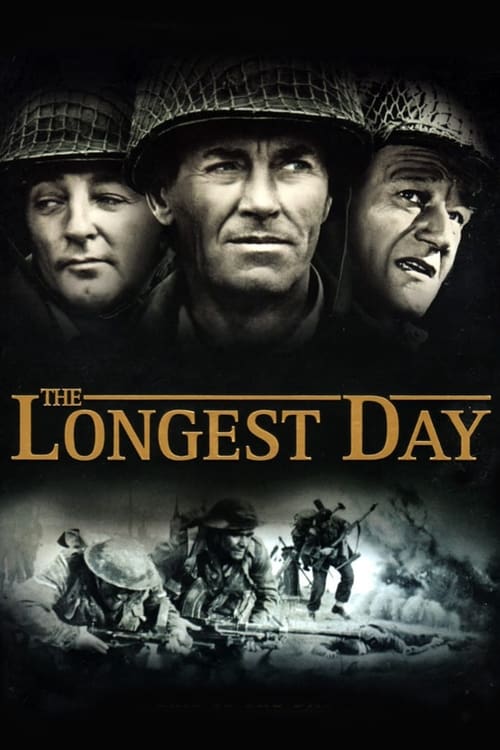
The Longest Day (1962)
Directed by Ken Annakin
No — The Longest Day is not woke, scoring 5 out of 100 on our wokeness meter.
Ken Annakin, Andrew Marton, and Bernhard Wicki assembled a war picture in 1962 that behaves less like a drama and more like a very expensive annotated timeline.
Consciousness Markers
The international ensemble reflects the actual multinational composition of the D-Day forces, not a modern diversity-casting initiative; nationalities exist as historical fact rather than as a representational statement.
The docudrama captions and narration convey factual information rather than social-justice moralizing; there is no modern lecture energy.
No LGBTQ+ characters, themes, or subtext of any kind appear in this 1962 war epic.
Women are essentially absent from the narrative save for a consultant credit; there is no feminist framing or female agency on display.
The film treats the war through national and military lenses with no engagement of racial consciousness or racial justice themes.
No environmental or climate themes are present in this combat docudrama.
The film is a straightforward military history with no critique of capitalism or class economics.
No body-positivity themes or messaging appear.
No neurodivergence themes or characters are present.
The film is a meticulously researched docudrama that adheres closely to the historical record, employing actual D-Day participants as consultants; it is the opposite of revisionist history.
Why it received this score
Ken Annakin, Andrew Marton, and Bernhard Wicki assembled a war picture in 1962 that behaves less like a drama and more like a very expensive annotated timeline. Captions introduce each figure. Narration supplies the facts. Actual D-Day participants served as consultants, and several cast members had themselves seen combat, which lends the whole enterprise the texture of a reunion rather than a performance. The result is a film that respects the record and asks nothing of the audience beyond attention.
The multinational ensemble is the detail that will draw modern eyes. Americans, Britons, Canadians, Free French, and Germans all appear, and the composition reflects the actual order of battle instead of a casting brief. That distinction matters. Nationality here is a fact of June 1944, not a statement about the present. Women are absent almost entirely, save for a consultant credit belonging to Rommel's widow. No romantic subplot intrudes. No character pauses to explain the moral architecture of the war to the audience, because the filmmakers assumed we already understood it.
Which leaves us with a curious specimen: a film that is historically rigorous, emotionally restrained, and almost entirely free of the cultural freight that contemporary audiences have learned to expect. Its only lectures concern tidal schedules and troop movements. The picture wants to show us what happened on the longest day, and then it stops. There is something almost restful about that. A modern viewer may find the absence of messaging strange, or even suspicious, but the explanation is simpler. In 1962, nobody expected a war epic to do anything else.
Analysis generated by our Consciousness Algorithm


Synopsis
The retelling of June 6, 1944, from the perspectives of the Germans, US, British, Canadians, and the Free French. Marshall Erwin Rommel, touring the defenses being established as part of the Reich's Atlantic Wall, notes to his officers that when the Allied invasion comes they must be stopped on the beach. "For the Allies as well as the Germans, it will be the longest day"
Questions about The Longest Day
Is The Longest Day woke?
No — The Longest Day is not woke, scoring 5 out of 100 on our wokeness meter. That earns it a verdict of Ultra Based.
Does The Longest Day have any woke elements?
Very few. None of the 10 markers reaches 30, the level where a marker counts as present; the highest is Representation Casting at 12.
How does The Longest Day compare to other 1962 movies?
It ranks #14 of the 23 films from 1962 we've scored; their average is 9. The wokest is The Exterminating Angel (47).
How is the Woke Score calculated?
An AI-assisted process researches the film and its reception, scores it 0–100 on ten markers, then combines those into one 0–100 Woke Score. It measures a specific set of 2020s cultural themes, not film quality.