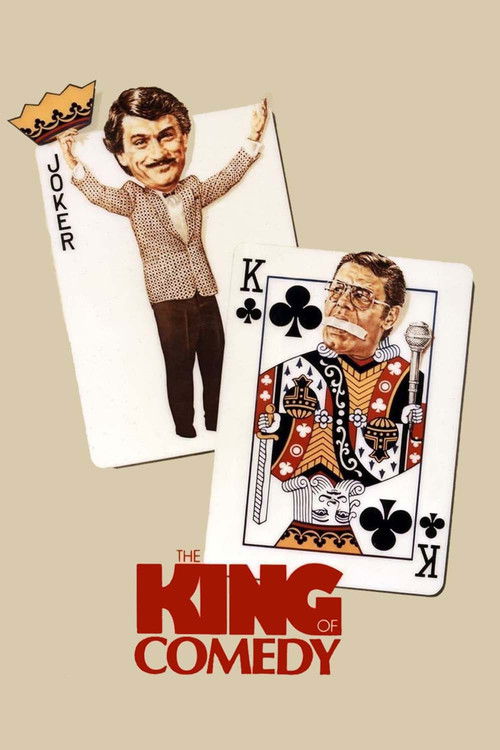
The King of Comedy (1982)
Directed by Martin Scorsese
No — The King of Comedy is not woke, scoring 9 out of 100 on our wokeness meter.
Martin Scorsese's 1982 study of celebrity hunger arrives with a low cultural temperature and a chill that has sharpened with age.
Consciousness Markers
Rupert Pupkin and Masha are depicted as delusional and mentally unstable, but the film frames this as pathology and danger rather than the affirming neurodivergence advocacy the marker denotes.
The cast is overwhelmingly white, with Diahnne Abbott as Rita and Kim Chan as Jonno appearing naturally in the story without any commentary on their presence. No deliberate representation agenda is evident.
The film critiques celebrity worship and media spectacle rather than capitalism or wealth inequality; there is no 'eat the rich' economic argument, only a portrait of fame obsession.
Scorsese's satire is observational and unsettling rather than preachy; it dramatizes obsession and media illusion without directly lecturing the audience on social lessons.
Sandra Bernhard's Masha and Diahnne Abbott's Rita are notable female presences, but the film offers no feminist critique or gender-conscious framing; the women are largely defined by their obsession with a male star.
Race is entirely absent as a subject; the film's satire of celebrity culture operates in a racially unmarked white milieu.
There are no LGBTQ+ characters, themes, or subtext anywhere in the film.
No environmental or climate themes appear in the film.
No body-positivity themes or messaging are present.
The film is a fictional satire with no historical revisionism or reclamation of historical narratives.
Why it received this score
Martin Scorsese's 1982 study of celebrity hunger arrives with a low cultural temperature and a chill that has sharpened with age. The milieu is white and unremarked upon. Diahnne Abbott and Kim Chan appear as ordinary figures in Rupert Pupkin's orbit, a bartender and a house servant, and the film passes no comment on their presence. Sandra Bernhard's Masha and Abbott's Rita carry real weight, yet both are defined by their fixation on a male star. Any gender critique here is incidental, and the film never reaches for one. The result is a portrait of obsession in which the women are as unwell as the men and nobody is invited to draw a lesson from it.
The film's animating complaint is not economic. It offers no argument about wealth or class, and its antagonist is not money but the mirage of fame itself. Rupert's ransom demand is a booking, not a redistribution. Where the film touches mental instability, it treats the condition as pathology and menace, a warning about delusion instead of an affirmation of cognitive difference. Race never surfaces as a subject either. The satire unfolds in a world where identity is simply not up for discussion, and the film seems content to leave it that way.
What remains is a cold and prescient piece of observation. Scorsese dramatizes obsession and media illusion without stopping to instruct the audience, and the absence of uplift is the entire point. There is no environmental sermon, no body-positive messaging, no reclamation of history, no lecture on the sins of capital. The film watches a man talk his way into the spotlight and lets the applause curdle. Four decades on, it reads as prophecy. Prophecy, done well, has never required a lecture.
Analysis generated by our Consciousness Algorithm


Synopsis
Aspiring comic Rupert Pupkin attempts to achieve success in show business by stalking his idol, a late night talk-show host who craves his own privacy.
Questions about The King of Comedy
Is The King of Comedy woke?
No — The King of Comedy is not woke, scoring 9 out of 100 on our wokeness meter. That earns it a verdict of Ultra Based.
Does The King of Comedy have any woke elements?
Very few. None of the 10 markers reaches 30, the level where a marker counts as present; the highest is Neurodivergence at 15.
How does The King of Comedy compare to other 1982 movies?
It ranks #9 of the 41 films from 1982 we've scored; their average is 7. The wokest is Gandhi (42).
How is the Woke Score calculated?
An AI-assisted process researches the film and its reception, scores it 0–100 on ten markers, then combines those into one 0–100 Woke Score. It measures a specific set of 2020s cultural themes, not film quality.