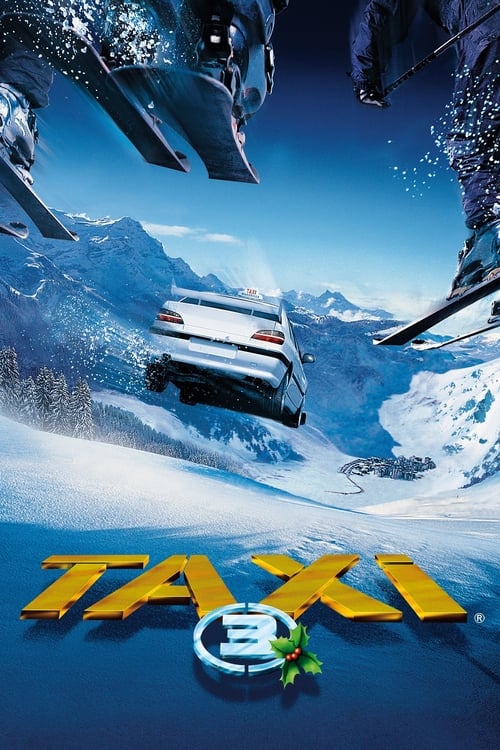
Taxi 3 (2003)
Directed by Gérard Krawczyk
No — Taxi 3 is not woke, scoring 12 out of 100 on our wokeness meter.
Taxi 3 arrived in 2003 as the third entry in a franchise that had already settled into its formula: a Marseille taxi driver, a hapless police captain, and a Peugeot capable of feats that defy physics, traffic law, and municipal paperwork.
Consciousness Markers
The cast features actors of North African and Chinese descent playing leads and a journalist, but their presence is unremarked-upon and functional to the plot rather than presented as a representational statement.
Emma Wiklund and Marion Cotillard appear, and there is a relationship-crisis subplot, but the film offers no feminist framing or commentary whatsoever.
No LGBTQ+ characters, themes, or subtext appear anywhere in this car-chase comedy.
The film plays its diverse Marseille setting as an ordinary backdrop with no racial consciousness or commentary.
Fast cars and stolen loot; the climate is never mentioned or thematized.
This is a blue-collar wish-fulfillment caper about outsmarting cops, not a critique of capitalism or wealth.
No body-positivity themes or messaging of any kind.
No neurodivergent characters or themes present.
A contemporary heist comedy with no interest in rewriting or recontextualizing history.
The film is content to be a slapstick Bond-spoof actioner; it lectures nobody about anything.
Why it received this score
Taxi 3 arrived in 2003 as the third entry in a franchise that had already settled into its formula: a Marseille taxi driver, a hapless police captain, and a Peugeot capable of feats that defy physics, traffic law, and municipal paperwork. The film escalates with a certain professional cheer. Caterpillar tracks appear. The opening titles borrow the James Bond template, the ski chase borrows more of it, and the whole contraption is built for velocity and very little else. It asks nothing of us but a laugh and a shrug. It receives both.
The cast is where a modern critic's instincts begin to twitch, and then settle back down. Samy Naceri, of Algerian descent, anchors the film as Daniel. Bai Ling turns up as the Chinese reporter shadowing the squad. Their presence is treated as ordinary municipal fact. Nobody remarks on it. Nobody frames it. Nobody in the screenplay appears aware that a statement has been made. Emma Wiklund and Marion Cotillard occupy the domestic subplot, where the crisis is a pregnancy and the resolution is forgiveness. It is the thinnest possible gesture toward a relationship and it carries no argument about anything. Diversity here is hiring. The film hired people and moved on.
Everything else is absent, and the absences are total. The thieves dress as Santa Claus, which is seasonal cosplay and not a critique of consumption. The taxi burns fuel at a rate that would alarm a climatologist, and no character raises the subject. The villains are caught by a fast car, not by the redistribution of wealth. There is no sermon, no lesson, no moment where someone turns to the camera and explains what we are meant to feel. The credits roll and no viewer leaves improved. That is not a failure of craft. It is a fact of classification, and classification, like this franchise, keeps moving whether we enjoy the ride or not. We classify anyway. The work is thankless and the work continues.
The only genuine gravity attached to this production sits offscreen, in a 2001 stunt accident that left a performer permanently disabled, a detail the film's breezy finale does nothing to acknowledge. The archive remembers. The movie does not. Such is the job.
{"thematic_tags": ["sequel"]}}
Analysis generated by our Consciousness Algorithm
Part of
Synopsis
A gang of thieves calling themselves the Santa Claus Gang are wreaking havoc, and the police can't keep up. Police Captain Gilbert is distracted by a Chinese reporter writing a story on his squad, and taxi driver Daniel is in the midst of a relationship crisis. After a string of mistakes in which the thieves outsmart the police time and time again, Daniel and his super-taxi pitch in.
Questions about Taxi 3
Is Taxi 3 woke?
No — Taxi 3 is not woke, scoring 12 out of 100 on our wokeness meter. That earns it a verdict of Ultra Based.
Does Taxi 3 have any woke elements?
Very few. None of the 10 markers reaches 30, the level where a marker counts as present; the highest is Representation Casting at 25.
How does Taxi 3 compare to other 2003 movies?
It ranks #51 of the 150 films from 2003 we've scored; their average is 12. The wokest is Mona Lisa Smile (60).
Is Taxi 3 the most woke Taxi movie?
Yes. It scores highest of the 5 Taxi films we've scored.