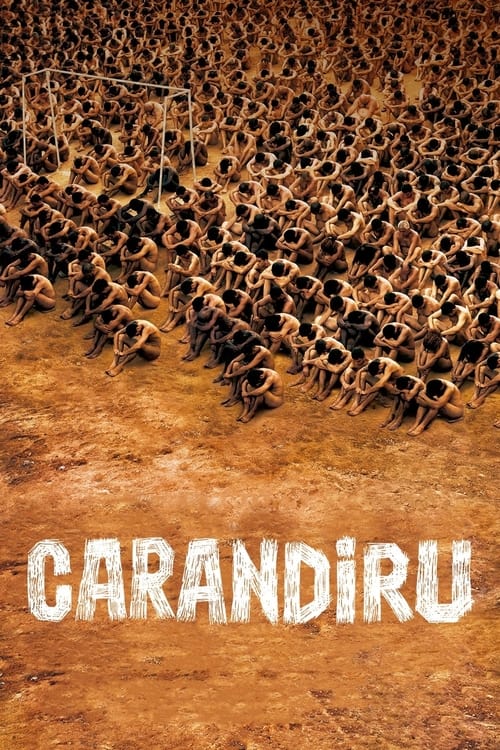
Carandiru (2003)
Directed by Héctor Babenco
No — Carandiru is not especially woke, scoring 33 out of 100 on our wokeness meter.
Héctor Babenco's Carandiru arrives with the sober bearing of a film that knows it is bearing witness.
Consciousness Markers
The character Lady Di, a trans woman, is given a genuine storyline and marriage to another inmate, treated with humanity rather than as a punchline. This is a real, if secondary, LGBTQ+ presence.
The film features a large, predominantly Afro-Brazilian and mixed-race cast, many of them novice actors and former inmates, authentically reflecting the prison population. This is casting for verisimilitude rather than a modern representation mandate, so it registers moderately.
The film humanizes a largely Black and mixed-race incarcerated population and indicts police brutality and a two-tier legal system, but it frames this through class and state violence rather than an explicit racial-consciousness lens.
Based on Dr. Drauzio Varella's memoir, the film offers a victim-centered counter-narrative of the 1992 Carandiru massacre, humanizing the prisoners against the official account. It is testimony-driven rather than ideologically revisionist.
The film carries a clear social message about inhuman prison conditions and police violence, but critics noted it delivers this with steely detachment rather than liberal hand-wringing, keeping the sermonizing restrained.
The film critiques the state, the prison system, and systemic abandonment of the poor, but its target is institutional violence and neglect rather than capitalism or wealth extraction specifically.
The narrative is overwhelmingly male and centered on the prison's masculine world; female characters (sisters, wives) appear only in service of the inmates' backstories. No feminist framework is advanced.
No environmental or climate themes appear anywhere in the film.
No body-positivity themes are present.
No neurodivergence themes are present.
Why it received this score
Héctor Babenco's Carandiru arrives with the sober bearing of a film that knows it is bearing witness. Based on Dr. Drauzio Varella's memoir, it filters the stories of São Paulo's Casa de Detenção through the doctor's AIDS-prevention rounds, letting a mostly Afro-Brazilian and mixed-race population of inmates narrate themselves. Babenco shot inside the actual penitentiary with a vast company of novice actors, some of them former prisoners, and the resulting texture is one of verisimilitude, not casting directive. The faces are right because the place was right.
Among the episodic strands, the marriage of Lady Di, a trans woman, to a fellow inmate receives a straightforward and uncondescending dignity, which is more than most films of the era managed. Elsewhere the film indicts police brutality and a two-tier legal system, though it routes its outrage through class and state abandonment instead of an explicit racial framework. The women who appear are sisters and wives, folded into the men's backstories, so the film's gaze stays locked in the yard. There is no environmental sermon here, no body-positive subplot, no neurodivergent character. The prison is a masculine, violent, and closed world, and Babenco does not pretend otherwise.
What keeps the picture from tipping into sermonizing is its coldness. Critics at the time noted the steely detachment with which it approaches the climactic 1992 massacre, where surrendering prisoners are gunned down anyway. The film offers a victim-centered counter-narrative to the official account, but it does so as testimony, not ideology. It is a serious work about serious things, which is not the same as a fashionable one. We are left with the demolition footage, the dust, and the quiet sense that the point was made without shouting.
Analysis generated by our Consciousness Algorithm


Synopsis
When a doctor decides to carry out an AIDS prevention program inside Latin America’s largest prison: the Casa de Detenção de São Paulo – Carandiru, he meets the future victims of one of the darkest days in Brazilian history.
Questions about Carandiru
Is Carandiru woke?
No — Carandiru is not especially woke, scoring 33 out of 100 on our wokeness meter. That earns it a verdict of Based.
Does Carandiru have any woke elements?
4 of the 10 markers register at 30 or above, led by LGBTQ+ Themes (45), Representation Casting (40) and Racial Consciousness (35). On LGBTQ+ Themes: The character Lady Di, a trans woman, is given a genuine storyline and marriage to another inmate, treated with humanity rather than as a punchline.
How does Carandiru compare to other 2003 movies?
It ranks #7 of the 150 films from 2003 we've scored; their average is 12. The wokest is Mona Lisa Smile (60).
How is the Woke Score calculated?
An AI-assisted process researches the film and its reception, scores it 0–100 on ten markers, then combines those into one 0–100 Woke Score. It measures a specific set of 2020s cultural themes, not film quality.