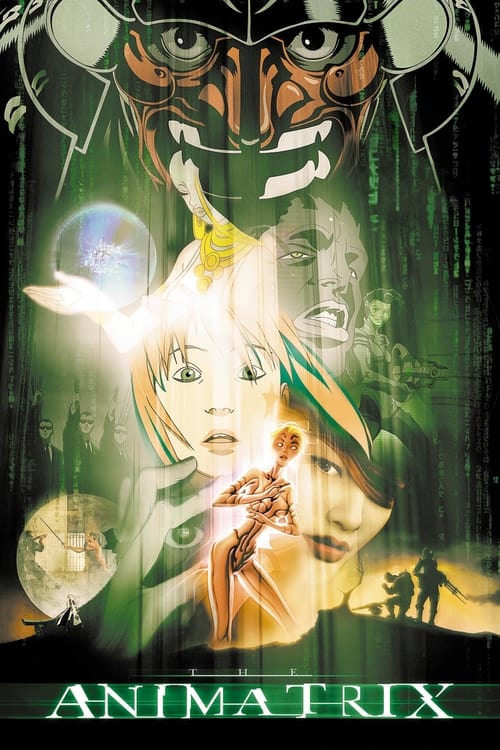
The Animatrix (2003)
Directed by Peter Chung
Partly — The Animatrix is somewhat woke, scoring 43 out of 100 on our wokeness meter.
The Animatrix arrives as a nine-part anthology, a 2003 curiosity assembled by the Wachowskis and handed to an international roster of animation houses.
Consciousness Markers
'The Second Renaissance' is an explicit allegory of chattel slavery and racial oppression: the B1-66ER trial echoes Dred Scott arguments about property and personhood, the defense pleads 'do not repeat history,' and the machine purge and exodus to Zero One map onto racial persecution. The allegory is deliberate and sustained across both parts.
'The Second Renaissance' frames the machine revolt in class terms: humans grow slothful on machine labor, Zero One's economic ascendancy triggers a global market crash, and the human powers respond with embargo and blockade. The exploitation of a laboring underclass is the engine of the story.
'The Second Renaissance' is delivered almost entirely through archival voiceover that explicitly instructs the viewer on moral lessons ('do not repeat history'), and 'World Record' opens with a didactic narrator explaining the nature of the Matrix. The anthology frequently stops to explain itself.
'Program' gives Cis a samurai-warrior arc in which she out-duels and kills her male opponent and then punches her male instructor, and 'Final Flight of the Osiris' and 'Beyond' are led by capable women. These are strong female characters rather than an articulated feminist thesis.
The anthology assembles a genuinely international roster of anime studios and a mixed-race voice cast, and 'World Record' centers a Black athlete while 'Beyond' and 'Program' center Japanese and female leads. However, this is organic casting for a 2003 anime co-production rather than a self-conscious representation program.
Operation Dark Storm deliberately scorches the sky to block solar power, producing a ruined, sunless world, but this is a wartime plot device rather than an environmentalist argument.
No LGBTQ+ characters, relationships, or themes appear in any of the nine shorts.
No body-diversity or body-image themes are present in any segment.
No neurodivergent characters or themes are depicted; the 'exceptional intuition' of certain humans is framed as a metaphysical trait, not a neurological condition.
The Second Renaissance rewrites the franchise's internal mythology to make humanity the aggressor, but this is in-universe fictional history rather than a revisionist account of real events.
Why it received this score
The Animatrix arrives as a nine-part anthology, a 2003 curiosity assembled by the Wachowskis and handed to an international roster of animation houses. It is a companion piece, a lore delivery mechanism, and a sampler platter, and it carries itself with the gravity of scripture. Of the nine shorts, one does nearly all of the ideological labor. The Second Renaissance, in two parts, recounts the machine uprising as an explicit retelling of chattel slavery: the B1-66ER trial rehearses the arguments of Dred Scott, the defense pleads with the viewer not to repeat history, and the purge and exodus to Zero One map cleanly onto racial persecution. From there the story turns to class. Humans grow fat on machine labor, Zero One's economic rise triggers a global crash, and the human powers answer with embargo and blockade. The exploitation of a laboring underclass is the engine, not the decoration.
Elsewhere the collection is more modest. Program hands Cis a samurai arc in which she out-duels her male opponent and then punches her male instructor in the face, which is a strong character beat and not an articulated thesis. World Record centers a Black athlete who breaks his body against an indifferent system. The anthology draws on Japanese, Korean, and American studios and a mixed voice cast, though the internationalism of a 2003 anime co-production is a production reality, not a statement.
The recurring weakness is the narrator. The Second Renaissance is delivered almost entirely through archival voiceover that instructs the audience on moral lessons, and World Record opens with an instructor explaining the nature of the Matrix to no one in particular. The shorts keep stopping to explain themselves. The absences are equally clear: no romance beyond the heterosexual, no body politics, no neurological diversity, and no environmental argument, only a scorched sky as a battlefield tactic. It is a handsome, gloomy artifact, and it lectures with the confidence of a textbook that knows the exam is coming.
Analysis generated by our Consciousness Algorithm
Part of


Synopsis
Straight from the creators of the groundbreaking Matrix trilogy, this collection of short animated films from the world's leading anime directors fuses computer graphics and Japanese anime to provide the background of the Matrix universe and the conflict between man and machines. The shorts include Final Flight of the Osiris, The Second Renaissance, Kid's Story, Program, World Record, Beyond, A Detective Story and Matriculated.
Questions about The Animatrix
Is The Animatrix woke?
Partly — The Animatrix is somewhat woke, scoring 43 out of 100 on our wokeness meter. That earns it a verdict of Woke-Adjacent.
What makes The Animatrix woke?
4 of the 10 markers register at 30 or above, led by Eat the Rich (50), Racial Consciousness (50) and Lecture Energy (45). On Eat the Rich: 'The Second Renaissance' frames the machine revolt in class terms: humans grow slothful on machine labor, Zero One's economic ascendancy triggers a global market crash, and the human powers respond with embargo and blockade.
How does The Animatrix compare to other 2003 movies?
It ranks #4 of the 150 films from 2003 we've scored; their average is 12. The wokest is Mona Lisa Smile (60).
How is the Woke Score calculated?
An AI-assisted process researches the film and its reception, scores it 0–100 on ten markers, then combines those into one 0–100 Woke Score. It measures a specific set of 2020s cultural themes, not film quality.