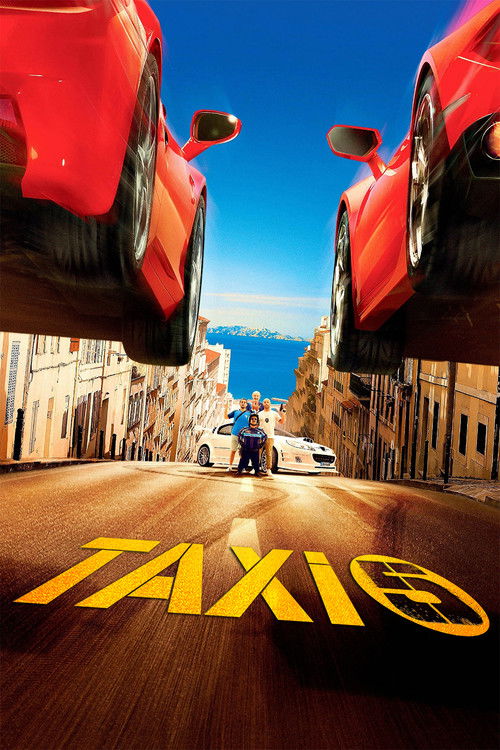
Taxi 5 (2018)
Directed by Franck Gastambide
No — Taxi 5 is not woke, scoring 7 out of 100 on our wokeness meter.
Taxi 5 arrives as the fifth installment of a French franchise that once ran on the novelty of a souped-up Peugeot and the bickering chemistry of its leads.
Consciousness Markers
The cast is led by French-Maghrebi actors (Gastambide, Bentalha, Ouazani, Toubali) reflecting Marseille's actual demographics, but this is natural ensemble casting rather than a self-conscious diversity statement.
Samia is a competent mechanic who works on the taxi and races at the end, but she functions mainly as a romantic interest in a male-driven buddy comedy with no feminist thesis.
The multiethnic Marseille setting is presented matter-of-factly with no commentary on race, discrimination, or identity politics.
A broad, lowbrow action comedy with no preachy or didactic messaging whatsoever.
No LGBTQ+ characters, themes, or subtext of any kind appear in the film.
The film is a car-chase comedy celebrating powerful Ferraris and a boosted taxi; environmental themes are entirely absent.
No critique of wealth, capitalism, or class structures; the plot revolves around jewel thieves and police procedure.
No body-positivity themes or messaging present.
No neurodivergent characters or themes; Eddie's incompetence is played for slapstick laughs, not as representation.
No historical subject matter to revise; it is a contemporary action comedy.
Why it received this score
Taxi 5 arrives as the fifth installment of a French franchise that once ran on the novelty of a souped-up Peugeot and the bickering chemistry of its leads. This one swaps out the old guard, relocates the action to Marseille's municipal police, and hands the wheel to a new ensemble led by Franck Gastambide, who also directs. The result is a broad, noisy chase comedy about Italian jewel thieves, a legendary white taxi, and a driver who cannot drive it. Critics were unkind. The box office was indifferent. None of this is surprising.
On the matter of social consciousness, the film is largely inert, and it seems content to be. The cast reflects Marseille's actual demographics, with Maghrebi-French actors filling most of the principal roles, but the film treats this as ordinary ensemble building instead of a statement. Samia, Eddie's sister, repairs the taxi and races at the finish, which grants her a measure of competence. She remains, however, a romantic target in a buddy comedy built around men shouting at each other in cars. There is no LGBTQ presence, no environmental concern in a movie that worships Ferraris, no critique of wealth, no body-positive or neurodivergent thread, and no history to revise. Eddie's ineptitude is slapstick, not representation.
The film's instructional ambitions are close to nil. It wants to sell tickets and stage car crashes, and it does so with a shrug. For a taxonomy of contemporary cultural markers, Taxi 5 is a near-empty specimen. It is not offensive. It is not enlightened. It is a sequel that simply exists, idling in neutral.
Analysis generated by our Consciousness Algorithm
Part of
Synopsis
A police officer who's transfered in the police of Marseille gets assigned to take down a group of Italian robbers who drive the powerfull Ferrari's with the older niece of Daniel, a terrible driver who gets the legendary white taxi.
Questions about Taxi 5
Is Taxi 5 woke?
No — Taxi 5 is not woke, scoring 7 out of 100 on our wokeness meter. That earns it a verdict of Ultra Based.
Does Taxi 5 have any woke elements?
Very few. None of the 10 markers reaches 30, the level where a marker counts as present; the highest is Representation Casting at 25.
How does Taxi 5 compare to other 2018 movies?
It ranks #233 of the 325 films from 2018 we've scored; their average is 20. The wokest is Return (92).
Is Taxi 5 the most woke Taxi movie?
No. It ranks #2 of the 5 Taxi films we've scored; the wokest is Taxi 3 (12).