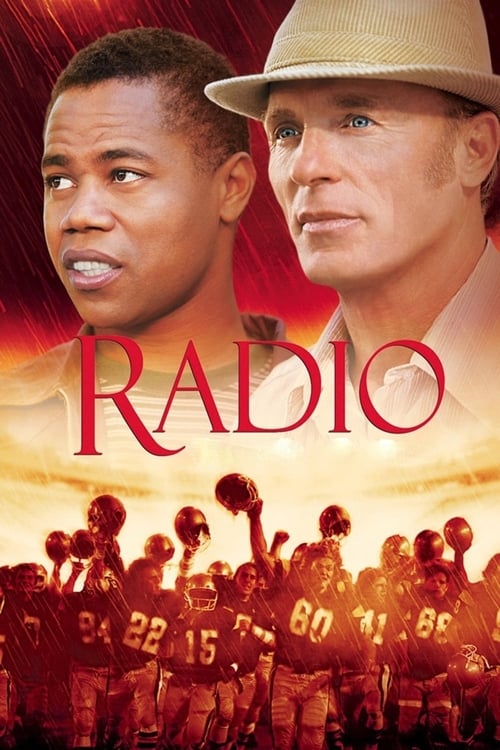
Radio (2003)
Directed by Michael Tollin
Partly — Radio is somewhat woke, scoring 48 out of 100 on our wokeness meter.
Radio arrives in 2003 carrying the full apparatus of the inspirational sports drama: a true story, a South Carolina town, a coach with a conscience, and a lead performance calibrated for awards season.
Consciousness Markers
The film centers a Black disabled lead and features a predominantly Black supporting cast, including Cuba Gooding Jr., Alfre Woodard, and S. Epatha Merkerson, in a major studio drama.
Set in a racially divided 1976 South Carolina town, the film explicitly addresses racial prejudice and the integration of a Black man into a white school and football team.
The central character has an intellectual disability, and the film explores his inclusion in school and community, though often through an inspiration narrative.
The film delivers sentimental moral lessons about kindness and acceptance, particularly in the coach's closing speech, but lacks overt political lecturing.
No LGBTQ+ characters or themes are present.
Female characters exist but the narrative does not advance a feminist agenda or critique patriarchal structures.
No environmental or climate-related themes are present.
No critique of capitalism or wealth inequality is offered.
No body positivity themes or plus-size representation are present.
Based on a true story but does not reinterpret history through a modern progressive lens.
Why it received this score
Radio arrives in 2003 carrying the full apparatus of the inspirational sports drama: a true story, a South Carolina town, a coach with a conscience, and a lead performance calibrated for awards season. Cuba Gooding Jr. plays James Robert Kennedy, a man with an intellectual disability who pushes a shopping cart through Anderson and collects shiny objects. Ed Harris plays Coach Harold Jones, who befriends him. The film was inspired by a 1996 Sports Illustrated article, the sort of provenance that lets a studio advertise sincerity without promising accuracy.
The casting deserves a note. A major studio drama built around a Black disabled lead, with Alfre Woodard, S. Epatha Merkerson, and Debra Winger in support, was not the default arrangement in 2003, and the film gives its ensemble real room. The setting, 1976, lets the screenplay address racial division head-on: a Black man is folded into a white high school and a white football team, and the town's discomfort becomes part of the plot. The treatment is earnest and almost entirely free of irony, which suits the material well enough.
The central figure's disability drives everything, and the film examines his inclusion in classrooms, on sidelines, and around the dinner tables of strangers. It handles this through uplift, the cuddly-saint mode that critics flagged at the time. The moral instruction lands in a closing speech about how Radio taught the townspeople to treat one another, a gentle sermon and nothing more. No other ideological freight is aboard. The film wants us to be kinder. It does not want to argue about anything else, and it does not.
Analysis generated by our Consciousness Algorithm


Synopsis
In the racially divided town of Anderson, South Carolina in 1976, football coach Harold Jones spots a mentally disabled African-American young man nicknamed Radio near his practice field and is inspired to befriend him. Soon, Radio is Jones' loyal assistant, and he becomes a student at T.L. Hanna High School. But things start to sour when Coach Jones begins taking guff from parents and fans who feel that his devotion to Radio is getting in the way of the team's quest for a championship.
Questions about Radio
Is Radio woke?
Partly — Radio is somewhat woke, scoring 48 out of 100 on our wokeness meter. That earns it a verdict of Woke-Adjacent.
What makes Radio woke?
4 of the 10 markers register at 30 or above, led by Representation Casting (70), Neurodivergence (60) and Racial Consciousness (60). On Representation Casting: The film centers a Black disabled lead and features a predominantly Black supporting cast, including Cuba Gooding Jr., Alfre Woodard, and S.
How does Radio compare to other 2003 movies?
It ranks #2 of the 150 films from 2003 we've scored; their average is 12. The wokest is Mona Lisa Smile (60).
How is the Woke Score calculated?
An AI-assisted process researches the film and its reception, scores it 0–100 on ten markers, then combines those into one 0–100 Woke Score. It measures a specific set of 2020s cultural themes, not film quality.