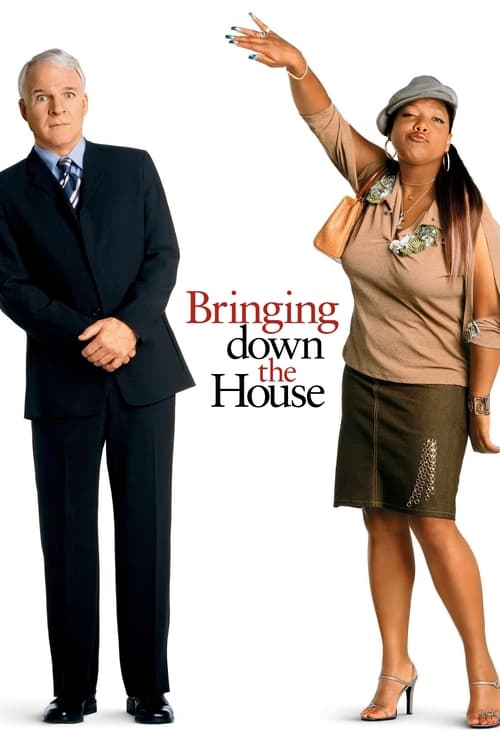
Bringing Down the House (2003)
Directed by Adam Shankman
No — Bringing Down the House is not especially woke, scoring 36 out of 100 on our wokeness meter.
Bringing Down the House arrives in 2003 as a high-concept studio comedy with a star pairing that was, for its era, a mild act of integration.
Consciousness Markers
Race is the film's central comic engine, with explicit scenes about racist remarks, a bigoted neighbor, and a wealthy client's nostalgia for degrading Black servants; however, it is filtered through broad stereotypes and outdated jokes.
Queen Latifah headlines as a Black female lead opposite Steve Martin, and the cast includes several Black supporting players, though the film predates modern DEI casting discourse and often trades in stereotypes.
Charlene is physically capable and assertive, but the plot largely uses her to repair Peter's family and romantic life, while female rivals are mocked as gold-diggers or bigots.
Charlene delivers lessons about racism, parenting, and loosening up, but they are embedded in broad comedy rather than sustained preaching.
There is mild mockery of country-club wealth and corporate law, but the film ultimately celebrates Peter's entrepreneurial success rather than attacking capital.
No LGBTQ+ characters, themes, or subtext.
No environmental or climate themes.
Queen Latifah's confident presence is not framed as a body-positivity statement, and the film makes no explicit commentary on body image.
Georgie's reading struggles are treated as a parenting/confidence issue, not as neurodivergence.
No historical revisionism; the film is a contemporary comedy.
Why it received this score
Bringing Down the House arrives in 2003 as a high-concept studio comedy with a star pairing that was, for its era, a mild act of integration. Queen Latifah headlines opposite Steve Martin, and the film surrounds her with Black supporting players. The movie knows race is its engine. It includes a bigoted neighbor, a wealthy client who fondly recalls her family's degrading treatment of Black servants, and repeated jokes about racist remarks. That gives the picture a racial consciousness, though it is filtered through broad stereotypes and punchlines that have aged poorly. The comedy wants credit for noticing prejudice while still using it as a prop.
On gender, Charlene is assertive, physically capable, and quick to violence when the plot requires. She rescues Sarah from unwanted advances and hangs a boy by his ankles. Yet the story mainly uses her to repair Peter's parenting, his confidence, and his marriage. Female rivals are mocked as gold-diggers or bigots. The feminist current is present but shallow. The film has no LGBTQ characters or themes. It has no environmental crusade. It has no body-positivity thesis, despite Latifah's confident presence. It has no neurodivergent framework; Georgie's reading struggles are a parenting problem. It has no revisionist history. It is a contemporary farce with a cell phone as a bulletproof plot device.
There is some mild mockery of country-club wealth and corporate law, but the ending celebrates Peter's new entrepreneurial firm. The anti-capitalist impulse is a faint sneer, not a program. Charlene delivers lessons about racism, parenting, and loosening up, yet the sermonizing stays inside slapstick. The film is a relic of a specific mainstream moment: eager to signal racial awareness, content to trade in stereotypes, and convinced that a Black woman's chief narrative purpose is to fix a white man's life. As cultural artifacts go, it is not dangerous. It is just tired.
Analysis generated by our Consciousness Algorithm


Synopsis
Uptight lawyer Peter Sanderson wants to dive back into dating after his divorce and has a hard time meeting the right women. He tries online dating and lucks out when he starts chatting with a fellow lawyer. The two agree to meet in the flesh, but the woman he meets — an escaped African-American convict named Charlene — is not what he expected. Peter is freaked out, but Charlene tries to convince him to take her case and prove her innocence. Along the way, she wreaks havoc on his middle-class life as he gets a lesson in learning to lighten up.
Questions about Bringing Down the House
Is Bringing Down the House woke?
No — Bringing Down the House is not especially woke, scoring 36 out of 100 on our wokeness meter. That earns it a verdict of Based.
Does Bringing Down the House have any woke elements?
4 of the 10 markers register at 30 or above, led by Racial Consciousness (60), Representation Casting (55) and Feminist Agenda (30). On Racial Consciousness: Race is the film's central comic engine, with explicit scenes about racist remarks, a bigoted neighbor, and a wealthy client's nostalgia for degrading Black servants; however, it is filtered through broad stereotypes and outdated jokes.
How does Bringing Down the House compare to other 2003 movies?
It ranks #6 of the 150 films from 2003 we've scored; their average is 12. The wokest is Mona Lisa Smile (60).
How is the Woke Score calculated?
An AI-assisted process researches the film and its reception, scores it 0–100 on ten markers, then combines those into one 0–100 Woke Score. It measures a specific set of 2020s cultural themes, not film quality.