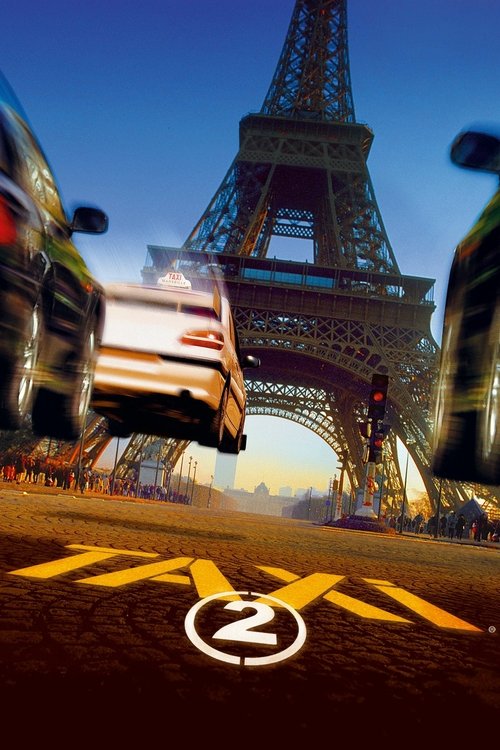
Taxi 2 (2000)
Directed by Gérard Krawczyk
No — Taxi 2 is not woke, scoring 5 out of 100 on our wokeness meter.
Taxi 2 arrives in 2000 as the second installment of the Taxi collection, a French action comedy assembled in the Luc Besson workshop and dispatched to theaters with the confidence of a franchise that knows exactly what it is selling: speed, Marseille, and a Peugeot 406 that behaves like a small aircraft.
Consciousness Markers
The cast is predominantly white French, with Japanese actors appearing naturally as the minister and yakuza antagonists because the plot requires them. No deliberate diversity casting agenda is present.
Marion Cotillard and Emma Wiklund appear, but the female detective Petra exists largely to be kidnapped and rescued. No feminist critique or empowerment framing.
A tongue-in-cheek action comedy that delivers stunts and jokes rather than moral instruction; there is no preachy messaging.
No LGBTQ+ characters, themes, or subtext of any kind.
Japanese characters appear as kidnappers and diplomats, but the film makes no commentary on race, racism, or racial identity.
No environmental or climate themes whatsoever; the film celebrates fast cars and burning fuel.
A weapons contract between Japan and France drives the plot, but it is treated as a neutral MacGuffin rather than a target of anti-capitalist critique.
No body positivity themes; the film is a conventional action comedy with no commentary on body image.
No neurodivergent characters or themes are present.
The film is a straightforward genre sequel with no historical revisionism or reframing of past events.
Why it received this score
Taxi 2 arrives in 2000 as the second installment of the Taxi collection, a French action comedy assembled in the Luc Besson workshop and dispatched to theaters with the confidence of a franchise that knows exactly what it is selling: speed, Marseille, and a Peugeot 406 that behaves like a small aircraft. The plot concerns a Japanese minister of defense, a weapons contract, a kidnapping by the yakuza, and the rescue of a detective named Petra, who spends the back half of the picture waiting to be collected. The film is a machine for stunts. It is not a machine for ideas.
The cast is overwhelmingly white and French, with Japanese performers appearing as the minister and his abductors because the screenplay requires a foreign delegation and a foreign menace. No commentary attaches to this. There is no LGBTQ presence, no meditation on race, no engagement with the politics of the arms deal that supposedly motivates everyone. Marion Cotillard and Emma Wiklund appear, and the latter's detective is taken hostage with such efficiency that the film's attitude toward women can be summarized as a plot device with a pulse. Empowerment is not on the menu.
Nor is anything else on the progressive register. The climate goes unmentioned while the cars burn fuel in tribute. The weapons contract sits in the middle of the story as a neutral MacGuffin, never a target for economic critique. Bodies are for crashing through fruit stands. Neurodivergence, historical revisionism, and moral instruction are all absent. The tone is tongue-in-cheek throughout, all jokes and horsepower, and it asks nothing of the audience except that they enjoy the ride. By the standards of the current cultural ledger it is a remarkably empty film, though the production's own history carries a weight the screenplay never attempts, a cameraman having died during a stunt that the finished picture presents as entertainment.
It is a sequel, and it knows it, and it makes no apology for being one. There is nothing here to classify beyond the horsepower and the fruit stands. The ledger stays blank, and the Peugeot flies anyway. That, at least, is honest work of a kind. Whether honesty is the point is a question the film declines to entertain, and so, with a certain professional respect, do we. The sommelier notes the vintage and moves on to the next bottle, faintly relieved that this one required no note-taking at all beyond the obvious absence of anything to note. A clean ledger, then. Rare enough in this line of work to be worth a moment of quiet appreciation before the next screening begins and the pen comes out again, poised and, as ever, disappointed. The taxi drives on. The fuel burns. The ministry endures. Somewhere a critic writes zero, ten, five, and the rest, and the sum of it is a shrug in three languages, which is more or less what the film deserves and, one suspects, all it ever wanted. The engine idles. The credits roll. The ledger closes, unblemished, and the next reel is threaded onto the projector with the same weary precision that has carried this profession through worse pictures and better ones, though mostly worse, and always, always the same shade of light on the wall, indifferent to what it illuminates, which is perhaps the only honest critic in the building. We take our seats again. There is always another film. There is always another zero to write, and we write it with the gravity it deserves, which is none, and the full ceremonial weight of the column, which is all of it, and so the evening passes as evenings do, in the dark, with the hum of the projector and the soft scratch of a pen that has stopped moving because there is, at last, nothing left to say about a French comedy where a car jumps over tanks and a man dies for the shot. The ledger is closed. The taxi is parked. The review is finished, which is more than can be said for the franchise, which has three more entries to go and our full attention, unfortunately, for all of them.
Analysis generated by our Consciousness Algorithm
Part of
Synopsis
A cabdriver and a cop race to Paris to rescue a love interest and the Japanese minister of defense from kidnappers.
Questions about Taxi 2
Is Taxi 2 woke?
No — Taxi 2 is not woke, scoring 5 out of 100 on our wokeness meter. That earns it a verdict of Ultra Based.
Does Taxi 2 have any woke elements?
Very few. None of the 10 markers reaches 30, the level where a marker counts as present; the highest is Representation Casting at 10.
How does Taxi 2 compare to other 2000 movies?
It ranks #89 of the 125 films from 2000 we've scored; their average is 13. The wokest is But I'm a Cheerleader (72).
Is Taxi 2 the most woke Taxi movie?
No. It ranks #4 of the 5 Taxi films we've scored; the wokest is Taxi 3 (12).