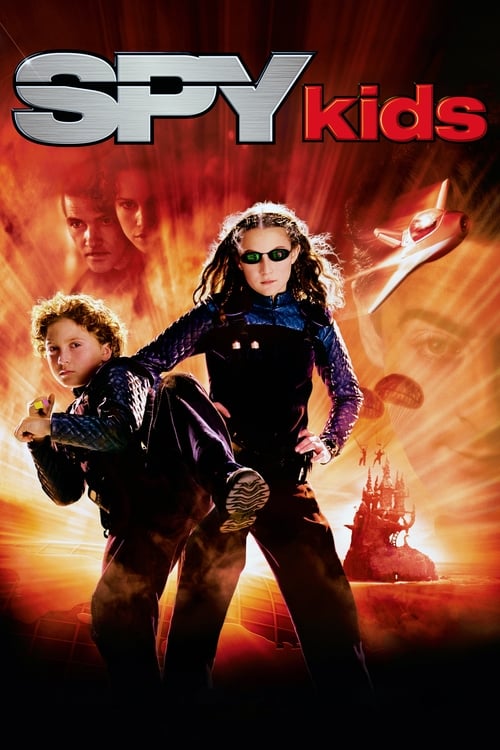
Spy Kids (2001)
Directed by Robert Rodriguez
No — Spy Kids is not woke, scoring 16 out of 100 on our wokeness meter.
The year is 2001.
Consciousness Markers
A rare 2001 studio family film headlined by a Latino family (the Cortezes), with Antonio Banderas, Carla Gugino, Alexa Vega, Daryl Sabara and Danny Trejo front and center; retrospective coverage cites this as significant for its era.
Carmen is a capable, competent older sibling who leads much of the mission alongside her brother, giving the film a modest girl-hero dynamic, though it is presented as family adventure rather than any explicit agenda.
The film carries a mild 'family working together' moral, especially in the closing 'as a family' mission, but it is delivered through action and humor rather than preaching.
The Latino family is central and celebrated, but the film never engages race as a subject or comments on racial identity or injustice; presence without commentary.
The villain Mr. Lisp is a scheming businessman seeking world control, a faintly corporate antagonist, but the film makes no economic argument and the theme is incidental.
No LGBTQ+ characters, themes, or subtext appear anywhere in the film.
No environmental themes or climate messaging of any kind.
No body-image or body-positivity themes; the Thumb-Thumbs and Minion mutation are pure creature design.
No neurodivergent characters or themes are present.
A wholly fictional spy-fantasy plot with no reworking of historical events.
Why it received this score
The year is 2001. Robert Rodriguez, a filmmaker who spent the preceding decade establishing a reputation for stylish violence, pivots to a children's spy caper headlined by a Latino family. The Cortezes are not a demographic checkbox; they are the entire premise, and the film's retrospective standing as a quiet milestone for on-screen representation rests on that simple fact. Antonio Banderas and Carla Gugino play retired agents, Alexa Vega and Daryl Sabara play the children who inherit the trade, and Danny Trejo turns up as an estranged uncle with a gadget shop. The casting registers without ever announcing itself, which is the most flattering thing a studio family film from this period can manage.
The progressive content here is mild and mostly structural. Carmen, the elder sibling, takes the lead through much of the mission and is plainly competent, a girl-hero arrangement the film treats as ordinary. Race exists as a lived fact and never as a subject; the family is Latino and the movie does not pause to explain or defend it. Mr. Lisp, the villain, is a scheming businessman, which lends the proceedings a faint anti-corporate tint that evaporates the moment the plot requires a robot fight. There is no romantic subplot of any orientation, no environmental sermon, no meditation on body image, no neurodivergent arc, and no reworking of history. This is a fantasy about thumb-shaped robots, and it stays that way.
The moral arrives through action. The closing beat, in which the children insist the whole family take the next mission together, is sentimental but earned, delivered in a line of dialogue and a group pose instead of a speech. Rodriguez keeps the sermonizing to a minimum, which is why the film has aged better than its imitators. Its selection for the National Film Registry in 2024 confirms what the retrospectives already suspected: this is a strange, unapologetically weird object, and its cultural footprint owes more to the Thumb-Thumbs than to any message. A modest artifact. The classification is straightforward.
Analysis generated by our Consciousness Algorithm
Part of


Synopsis
Carmen and Juni think their parents are boring. Little do they know that in their day, Gregorio and Ingrid Cortez were the top secret agents from their respective countries. They gave up that life to raise their children. Now, the disappearances of several of their old colleagues forces the Cortez' return from retirement. What they didn't count on was Carmen and Juni joining the "family business."
Questions about Spy Kids
Is Spy Kids woke?
No — Spy Kids is not woke, scoring 16 out of 100 on our wokeness meter. That earns it a verdict of Ultra Based.
Does Spy Kids have any woke elements?
1 of the 10 markers register at 30 or above, led by Representation Casting (52). On Representation Casting: A rare 2001 studio family film headlined by a Latino family (the Cortezes), with Antonio Banderas, Carla Gugino, Alexa Vega, Daryl Sabara and Danny Trejo front and center; retrospective coverage cites this as significant for its era.
How does Spy Kids compare to other 2001 movies?
It ranks #33 of the 148 films from 2001 we've scored; their average is 12. The wokest is Monster's Ball (60).
Is Spy Kids the most woke Spy Kids movie?
No. It ranks #2 of the 4 Spy Kids films we've scored; the wokest is Spy Kids: All the Time in the World (18).