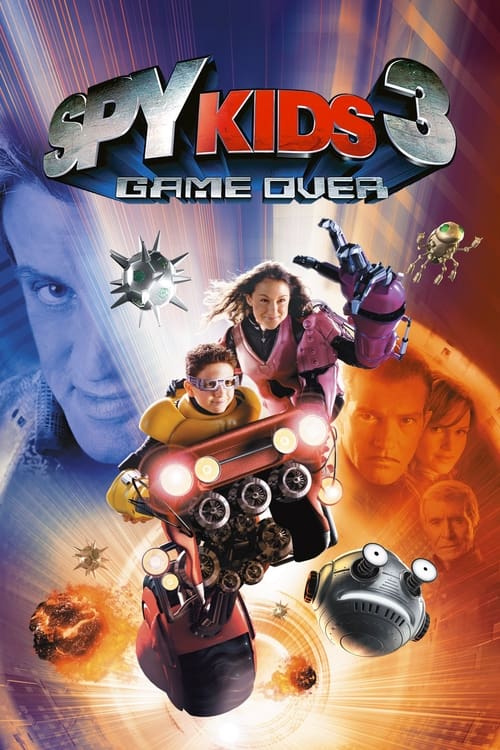
Spy Kids 3-D: Game Over (2003)
Directed by Robert Rodriguez
No — Spy Kids 3-D: Game Over is not woke, scoring 15 out of 100 on our wokeness meter.
Robert Rodriguez's third Spy Kids installment arrives as a technical curio, shot almost entirely against green screen and released at the height of the early-2000s 3D revival.
Consciousness Markers
The film features a predominantly Latino cast, including the central Cortez family, which was notable for a mainstream family film in 2003. However, the diversity is presented naturally without explicit commentary on representation.
Carmen is a capable spy, but she spends much of the film as a damsel in distress. Other female characters like Demetra and Gerti have agency, but the film does not advance a feminist agenda.
The film delivers a mild message about family and forgiveness, but it is not preachy or didactic about social issues.
No LGBTQ+ characters or themes are present.
While the cast is diverse, the film does not engage with themes of race or racial consciousness. Characters' ethnicities are not a focus of the narrative.
No environmental or climate-related themes.
The villain is a game developer seeking mind control, but the film does not critique capitalism or wealth inequality.
The grandfather uses a wheelchair and later gains a robotic suit to walk, but the film does not promote body positivity or disability acceptance.
No neurodivergent characters or themes.
No historical events are revised or reimagined.
Why it received this score
Robert Rodriguez's third Spy Kids installment arrives as a technical curio, shot almost entirely against green screen and released at the height of the early-2000s 3D revival. The plot concerns Juni Cortez, a retired child spy, who enters a virtual reality game to rescue his sister Carmen from the Toymaker, a villain bent on enslaving the world's youth. The Cortez family is Latino, and so is much of the ensemble. In 2003 this read as unremarkable in the best sense: the film never stops to announce it, never treats ethnicity as a thesis. We log this as representation by presence, not by proclamation.
The feminist ledger is thinner. Carmen is introduced as a capable agent and then spends the bulk of the runtime imprisoned on Level 4, a hostage in a game. Demetra and Gerti Giggles show flashes of competence, but the romantic beats still hinge on Juni gifting extra lives to a girl who turns out to be a program. There is a wheelchair-using grandfather, Valentin, who receives a robotic suit and walks again, which reads less as an embrace of disability than as a wish-fulfillment upgrade. No LGBTQ+ content. No racial consciousness. No climate anxiety. No critique of the game developer's wealth. The Toymaker wants mind control, not market share.
What remains is a mild homily about family and forgiveness, delivered with the softest possible hand. The film asks us to forgive the man who put grandfather in a wheelchair, and it does so without a lecture. That is the entire moral payload. As a cultural artifact it is a time capsule of 2003: a children's sequel, a box office champion, and a Razzie recipient for Sylvester Stallone. The classification is straightforward. The film's progressive content is largely inherited instead of argued, and it ends where it began, with a family reunion and a defeated robot.
Analysis generated by our Consciousness Algorithm
Part of


Synopsis
Carmen's caught in a virtual reality game designed by the Kids' new nemesis, the Toymaker. It's up to Juni to save his sister, and ultimately the world.
Questions about Spy Kids 3-D: Game Over
Is Spy Kids 3-D: Game Over woke?
No — Spy Kids 3-D: Game Over is not woke, scoring 15 out of 100 on our wokeness meter. That earns it a verdict of Ultra Based.
Does Spy Kids 3-D: Game Over have any woke elements?
1 of the 10 markers register at 30 or above, led by Representation Casting (40). On Representation Casting: The film features a predominantly Latino cast, including the central Cortez family, which was notable for a mainstream family film in 2003.
How does Spy Kids 3-D: Game Over compare to other 2003 movies?
It ranks #40 of the 150 films from 2003 we've scored; their average is 12. The wokest is Mona Lisa Smile (60).
Is Spy Kids 3-D: Game Over the most woke Spy Kids movie?
No. It ranks #3 of the 4 Spy Kids films we've scored; the wokest is Spy Kids: All the Time in the World (18).