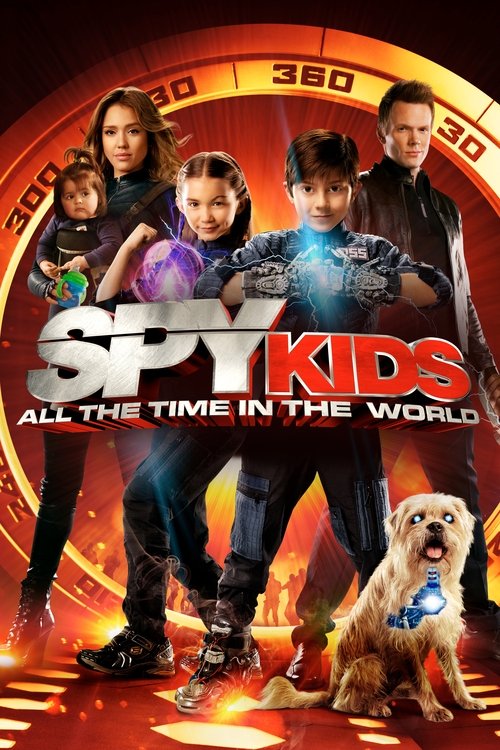
Spy Kids: All the Time in the World (2011)
Directed by Robert Rodriguez
No — Spy Kids: All the Time in the World is not woke, scoring 18 out of 100 on our wokeness meter.
The fourth Spy Kids installment arrives with a scratch-and-sniff card and a premise borrowed from a diaper change.
Consciousness Markers
The cast features Latina leads and supporting players such as Jessica Alba, Alexa Vega, Daryl Sabara, and Danny Trejo in a mixed stepfamily, but the diversity is incidental rather than framed as a modern representation statement.
Marissa is a capable female spy protagonist and Rebecca has agency, but the film frames this within a conventional family-comedy structure rather than an explicit feminist agenda.
The film delivers a generic moral about valuing time with family, but it is not a sustained modern social-justice lecture.
There are no LGBTQ+ characters, themes, or subtext in the film.
The film does not engage with racial identity, racism, or racial justice themes.
There is no environmental or climate-related messaging in the story.
The film has no critique of capitalism, wealth, or class structures.
There is no body-positivity theme or commentary on body image.
Cecil has hearing loss, but that is a disability portrayal rather than a neurodivergence theme such as autism or ADHD.
The film is a fictional spy-family adventure and does not revise or reinterpret historical events.
Why it received this score
The fourth Spy Kids installment arrives with a scratch-and-sniff card and a premise borrowed from a diaper change. Robert Rodriguez, watching Jessica Alba wrestle an infant on the set of Machete, wondered what a spy mother might look like. The result is a film about a retired agent named Marissa who is pulled back into service while nine months pregnant, then again a year later, dragging two stepchildren and a talking robot dog through a plot about a villain who wants to hoard time itself. The franchise had run its course, and the critics said as much, though the aroma-scope cards were a novel touch.
On the matter of progressive sensibilities, the film practices restraint. Alba anchors a Latina family, Danny Trejo appears as an uncle named Machete, and the stepmother is competent, armed, and unbothered by the domestic expectations placed upon her. Rebecca, the stepdaughter, gets her own arc of agency. This is representation that exists without commentary, and a female lead who never pauses to announce what she represents. The film shows no interest in racial justice, no environmental sermon, no critique of the wealthy, and no characters whose identity is the point. Cecil has hearing loss, portrayed plainly, which is a disability detail and not a study in neurodivergence. The stepfamily simply is.
What remains is a moral, delivered with the subtlety of a clock striking noon. The Timekeeper's grievance is that people waste their hours on trivial pursuits, and the film's answer is that we should cherish our families. That is a lesson, not a movement. It lectures, gently, about time, then ends by inviting the audience to become recruiters for the next generation of spies. The whole affair is amiable, exhausted, and faintly damp from the smell cards. A franchise can only stop to smell its own roses for so long.
Analysis generated by our Consciousness Algorithm
Part of


Synopsis
Eight years after the third film, the OSS has become the world's top spy agency, while the Spy Kids department has since become defunct. Retired spy Marissa is called back into action, and to bond with her new stepchildren Rebecca and Cecil, she invites them along to stop the evil Timekeeper from taking over the world.
Questions about Spy Kids: All the Time in the World
Is Spy Kids: All the Time in the World woke?
No — Spy Kids: All the Time in the World is not woke, scoring 18 out of 100 on our wokeness meter. That earns it a verdict of Ultra Based.
Does Spy Kids: All the Time in the World have any woke elements?
2 of the 10 markers register at 30 or above, led by Feminist Agenda (30) and Representation Casting (30). On Feminist Agenda: Marissa is a capable female spy protagonist and Rebecca has agency, but the film frames this within a conventional family-comedy structure rather than an explicit feminist agenda.
How does Spy Kids: All the Time in the World compare to other 2011 movies?
It ranks #35 of the 245 films from 2011 we've scored; their average is 11. The wokest is Paul (68).
Is Spy Kids: All the Time in the World the most woke Spy Kids movie?
Yes. It scores highest of the 4 Spy Kids films we've scored.