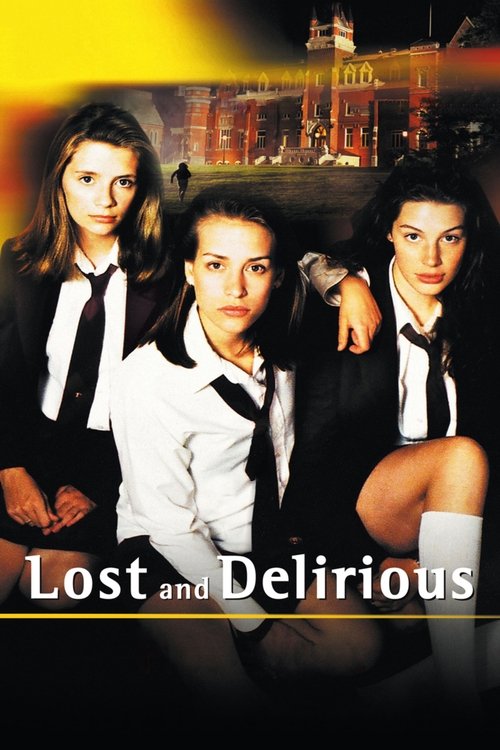
Lost and Delirious (2001)
Directed by Léa Pool
Yes — Lost and Delirious is woke, scoring 60 out of 100 on our wokeness meter.
Lost and Delirious is a 2001 Canadian drama directed by Léa Pool and adapted from Susan Swan's novel The Wives of Bath.
Consciousness Markers
The entire film revolves around a lesbian relationship, coming out, internalized homophobia, and the destructive cost of a homophobic family and society.
A female director tells a woman-centered story set in an all-girls school, critiquing patriarchal expectations and the boys who grope and objectify the students.
The cast is almost entirely white, but the film centers a same-sex relationship and is led by women, giving it a modest representational dimension for its era.
The film is a tragic melodrama rather than a preachy message piece; its themes of homophobia emerge through character and consequence rather than direct lecturing.
No engagement with race or racial identity; the characters and conflicts are entirely within a white milieu.
No environmental or climate themes present.
No economic or class-based critique; the setting is an upmarket boarding school with no anti-capitalist framing.
No body positivity themes; the film does not address body image or size acceptance.
No neurodivergence themes or characters.
No historical revisionism; the story is a contemporary (for 2001) fictional drama.
Why it received this score
Lost and Delirious is a 2001 Canadian drama directed by Léa Pool and adapted from Susan Swan's novel The Wives of Bath. It concerns three roommates at an upmarket boarding school, and it commits itself without apology to the love between two of them. Pauline and Victoria are lovers, and the film tracks the collapse that follows when Victoria's homophobic family, and Victoria's own terror of them, forces her back into the closet. Paulie, adopted and already abandoned once, does not survive the betrayal. She ends the film on a rooftop, quoting Shakespeare, and steps off it. The camera does not flinch.
The film's feminist credentials are genuine enough. Pool, a woman, tells a woman-centered story inside an institution built to shape girls into wives, and she lets her teenagers sneer at the boys from the neighboring school who paw at them. Victoria's line about a suitor liking her chest, and her refusal to attend a party where gross guys will grope her, carries a contempt the film shares. The tragedy is not that these girls love each other. It is that the world around them has priced that love at the cost of everything else.
What the film does not do is instruct. There is no sermon here, no lecture from the pulpit, only consequence. It also declines to widen its lens. The cast is nearly all white, the milieu is affluent, and race, class, money, and the environment go unmentioned, which for a 2001 Canadian indie is unremarkable and for a modern scorecard is simply absent. There is a wounded falcon, trained and then lost, and the symbolism is as subtle as a brick through a window. The critics of the day called it overwrought. They were not wrong. Perabo, however, is a geyser, and the film's sincerity burns through the clumsy metaphor. We classify it. We do not rescue it.
Analysis generated by our Consciousness Algorithm
Synopsis
After starting at an upmarket boarding school, a teenage girl forms close friendships with her two older roommates. However, when she discovers that her new friends are lovers she finds herself caught in a complicated situation.
Questions about Lost and Delirious
Is Lost and Delirious woke?
Yes — Lost and Delirious is woke, scoring 60 out of 100 on our wokeness meter. That earns it a verdict of Woke.
What makes Lost and Delirious woke?
3 of the 10 markers register at 30 or above, led by LGBTQ+ Themes (92), Feminist Agenda (60) and Representation Casting (40). On LGBTQ+ Themes: The entire film revolves around a lesbian relationship, coming out, internalized homophobia, and the destructive cost of a homophobic family and society.
How does Lost and Delirious compare to other 2001 movies?
It is the wokest of the 148 films from 2001 we've scored; their average is 12.
How is the Woke Score calculated?
An AI-assisted process researches the film and its reception, scores it 0–100 on ten markers, then combines those into one 0–100 Woke Score. It measures a specific set of 2020s cultural themes, not film quality.