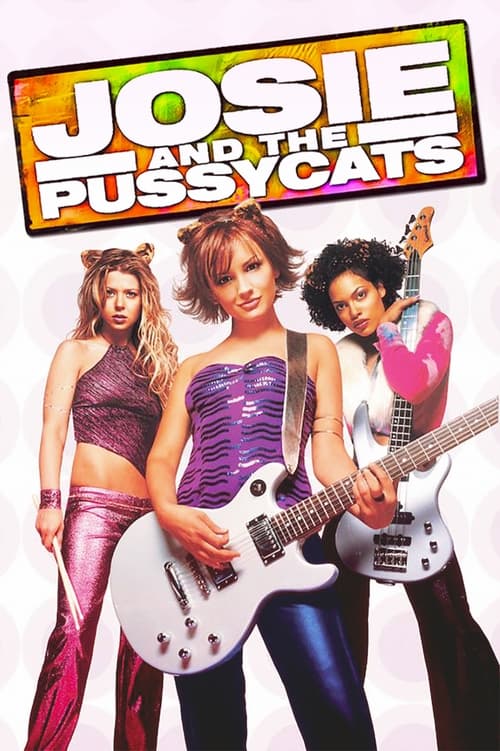
Josie and the Pussycats (2001)
Directed by Deborah Kaplan
Partly — Josie and the Pussycats is somewhat woke, scoring 46 out of 100 on our wokeness meter.
Josie and the Pussycats arrived in 2001 to a shrug and a domestic gross that failed to cover its budget, and it has spent the intervening decades being quietly rehabilitated by people who noticed what it was actually doing.
Consciousness Markers
The entire plot is a sustained satire of corporate and government collusion to brainwash teens into consumerism via subliminal advertising, with the music industry as the villain. A sharp, prescient anti-consumerist and anti-corporate critique.
The band is deliberately multiracial for 2001, with Rosario Dawson as a Black lead alongside white co-stars, and Donald Faison in the supporting boy band. The diversity is present but largely unremarked upon rather than foregrounded as a statement.
An all-girl band fronted by women, co-written and co-directed by Deborah Kaplan, with 'girl-power hijinks' and women battling a male-dominated corporate machine. The empowerment is real but framed as bubbly pop fun rather than explicit feminist argument.
The film carries a pointed message about media manipulation and consumerism, but delivers it through absurdist comedy and satire rather than direct moralizing.
Valerie's resentment that the label promotes white frontwoman Josie over the band carries an implicit racial dynamic, but the film never names or interrogates race directly.
No LGBTQ+ characters, themes, or subtext appear anywhere in the film.
No environmental or climate themes whatsoever.
No body-positivity themes or messaging present.
Melody's spacey, distracted demeanor is played for comedy, not framed as neurodivergence or neurodiversity advocacy.
No historical revisionism; the film is a contemporary satire of the music industry.
Why it received this score
Josie and the Pussycats arrived in 2001 to a shrug and a domestic gross that failed to cover its budget, and it has spent the intervening decades being quietly rehabilitated by people who noticed what it was actually doing. The film's true subject is not the band. It is the machinery that manufactures the band: a record label, MegaRecords, in open collusion with the United States government to pipe subliminal commands into teenagers through pop songs, all so that young people will spend their babysitting money on branded merchandise. The product placement is relentless and unpaid, a running gag the filmmakers inserted on purpose. Here is a studio comedy that treats the music industry as a brainwashing apparatus and the consumer economy as its delivery system. It is a sharper piece of anti-corporate satire than most films that wear the label openly.
The band itself is deliberately multiracial for its moment, with Rosario Dawson standing beside two white co-stars and Donald Faison in the doomed boy band upstairs. Nobody comments on it. The film simply casts and moves on, which is its own quiet statement. Valerie's mounting resentment that the label promotes the white frontwoman over the group gestures toward a racial dynamic without ever naming it, and the screenplay leaves that thread dangling. The all-girl premise, co-written and co-directed by Deborah Kaplan, offers empowerment as bubbly pop fun instead of argument.
Elsewhere the ledger is thinner. There is no queer presence of any kind, no interest in body image, and no environmental concern to speak of. Melody's distracted spaciness exists to be laughed at, not diagnosed. The film does carry a message about media manipulation, but it smuggles that message inside absurdist comedy, which keeps the sermonizing at a low simmer. A movie this silly should not be this prescient. It is, and its failure at the box office remains the joke that outlived the film.
Analysis generated by our Consciousness Algorithm
Part of


Synopsis
Josie, Melody and Val are three small-town girl musicians determined to take their rock band out of their garage and straight to the top, while remaining true to their look, style and sound. They get a record deal which brings fame and fortune but soon realize they are pawns of two people who want to control the youth of America. They must clear their names, even if it means losing fame and fortune.
Questions about Josie and the Pussycats
Is Josie and the Pussycats woke?
Partly — Josie and the Pussycats is somewhat woke, scoring 46 out of 100 on our wokeness meter. That earns it a verdict of Woke-Adjacent.
What makes Josie and the Pussycats woke?
5 of the 10 markers register at 30 or above, led by Eat the Rich (75), Representation Casting (50) and Feminist Agenda (45). On Eat the Rich: The entire plot is a sustained satire of corporate and government collusion to brainwash teens into consumerism via subliminal advertising, with the music industry as the villain.
How does Josie and the Pussycats compare to other 2001 movies?
It ranks #8 of the 148 films from 2001 we've scored; their average is 12. The wokest is Monster's Ball (60).
How is the Woke Score calculated?
An AI-assisted process researches the film and its reception, scores it 0–100 on ten markers, then combines those into one 0–100 Woke Score. It measures a specific set of 2020s cultural themes, not film quality.