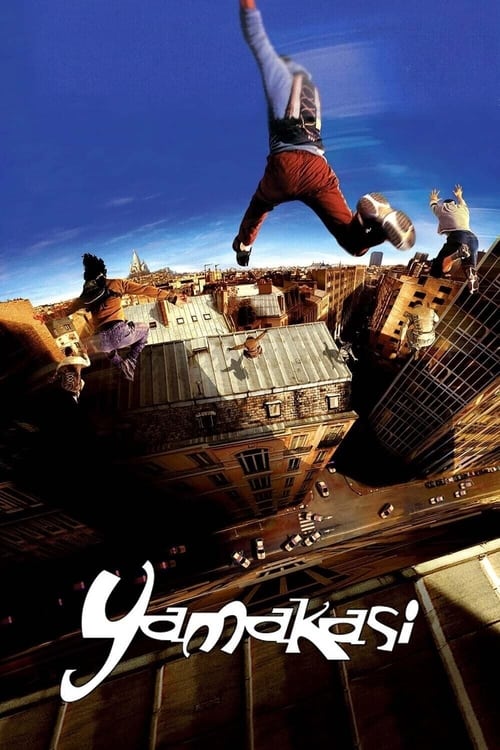
Yamakasi (2001)
Directed by Ariel Zeitoun
Partly — Yamakasi is somewhat woke, scoring 49 out of 100 on our wokeness meter.
The film arrives from 2001, before the current era of studio conscience, and yet its instincts are legible enough.
Consciousness Markers
The plot is a direct, Robin Hood-esque confrontation with corporate greed, where the Yamakasi steal from the wealthy to solve a medical crisis.
The narrative is deeply rooted in the socio-economic realities of the immigrant ghetto, highlighting systemic inequality and the struggle against poverty.
The film centers on a diverse group of young men from the Parisian banlieue, providing a significant, if somewhat stylized, representation of marginalized youth.
While the Yamakasi discuss injustice, the film prioritizes action and plot over didactic, ideological monologues typical of high-energy 'lecture' cinema.
Female characters are present primarily in supportive roles (mother, sister, secretary) and do not drive the central narrative or challenge patriarchal structures.
The characters are defined by their physical prowess and athletic ability (parkour), but the film does not engage with modern discussions of body acceptance or diversity.
The film is entirely devoid of LGBTQ+ themes or characters, focusing strictly on class and social struggle.
The environmental conditions and climate are entirely ignored in favor of urban action and social commentary.
There is no evidence of characters with neurodivergent traits or conditions being explored in the narrative.
The film is a fictional narrative and does not attempt to reinterpret any established historical events.
Why it received this score
The film arrives from 2001, before the current era of studio conscience, and yet its instincts are legible enough. It follows seven young men of assorted origins through a Parisian banlieue, each introduced with a nickname and a specialty, all of them leaping off buildings for sport and recognition. The casting is a genuine cross-section of the immigrant neighborhoods France prefers not to photograph, and the film grants these men competence, charm, and moral authority. That is representation of a functional sort, achieved without a press release or a consultant.
The plot is Robin Hood with a hospital bill attached. A boy suffers cardiac arrest, the family needs four hundred thousand francs within twenty-four hours, and the chief physician helpfully mentions a broker who sells hearts. So the crew robs the hospital board of directors, house by house, and tosses the loot to a fence. The anger lands squarely on the arrangement whereby a child's survival depends on his parents' bank balance, and the final scene in which the doctor attempts to renegotiate the price at gunpoint is about as subtle as a brick through a boardroom window. This is class rage, not environmental anxiety. Nobody measures a carbon footprint. The women in the story, a mother, a sister, a secretary, hover at the edges, useful for grief and logistics.
The film talks about injustice, but it would much prefer to run, jump, and vault over the saying of it, so the sermonizing stays modest. The bodies on display are athletic instruments, not sites of self-acceptance discourse. There are no LGBTQ characters, no neurodivergent arcs, no reinterpreted history, merely a fictional account of urban acrobats extracting money from the comfortable. Two decades on, the political vocabulary has shifted beneath it while the film itself remains a lean, sincere, faintly preachy heist picture. We classify it, we file it, and we move along to the next. We are always moving along to the next.
{"thematic_tags": []}
Analysis generated by our Consciousness Algorithm
Synopsis
Yamakasi - Les samouraïs des temps modernes is a 2001 French movie written by Luc Besson. It demonstrates the skills of the Yamakasi, a group of traceurs who battle against injustice in the Paris ghetto. They use parkour to steal from the rich in order to pay off medical bills for a kid injured copying their techniques.
Questions about Yamakasi
Is Yamakasi woke?
Partly — Yamakasi is somewhat woke, scoring 49 out of 100 on our wokeness meter. That earns it a verdict of Woke-Adjacent.
What makes Yamakasi woke?
3 of the 10 markers register at 30 or above, led by Eat the Rich (85), Racial Consciousness (75) and Representation Casting (65). On Eat the Rich: The plot is a direct, Robin Hood-esque confrontation with corporate greed, where the Yamakasi steal from the wealthy to solve a medical crisis.
How does Yamakasi compare to other 2001 movies?
It ranks #7 of the 148 films from 2001 we've scored; their average is 12. The wokest is Monster's Ball (60).
How is the Woke Score calculated?
An AI-assisted process researches the film and its reception, scores it 0–100 on ten markers, then combines those into one 0–100 Woke Score. It measures a specific set of 2020s cultural themes, not film quality.