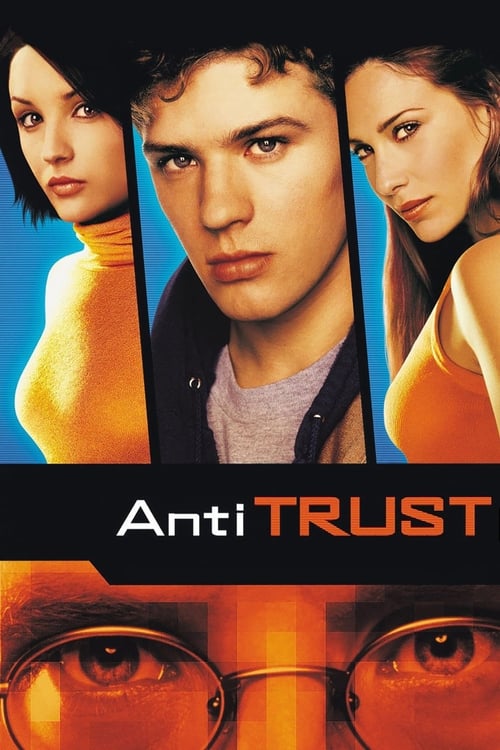
Antitrust (2001)
Directed by Peter Howitt
Partly — Antitrust is somewhat woke, scoring 51 out of 100 on our wokeness meter.
Antitrust (2001) arrives as a techno-thriller with a very specific grievance: the large software corporation is stealing code, surveilling employees, and disposing of inconvenient programmers.
Consciousness Markers
The plot is built around a sinister mega-corporation that steals code, surveils employees, and murders rivals, while the heroes champion open-source software against corporate monopoly power.
The film carries a clear pro-open-source message and critiques corporate control of technology, but it delivers this through thriller plotting rather than sustained preaching.
The cast includes a few minority actors in supporting roles, but they exist naturally in the story without any deliberate representation agenda or commentary.
There are no LGBTQ+ characters, themes, or subtext in the film.
Female characters are present as girlfriend and co-worker roles, but the film does not engage with feminist themes or gender politics.
The film does not address race, racial inequality, or racial consciousness in any meaningful way.
There is no environmental or climate-related content in the film.
The film does not engage with body positivity or body-image themes.
The programmer characters are not framed through neurodivergence or mental-health identity politics.
The film is a fictional techno-thriller and does not revise or reinterpret historical events.
Why it received this score
Antitrust (2001) arrives as a techno-thriller with a very specific grievance: the large software corporation is stealing code, surveilling employees, and disposing of inconvenient programmers. The villain, Gary Winston, is a charismatic monopolist with a campus so aggressively pleasant it feels like a threat. The film's political energy sits almost entirely in this corporate-conspiracy lane. NURV is a machine for absorbing independent work and crushing rivals, while the heroes rally around open-source software as a public good. That is a real ideological commitment, though it is delivered through car chases, break-ins, and a public-access television climax instead of a sermon. The result is a film with a message but not much lecturing.
The broader cultural register is notably quiet. The cast includes minority actors in supporting roles, and they move through the story without comment. Female characters exist as girlfriend, co-worker, and operative, but the film does not examine gender politics. There is no LGBTQ thread, no racial argument, no climate anxiety, no body-image conversation, and no mental-health identity framework. The programmers are eccentric because they are programmers, not because the screenplay wants to diagnose them. History is not revised, because the film is too busy inventing a fictional software empire that resembles a certain real one. This is not a criticism of the film's entertainment value. It is a description of its limited social imagination.
What remains is a period piece about open-source idealism at the turn of the millennium, made by people who thought a minidisc and a friendship bracelet could carry dramatic weight. The anti-corporate streak is genuine and sustained. The sermonizing is mild. The film wants us to fear monopoly power and root for the garage geniuses, and it makes that case with the subtlety of a server room alarm. It is a modest specimen: loud about software freedom, silent about nearly everything else.
Analysis generated by our Consciousness Algorithm


Synopsis
A computer programmer's dream job at a hot Portland-based firm turns nightmarish when he discovers his boss has a secret and ruthless means of dispatching anti-trust problems.
Questions about Antitrust
Is Antitrust woke?
Partly — Antitrust is somewhat woke, scoring 51 out of 100 on our wokeness meter. That earns it a verdict of Woke-Adjacent.
What makes Antitrust woke?
1 of the 10 markers register at 30 or above, led by Eat the Rich (60). On Eat the Rich: The plot is built around a sinister mega-corporation that steals code, surveils employees, and murders rivals, while the heroes champion open-source software against corporate monopoly power.
How does Antitrust compare to other 2001 movies?
It ranks #6 of the 148 films from 2001 we've scored; their average is 12. The wokest is Monster's Ball (60).
How is the Woke Score calculated?
An AI-assisted process researches the film and its reception, scores it 0–100 on ten markers, then combines those into one 0–100 Woke Score. It measures a specific set of 2020s cultural themes, not film quality.