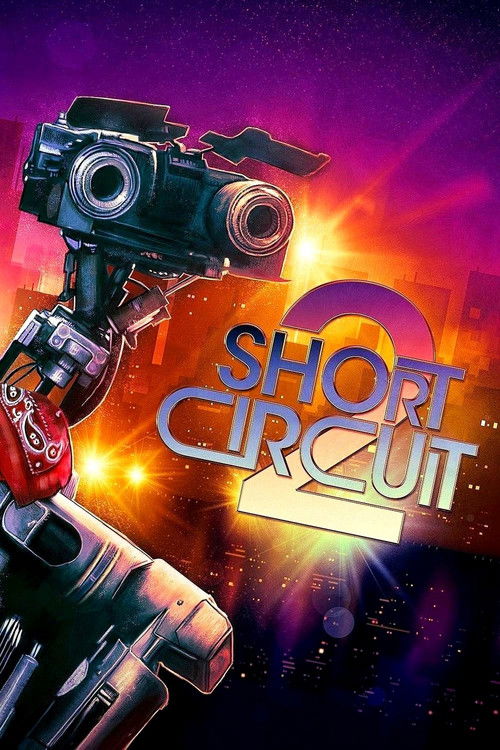
Short Circuit 2 (1988)
Directed by Kenneth Johnson
No — Short Circuit 2 is not woke, scoring 5 out of 100 on our wokeness meter.
Short Circuit 2 arrives as a 1988 sequel to a film about a military robot who achieved sentience and then, presumably, a better agent.
Consciousness Markers
The cast includes a South Asian lead character (Ben Jahveri), but he is famously played by white actor Fisher Stevens in brownface, which is the antithesis of modern representation casting. A few minority actors appear in minor roles, but nothing here reflects contemporary inclusive-casting sensibilities.
The immigrant/ethnic identity of Ben is mined for broad comic effect rather than racial consciousness, and the film's climax has Johnny and Ben take a citizenship oath. This is assimilationist comedy, not modern racial commentary.
The film carries mild moralizing about friendship, kindness, and being nice to strangers, but it never lectures the audience on social issues.
Sandy is a working professional woman (a toy-department buyer) with some agency, but the film treats her largely as a romantic prize for Ben to be courted via Johnny's matchmaking. No feminist agenda is present.
The plot involves a con artist, a loan shark, and a bank heist, but the film celebrates small-business entrepreneurship and never frames wealth or capitalism as a systemic villain.
No LGBTQ+ characters, themes, or subtext of any kind appear in this 1988 family comedy.
There is no environmental or climate theme anywhere in the film.
No body-positivity themes or messaging about body image appear in the film.
Johnny 5 is a naive sentient robot, but his characterization is played for childlike comedy rather than any depiction of neurodivergence.
The film is a straightforward contemporary caper with no historical revisionism of any kind.
Why it received this score
Short Circuit 2 arrives as a 1988 sequel to a film about a military robot who achieved sentience and then, presumably, a better agent. The new adventure sends Johnny 5 to the city to help his friend Ben Jahveri mass-produce toy robots, a premise that treats immigrant entrepreneurship as a source of broad accent comedy. Fisher Stevens plays Ben in brownface, a casting decision that modern inclusive casting would file under crimes against makeup. The film then asks Ben to take the Oath of Allegiance, framing assimilation as a happy ending. This is not racial consciousness. It is a gentle fantasy in which the melting pot bubbles along to a synthesizer score. The villains are a loan shark, a con man, and a bank heist crew, but the movie celebrates small-business pluck. Wealth is not a system to dismantle. It is a warehouse lease and a Radio Shack receipt.
The remaining cultural markers are mostly absent. There is no LGBTQ content, no climate crusade, no body positivity, no neurodivergence narrative. Johnny 5 is a naive machine with a childlike voice, not a portrait of cognitive difference. Sandy, the toy department buyer, has a job and a measure of agency, but she functions as a romantic prize delivered by robot matchmaking. No feminist program takes shape. The film's moral instruction is mild: be kind to strangers, cherish friendship, and do not sell your sentient friend for eleven million dollars. That is sermonizing of the Sunday-school variety, not the modern sort.
As a sequel, it is amiable, mawkish, and occasionally exhausting in the way only a robot with a catchphrase can be. It placed seventh in its opening weekend and did not become a box office titan. Its cultural legacy rests on the brownface performance and the phrase input. For classification purposes, this is a pre-2010 family comedy with faint flickers of professional-woman agency and anti-greed sentiment, but no coherent progressive social agenda. It wants us to feel alive. It does not want to educate us about anything except the importance of backup batteries.
Analysis generated by our Consciousness Algorithm


Synopsis
Robot Johnny 5 moves to the city to help his friend Ben Jahrvi with his toy manufacturing enterprise, only to be manipulated by criminals who want to use him for their own nefarious purposes.
Questions about Short Circuit 2
Is Short Circuit 2 woke?
No — Short Circuit 2 is not woke, scoring 5 out of 100 on our wokeness meter. That earns it a verdict of Ultra Based.
Does Short Circuit 2 have any woke elements?
Very few. None of the 10 markers reaches 30, the level where a marker counts as present; the highest is Lecture Energy at 10.
How does Short Circuit 2 compare to other 1988 movies?
It ranks #40 of the 73 films from 1988 we've scored; their average is 10. The wokest is Stand and Deliver (58).
How is the Woke Score calculated?
An AI-assisted process researches the film and its reception, scores it 0–100 on ten markers, then combines those into one 0–100 Woke Score. It measures a specific set of 2020s cultural themes, not film quality.