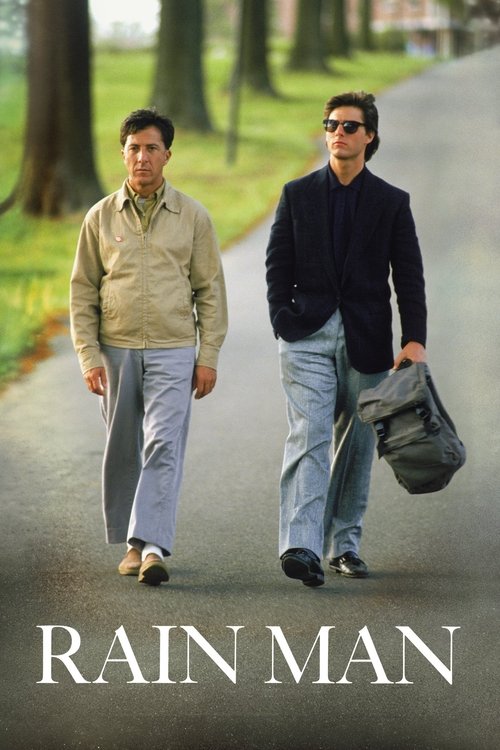
Rain Man (1988)
Directed by Barry Levinson
No · Based
How we score movies →Consciousness Markers
While autism is central to the plot, modern scholarship indicates the portrayal reinforces stereotypes about savantism and treats neurodivergence as spectacle rather than authentic representation.
Features a disabled protagonist, rare for 1988, but the narrative centers the neurotypical perspective rather than authentic representation of the autistic character.
The film educates audiences about autism but in a manner that feels preachy and patronizing by contemporary standards, treating the audience as needing instruction.
Minimal female presence in the narrative, no feminist themes or agenda explored.
Predominantly white cast with no engagement with racial themes or consciousness.
The plot is driven by capitalist motivation (inheritance and money), with no critique of wealth accumulation.
No LGBTQ themes or characters present in the film.
No environmental or climate-related content in the film.
No body positivity themes or representation present.
No historical revisionism or reframing of historical events.


Synopsis
When car dealer Charlie Babbitt learns that his estranged father has died, he returns home to Cincinnati, where he discovers that he has a savant older brother named Raymond and that his father's $3 million fortune is being left to the mental institution in which Raymond lives. Motivated by his father's money, Charlie checks Raymond out of the facility in order to return with him to Los Angeles. The brothers' cross-country trip ends up changing both their lives.
Why it received this score
Rain Man arrives at its moment of cultural reckoning with the gentle weight of an artifact that meant well but has aged poorly. The film's central conceit, that audiences should be moved by the spectacle of Raymond Babbitt's autistic savantism, now reads as a kind of disability tourism. Dustin Hoffman's performance, Oscar-nominated and beloved, has been reexamined by contemporary disability scholars as a reinforcement of the very stereotypes it claimed to illuminate. The narrative remains fundamentally about a neurotypical man (Tom Cruise) learning compassion through proximity to neurodivergence, a structure that centers the able-bodied perspective rather than authentic representation. For 1988, this was groundbreaking visibility. By modern standards, it is a well-intentioned misfire. The film demonstrates how sincerity and box office success can coexist with structural misrepresentation, a lesson that has not aged better than the performances themselves.
What remains instructive about Rain Man is its revelation that representation without consultation is merely performance. The film brought autism into mainstream consciousness, a genuine cultural contribution, yet did so by reducing a complex neurological difference into a collection of tics and numerical parlor tricks. Contemporary autism advocacy has moved toward neurodiversity frameworks that reject the savant mythology, making Raymond Babbitt feel less like a character and more like a museum exhibit. The film's treatment of disability as a plot device, a McGuffin that drives the brothers toward emotional development, suggests that the filmmakers saw Raymond primarily as a vehicle for Charlie's transformation rather than as a subject worthy of his own narrative.
Three decades later, Rain Man functions as a cultural milestone marker rather than a film that has transcended its moment. It marks the boundary between an older era of disability cinema and the emerging (if still imperfect) frameworks of contemporary representation. The film remains watchable, even moving, but increasingly one watches it with awareness of what it failed to see about itself, which may be the most honest reckoning a film from this period can receive.
Analysis generated by our Consciousness Algorithm
Critic Reviews
“There've been few screen moments more moving this year than Cruise's initial reaction to his brother's almost superhuman math prowess. [16 Dec 1988]”
“Somehow, Hoffman makes all this hypnotically interesting, and, through impeccable timing, sometimes terribly funny--a sweet humor which never betrays Raymond's unalterable character. [16 Dec 1988]”
“In every detail - the superb soundtrack, the rich cinematography, the dinstinctively edgy editing - Rain Man reveals itself as a movie made with care, smarts, and a refreshing refusal to settle for the unexpected. [19 Dec 1988]”
“It's Hoffman's failure, though, that sinks the picture. He is working here with his usual meticulousness, but there's no relaxation in his performance, no sense that he has ever merged with his subject, that he has found Raymond's center and is simply acting out of it.”