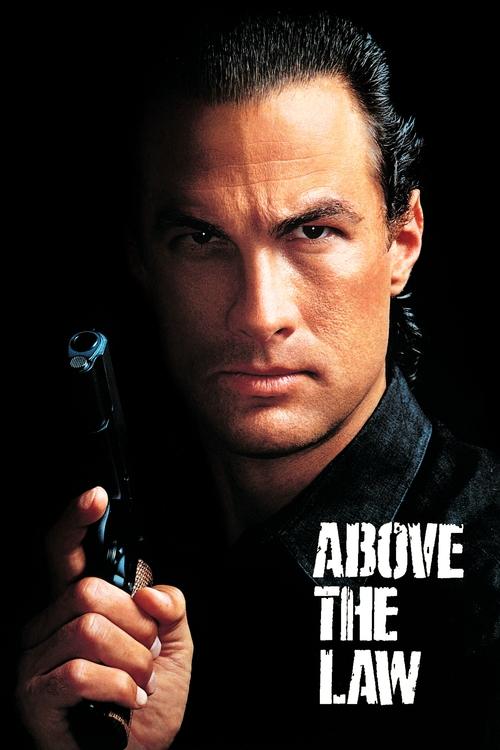
Above the Law (1988)
Directed by Andrew Davis
No — Above the Law is not especially woke, scoring 27 out of 100 on our wokeness meter.
Above the Law arrives from 1988 with the confidence of a film that knows exactly what it is: a star vehicle built around a man who had never acted before and could, by all accounts, break a wrist on command.
Consciousness Markers
Pam Grier plays Delores 'Jacks' Jackson, a Black female detective and partner to Seagal's character, providing notable racial and gender diversity in a 1988 action film.
No LGBTQ+ themes or characters are present.
No feminist agenda or commentary; female characters are present but not central to any gender-based critique.
No exploration of racial issues or consciousness; diversity in casting is incidental.
No environmental or climate-related themes.
No anti-capitalist or eat-the-rich messaging; the plot focuses on government corruption and drug trafficking.
No body positivity themes or messaging.
No neurodivergence themes or characters.
No revisionist history; the film is a fictional action thriller with no historical reimagining.
No preachy or lecture-like energy; it is a straightforward action film.
Why it received this score
Above the Law arrives from 1988 with the confidence of a film that knows exactly what it is: a star vehicle built around a man who had never acted before and could, by all accounts, break a wrist on command. Steven Seagal plays Nico Toscani, an Italian immigrant, former CIA operative, and Chicago detective who discovers that the agency he once served is running drugs and torturing priests. Andrew Davis shoots the city with affection and stages the aikido with a certain instructional clarity. The picture is regarded as the first American production to put aikido in fight sequences, a distinction that carries weight in some circles and none in others.
Pam Grier appears as Delores Jackson, Nico's partner, a Black woman with a badge and a caseload in a 1988 action picture. This is the film's one measurable gesture toward contemporary casting sensibilities, and it is a real one, though the script asks little of her beyond competence and a well-timed quip. Sharon Stone plays the wife. The villains are CIA men and a Salvadoran drug lord, which makes the film's animating suspicion institutional, not economic. No one lectures. No one monologues about the planet, the patriarchy, or the arrangement of wealth. The film prefers to settle its arguments with a broken nose, and there is something almost restful about that.
Critics were split at the time. Ebert gave it three stars and admitted the lead did not look or sound like an actor. Leonard Maltin was less generous. The verdict here is a film of limited cultural ambition and steady forward momentum, its social consciousness confined to who gets to stand beside the star.
Analysis generated by our Consciousness Algorithm
Part of


Synopsis
Nico Toscani is an Italian immigrant, American patriot, ex-CIA agent, aikido specialist and unorthodox Chicago policeman. He is as committed to his job as he is to his personalized brand of justice—expert and thorough bone-crushing.
Questions about Above the Law
Is Above the Law woke?
No — Above the Law is not especially woke, scoring 27 out of 100 on our wokeness meter. That earns it a verdict of Based.
Does Above the Law have any woke elements?
1 of the 10 markers register at 30 or above, led by Representation Casting (45). On Representation Casting: Pam Grier plays Delores 'Jacks' Jackson, a Black female detective and partner to Seagal's character, providing notable racial and gender diversity in a 1988 action film.
How does Above the Law compare to other 1988 movies?
It ranks #6 of the 73 films from 1988 we've scored; their average is 10. The wokest is Stand and Deliver (58).
How is the Woke Score calculated?
An AI-assisted process researches the film and its reception, scores it 0–100 on ten markers, then combines those into one 0–100 Woke Score. It measures a specific set of 2020s cultural themes, not film quality.