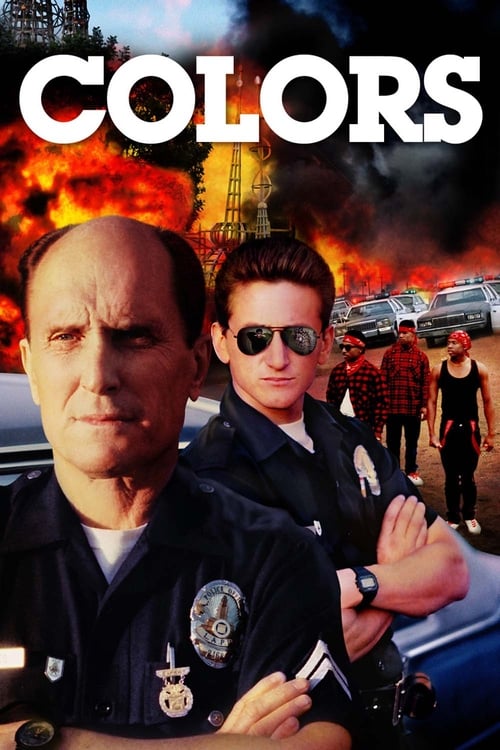
Colors (1988)
Directed by Dennis Hopper
No — Colors is not especially woke, scoring 23 out of 100 on our wokeness meter.
Dennis Hopper returned to the director's chair in 1988 with a police procedural that treats the gang corridors of Los Angeles as a taxonomy of colors, insignia, and grievances.
Consciousness Markers
The film is explicitly about Black and Hispanic gang conflict, but it was criticized by the NAACP for trafficking in stereotypes and for omitting systemic racism and white flight, so its racial engagement is descriptive rather than progressive.
The cast is genuinely multiethnic, with Black and Hispanic actors (Don Cheadle, Glenn Plummer, María Conchita Alonso) in substantial roles, but this reflects the film's subject matter rather than any deliberate diversity mandate.
The film gestures at a moral about the cycle of violence through McGavin's closing reflection, but it is understated and observational rather than preachy.
The lone significant female character, Louisa, functions primarily as a love interest and object of the rookie's attention; the film is thoroughly male-centric.
No LGBTQ+ characters or themes appear anywhere in the film.
No environmental or climate themes are present.
No critique of capitalism or economic inequality; the film is a police procedural about gang violence.
No body positivity themes or messaging.
No neurodivergent characters or themes.
A fictional narrative, not a revisionist retelling of historical events.
Why it received this score
Dennis Hopper returned to the director's chair in 1988 with a police procedural that treats the gang corridors of Los Angeles as a taxonomy of colors, insignia, and grievances. Sean Penn and Robert Duvall play the rookie and the veteran, paired in the C.R.A.S.H. unit, and the film moves through South Central, Echo Park, and East L.A. with documentary briskness. The cast is genuinely multiethnic, with Don Cheadle, Glenn Plummer, Trinidad Silva, and María Conchita Alonso in substantial roles. That reflects the subject matter, not a casting agenda. The gangs on screen are Black and Hispanic because the gangs in the city were Black and Hispanic.
The film's engagement with race is descriptive. It catalogs conflict between the Bloods, the Crips, and the 21st Street gang without much interest in the conditions that produced them. The NAACP objected at the time, and the writer Wanda Coleman noted the absence of white flight and systemic racism from the frame. Fair points. The movie is about the texture of the streets, and its politics stop at the curb. Louisa, the waitress, exists to be romanced and then to disappoint the rookie, which is the whole of the film's attention to women. There is nothing here for the LGBTQ viewer, nothing for the climate-minded, nothing for the body-positive or the neurodivergent. Economic critique is absent. Hopper's Los Angeles is a place where the poor kill the poor and the institution watches.
A moral arrives at the end, delivered in McGavin's closing reflection on the cycle of violence, but it stays quiet and observational. The film prefers to show the wheel turning. Hopper hired real gang members as extras and security, and two of them were shot during production, which lends the enterprise a grim authenticity no sermon could supply. We are left with a lean, well-acted crime picture with a strong cast and a thin thesis. It observes inequity without indicting its causes. A sommelier might call this a robust vintage with a short finish. Recommended for those who like their social commentary implied.
{"thematic_tags": []}
Analysis generated by our Consciousness Algorithm


Synopsis
A confident young cop is shown the ropes by a veteran partner in the dangerous gang-controlled barrios of Los Angeles, where the gang culture is enforced by the colors the members wear.
Questions about Colors
Is Colors woke?
No — Colors is not especially woke, scoring 23 out of 100 on our wokeness meter. That earns it a verdict of Based.
Does Colors have any woke elements?
2 of the 10 markers register at 30 or above, led by Racial Consciousness (40) and Representation Casting (35). On Racial Consciousness: The film is explicitly about Black and Hispanic gang conflict, but it was criticized by the NAACP for trafficking in stereotypes and for omitting systemic racism and white flight, so its racial engagement is descriptive rather than progressive.
How does Colors compare to other 1988 movies?
It ranks #7 of the 73 films from 1988 we've scored; their average is 10. The wokest is Stand and Deliver (58).
How is the Woke Score calculated?
An AI-assisted process researches the film and its reception, scores it 0–100 on ten markers, then combines those into one 0–100 Woke Score. It measures a specific set of 2020s cultural themes, not film quality.